A commodity ETF gives exposure to a basket of raw materials, such as oil, gas, metals, grains and livestock, through one listed security. Almost all broad products track an index of futures contracts, most often the Bloomberg Commodity Index or the S&P GSCI, rather than holding the goods themselves. Returns come from three sources: the change in futures prices, the roll yield from replacing expiring contracts, and interest on the collateral. The two big indices are built very differently: energy made up 51.8% of the S&P GSCI at 31 January 2026, while the Bloomberg Commodity Index caps any related group at 33%.
This explainer covers how the indices are constructed, where the returns come from, why UK products are structured as they are, what the research says about commodities and inflation, and the costs and UK tax points to check. Our guide to what an ETF is covers the basics of listed funds.
What a commodity ETF holds
Storing barrels of oil, tonnes of copper and live cattle is not practical for a listed fund, so a broad commodity ETF holds futures contracts, or a swap that pays the return of an index of futures contracts. The US Energy Information Administration describes a commodity index fund as one that “provides exposure to baskets of commodities, without requiring direct investment in futures contracts or physical commodities”, and notes that most such funds are long-only and “rolling contracts forward to avoid physical delivery” (EIA).
The money investors pay in is mostly held as collateral. A US-listed fund tracking the S&P GSCI, the iShares trust used for several figures in this guide, describes its assets as futures positions “together with cash, U.S. Treasury securities or other short-term securities”, and says it seeks to track “a diversified, fully collateralized investment in futures contracts” (annual report for 2025). Fully collateralised means every pound of exposure is backed by a pound of cash or bills, so the fund is not borrowing to invest.
- A commodity ETF that holds futures contracts directly is futures-based.
- One that holds a swap with a bank, plus a basket of collateral, is synthetic.
- Physically backed products exist mainly for precious metals, which we cover in separate guides.
How the Bloomberg Commodity Index and the S&P GSCI are built
The choice of index decides what you own. The two main benchmarks start from different principles.
The Bloomberg Commodity Index
The Bloomberg Commodity Index, or BCOM, was created in 1998 and is administered by Bloomberg Index Services Limited. Its methodology weights commodities using “both liquidity data and U.S.-dollar-weighted production data”, combining them in a ratio of two-thirds liquidity to one-third production. It then applies diversification rules each year:
- no single commodity may constitute “more than 15% of the Index”;
- no commodity together with its derivatives, for example WTI and Brent crude with diesel, gasoline and gas oil, may exceed 25%;
- no “related group of commodities (e.g., energy, precious metals, livestock or grains)” may exceed 33%;
- no single commodity may be less than 2%, “as liquidity allows”.
The methodology says these rules are “structurally compatible with the European Union’s UCITS 35/20 requirements”. Bloomberg’s fact sheet gives a base value of 100 on 31 December 1990 and says the index rolls from current to later contracts in a period that “typically falls within the 6th-10th business day of each month”.
The S&P GSCI
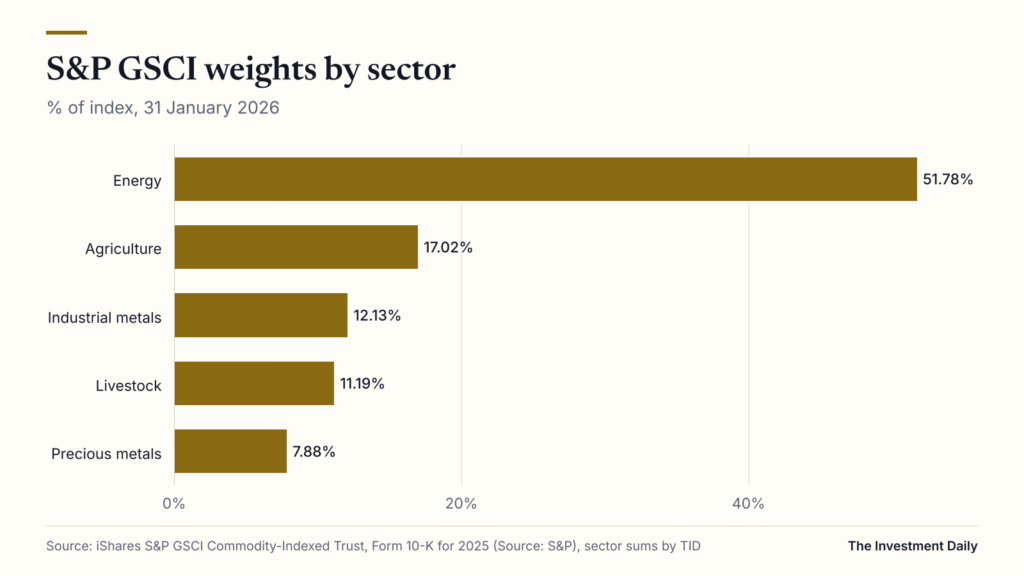
The S&P GSCI is an index on a “production-weighted basket of principal physical commodities”, with each commodity weighted “to reflect the relative significance (in the view of the Index Sponsor) of those commodities to the world economy”, according to the iShares trust’s annual report. Quantities are set using a five-year average of world production. Energy dominates the result. The report lists these weights at 31 January 2026, with the note “Source: S&P. Used with permission.”
| S&P GSCI at 31 January 2026 | Weight | Largest components |
|---|---|---|
| Energy | 51.78% | Brent crude 18.22%, WTI crude 17.79%, gas oil 5.22% |
| Agriculture | 17.02% | Corn 4.67%, soybeans 3.10%, Chicago wheat 2.38% |
| Industrial metals | 12.13% | Copper 5.47%, aluminium 4.28% |
| Livestock | 11.19% | Live cattle 5.20%, lean hogs 3.31% |
| Precious metals | 7.88% | Gold 7.24%, silver 0.64% |
Source: the iShares trust’s Form 10-K for 2025, filed 27 February 2026. Sector totals are our sums of the published component weights.
The contrast is stark. A commodity ETF on the S&P GSCI was, at the start of 2026, mainly a bet on oil and oil products, while the Bloomberg Commodity Index caps energy as a group at 33%. Neither weighting is right or wrong, but they behave differently: the S&P GSCI is far more exposed to oil price moves such as those of 2026.
Where commodity ETF returns come from: spot, roll yield and collateral yield
The return on a commodity ETF is not the change in the prices of physical goods. Bloomberg’s methodology makes the point directly: its spot version of BCOM tracks prices “without the positive or negative return effects caused by rolling futures or the costs involved in actually holding physical commodities”, and is “not ‘investable'”. Investable returns come from three parts.
Futures price changes
The index holds near-dated futures contracts on each commodity. When they rise in price, the index rises. The S&P GSCI rolls “on the fifth through the ninth business days of each month”, shifting 20% of each position per day from the expiring contract to the next one, the iShares report explains.
Roll yield
The same report describes the two shapes of futures curve. In backwardation, near contracts cost more than later ones, which at the roll allows “the contract holder to purchase a greater quantity of the later contract” and adds to returns. In contango, later contracts cost more, often “due to the costs of long-term storage of a physical commodity”, so the roll subtracts from returns. The report warns that “the absence of backwardation or the existence of contango” may hurt investors and that fees mean value “may decrease even in periods where commodity prices are otherwise stationary”.
Collateral yield
Interest on the collateral is the third part. Bloomberg calculates BCOM on an “excess return” basis and a total return version, BCOMTR, which “combines the returns of BCOM with the returns on cash collateral invested in Treasury Bills”. For the iShares trust, net investment income, broadly the interest on its collateral after expenses, was 3.38% of average net assets in 2025 and 4.39% in 2024, but only US$0.09 a share in 2022. In 2023 it was the only positive part of the return: futures lost US$1.98 a share while income added US$0.84, leaving a total return of minus 5.37%.
Physical, futures-based and synthetic commodity ETFs
Under the UCITS Directive as it applies in UK law, a UCITS may invest only in listed types of asset, including transferable securities, deposits and derivatives on eligible underlyings such as “financial indices”, and “shall not” acquire “precious metals or certificates representing them” (Article 50).
A financial index must be “sufficiently diversified”, so that “price movements or trading activities regarding one component do not unduly influence the performance of the whole index” (Directive 2007/16/EC, Article 9). The benchmark is the 20% limit for index-tracking funds, which can rise to 35% for one issuer in exceptional conditions (Article 53).
So a broad commodity ETF in UCITS form gets its exposure through derivatives on a diversified index, either exchange-traded futures or a swap with a bank. A single-commodity product, such as an oil tracker, cannot meet the diversification test and is usually issued instead as an exchange-traded commodity: a debt security issued by a company, often a special-purpose vehicle, rather than a share in a fund.
| Structure | How exposure is gained | Main extra risks |
|---|---|---|
| UCITS ETF, futures-based | Holds exchange-traded futures on a diversified index, plus collateral | Roll yield, tracking difference, position limits |
| UCITS ETF, swap-based (synthetic) | Holds a basket of collateral and a swap paying the index return | Swap counterparty risk, quality of collateral |
| ETC on a commodity basket | Debt security whose value follows an index, backed by collateral or swaps | Issuer and counterparty risk; not a fund |
| Physically backed ETC | Holds metal in a vault; precious metals only in practice | Custody, single-metal concentration |
With a swap-based product, check who the counterparty is, what the collateral consists of and how often exposure is reset. With an ETC, read what the prospectus says about security and what happens if the issuer defaults. A UCITS ETF domiciled outside the UK may be an offshore fund for tax purposes, which we cover below.
Commodities and inflation: what the evidence says
A commodity ETF is often described as an inflation hedge. The research is mixed. In a widely cited 2004 study, Gary Gorton and K. Geert Rouwenhorst built an equally weighted index of commodity futures from July 1959 to March 2004 and found that “fully-collateralized commodity futures have historically offered the same return and Sharpe ratio as equities”, were “negatively correlated with equity returns and bond returns”, and were “positively correlated with inflation, unexpected inflation, and changes in expected inflation” (NBER Working Paper 10595).
Claude Erb and Campbell Harvey reached more cautious conclusions in 2005. Their evidence “suggests that commodity futures are an inconsistent, if not tenuous, hedge against unexpected inflation”, that historical returns are “largely driven by the choice of weighting schemes”, and that “an equally weighted long-only portfolio of commodity futures returns has approximately a zero excess return over the past 25 years” (NBER Working Paper 11222). A long-only allocation, they wrote, is “a bet on the future term structure of commodity prices”.
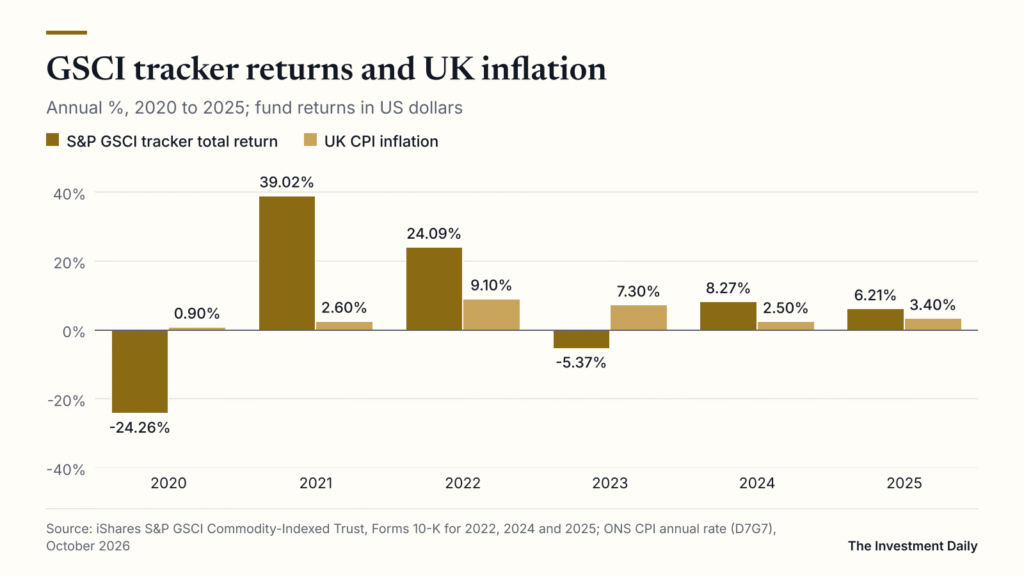
| Year | iShares GSCI tracker total return (US$) | UK CPI inflation, annual average |
|---|---|---|
| 2020 | -24.26% | 0.9% |
| 2021 | 39.02% | 2.6% |
| 2022 | 24.09% | 9.1% |
| 2023 | -5.37% | 7.3% |
| 2024 | 8.27% | 2.5% |
| 2025 | 6.21% | 3.4% |
Sources: the iShares trust’s Forms 10-K for 2022, 2024 and 2025, total return at net asset value; ONS, CPI annual rate. The fund is US-listed and its returns are in US dollars. Past performance is not a guide to future returns.
The recent record fits both views. Commodities rose strongly in 2021 and 2022, ahead of and during the jump in UK inflation, which the ONS shows peaking at 11.1% in October 2022. But they lost money in 2023, when UK inflation still averaged 7.3%. Six years of annual figures are a short sample, and they say little about the long run.
The role a commodity ETF can play in a portfolio
Investors who hold a commodity ETF usually do so for diversification rather than for long-run growth, because commodities produce no earnings, rents or interest of their own. The Gorton and Rouwenhorst findings on negative correlation with shares and bonds are the main case for including them; the Erb and Harvey findings on weighting and term structure are the main caution. Both papers studied US futures markets in US dollars.
- A small allocation can behave differently from shares and bonds.
- Roll yield can be negative for long periods when futures curves are in contango.
- Index choice matters: an energy-heavy index and a capped index can diverge sharply in the same year.
- Sterling investors also carry US dollar exposure unless the share class is hedged.
Our guide to building a diversified portfolio explains how alternatives fit alongside shares, bonds and cash. For a single precious metal, see how to invest in gold.
The costs of a commodity ETF
The ongoing charge is only the visible part. The iShares trust charges a sponsor fee that “accrues daily at an annualized rate of up to 0.75%” of net assets, and its expense ratio was 0.82% in 2025. Each UK-listed UCITS commodity ETF publishes its own ongoing charge, which differs by provider and structure.
- Ongoing charge: taken from the fund, shown in the product’s key information.
- Roll costs: not a fee, but the effect of contango or backwardation on returns.
- Swap fees: for synthetic products, the counterparty may charge a spread on top of the index return.
- Dealing spread and platform fees: paid when you buy and sell, and while you hold.
- Currency: commodity futures are priced mostly in US dollars.
Compare the tracking difference, the gap between the fund’s return and its index over several years, as well as the headline fee. The Gold and Commodities desk follows product launches and flows.

UK tax and reporting status
HMRC’s helpsheet HS265 says that, broadly, “an offshore fund is an investment fund which is based outside the UK and meets certain conditions”, which can include a UCITS commodity ETF domiciled abroad. HMRC says “it is the investor’s responsibility to ensure that they know whether they hold an investment in an offshore fund”, and that funds with reporting status appear on a list it updates monthly (HMRC IFM12152). Its list of approved reporting funds was last updated on 12 October 2026.
Status changes the tax on a sale outside an ISA or pension. HS265 says that on a disposal of a reporting fund “you will be subject to Capital Gains Tax on any gain you realise”, while a gain on a non-reporting fund “will normally be treated as an ‘offshore income gain'”, on which “you will be subject to Income Tax, rather than Capital Gains Tax”. The capital gains tax annual exempt amount therefore does not cover it.
Reporting funds must report their income to HMRC and to UK investors. HMRC says investors “are taxed on their full share of reportable income, even if it has not been distributed”; the undistributed part is called excess reported income.
A worked example, for illustration only.
A higher rate taxpayer sells a commodity ETF outside an ISA in 2027-28 with a £4,000 gain and no other gains. If the fund has reporting status, the gain is a capital gain: after the £3,000 annual exempt amount, £1,000 is taxed at 24%, or £240. If it is a non-reporting offshore fund, the whole £4,000 is an offshore income gain taxed at the 40% higher rate, or £1,600. Check HMRC’s list for the reporting status of the exact share class you hold.
The bond fund test
HS265 also says that if an offshore fund “is a company and more than 60% of its investments are in interest bearing assets”, its income, including excess reported income, is reported as interest; HMRC notes this type of fund “is commonly referred to as a ‘bond fund'”.
A fully collateralised commodity fund that holds most of its assets in Treasury bills could meet that test, so check the fund’s tax reporting. That matters more after Budget 2026, which confirmed that savings income rates rise from 20%, 40% and 45% in 2026-27 to 24%, 44% and 49% from 6 April 2027, according to OOTLAR Annex A. Capital gains tax stays at 18% and 24%, with a £3,000 annual exempt amount, in both years.
ISAs and pensions
HMRC’s guidance for ISA managers lists units or shares in UK UCITS and recognised UCITS, and securities issued by companies admitted to trading on a recognised stock exchange, among qualifying investments, so UCITS commodity ETFs and listed ETCs can generally be held in a stocks and shares ISA if your provider offers them. Inside an ISA you do not pay tax on “income or capital gains from investments” (GOV.UK), so reporting status does not affect the tax there.
Commodity ETF checklist: what to check before you buy
A commodity ETF is a way to hold a basket of futures contracts with one trade. What you get depends on the index, the futures curve and the interest on collateral as much as on commodity prices. The evidence that commodities hedge inflation is mixed, and returns have swung from minus 24% to plus 39% in consecutive years.
- Name the index: the Bloomberg Commodity Index, the S&P GSCI or another, and its current sector weights.
- Check the roll method, the recent roll yield and whether the index uses near-dated or longer-dated contracts.
- Check the structure: futures-based or swap-based UCITS ETF, or an ETC, and the counterparty and collateral.
- Compare the ongoing charge and the tracking difference over several years.
- Check the tax: offshore fund status, reporting status and whether the fund counts as a bond fund.
- Check protection: the FSCS can only help where “the PRA or the FCA must have authorised the provider or adviser, as well as regulated the service and product it provided” (FSCS), and never for falls in value.
Past performance is not a guide to future returns.