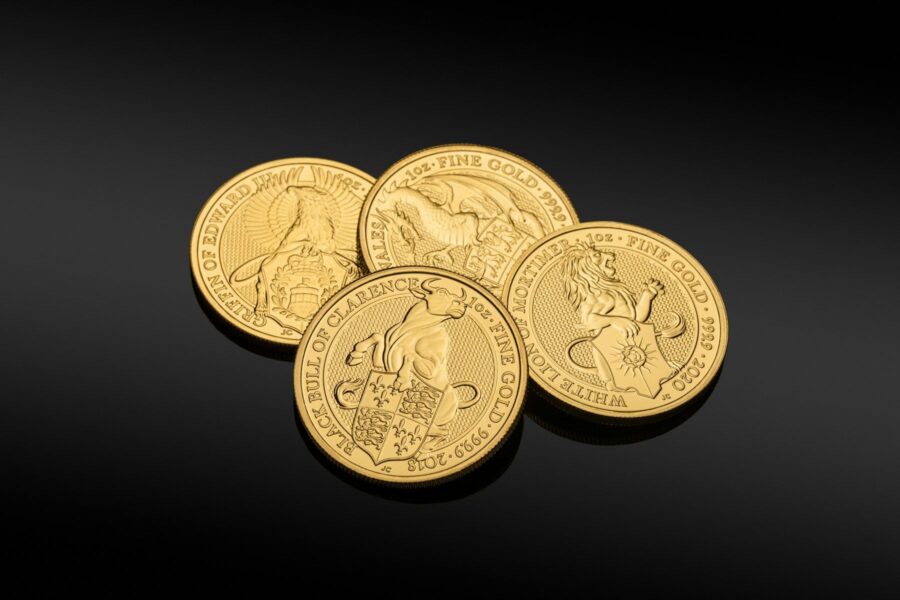
There are four practical ways to invest in gold from the UK: buy coins or bars and hold them yourself, buy bullion stored for you in a vault, buy an exchange-traded commodity (ETC) through a share-dealing account, or buy shares in gold miners or a fund that holds them. All four respond to the gold price, but they differ on cost, tax, the wrappers you can use and who you rely on if something goes wrong. This guide sets them side by side, with the rules as at 9 October 2026.
The gold price, for context
The gold price ended September 2026 at US$4,176 an ounce, or £3,149, according to the World Gold Council. That was 8.5% lower over the month in dollars and 6.6% lower in sterling. The sterling high in the council’s table was £3,961, set on 2 March 2026. Past performance is not a guide to future returns, and nothing here is a view on where the price goes next.
UK investors have recently favoured the listed route. UK-listed gold ETFs took in US$2.2bn in September 2026 and US$7.5bn over the third quarter, their strongest quarter on record, the World Gold Council reported on 7 October 2026. UK bar and coin demand was 3.0 tonnes in the second quarter of 2026, down 50% on the previous quarter (World Gold Council, 30 July 2026). Our report on UK gold ETF inflows has the monthly detail.
How to invest in gold: the four routes compared
The first table compares what you own, what it costs and who you depend on. The second covers tax and wrappers for a UK individual.
| Route | What you own | Main costs | Storage | Counterparty risk |
|---|---|---|---|---|
| Coins (for example Sovereigns and Britannias) | Physical coins | Dealer premium over the value of the gold; the gap between the dealer’s selling and buy-back prices | Your own, insured, or paid storage | The dealer until delivery; after that, loss and theft |
| Bars and wafers | Physical bars | Premium and buy-back spread, as for coins | As for coins | As for coins |
| Vaulted gold | Allocated: identified bars held for you. Unallocated: a claim on the provider for a quantity of gold | Dealing spread plus storage and insurance fees | The provider’s vault | The provider and its custodian; higher with unallocated metal |
| Gold ETCs | A listed security that tracks the gold price, usually backed by physical metal | Platform dealing charge, bid-offer spread, annual product charge | None for you | The issuer, its custodian and your platform |
| Miners’ shares and funds | Shares in mining companies, or units in a fund that holds them | Dealing charges and fund charges | None for you | The companies: their costs, debt, management and the countries they mine in |
| Route | VAT | CGT for UK individuals | Stocks and shares ISA | Investment-regulated pension (such as a SIPP) |
|---|---|---|---|---|
| Sovereigns (1837 onwards) and Britannias | Exempt as investment gold coins | Exempt: HMRC treats them as sterling currency | No | Taxable property, so tax charges apply |
| Other gold coins, such as Krugerrands | Exempt if they meet HMRC’s tests or are on its list | Chargeable, with no chattels exemption | No | Taxable property |
| Bars and wafers of 995 purity or more, at home or vaulted | Exempt | Chargeable, unless a single item sells for £6,000 or less | No | Permitted: investment-grade bullion is excepted from taxable property |
| Gold ETCs | No VAT: dealing in securities is exempt | Chargeable outside a wrapper | Can qualify if listed on a recognised stock exchange | Not taxable property |
| Miners’ shares and funds | No VAT: dealing in securities is exempt | Chargeable outside a wrapper | Yes, where the shares or funds qualify | Not taxable property |
The sections below give the HMRC source for each cell.
VAT: investment gold is exempt
Most gold bought as an investment carries no VAT. HMRC’s VAT Notice 701/21 defines investment gold as bars or wafers of at least 995 thousandths purity in a weight accepted by the bullion markets, or gold coins minted after 1800 that are at least 900 thousandths pure, are or have been legal tender in their country of origin, and normally sell for no more than 180% of the open market value of the gold they contain. Supplies of investment gold are exempt, and so are supplies that give a right to take possession of it, which the notice says includes unallocated gold.
Coins can also qualify by appearing on HMRC’s list in VAT Notice 701/21A, last updated on 3 July 2026. Gold coins outside both routes are standard-rated. The price test applies to a coin type’s normal selling price, so a proof issue that usually sells for more than 180% of its gold value falls outside it unless it is listed. Buying an ETC or a mining share is a dealing in securities, which is exempt from VAT.
Capital gains tax: why coins and bars differ
For UK individuals, the biggest tax difference between the routes is capital gains tax (CGT). HMRC’s Capital Gains Manual at CG78305 says Sovereigns minted in 1837 and later years and Britannia gold coins are currency and, like all sterling currency, are exempt. Coins that are currency but not sterling, such as Krugerrands, are chargeable assets, and the chattels exemption does not apply to them. Companies are outside these instructions and follow the corporate foreign exchange rules (CG78300).
Bars are different. HMRC defines a chattel as tangible moveable property, and there is no chargeable gain on a single chattel sold for £6,000 or less (CG76573). Above that, the gain counts towards your CGT bill, and special rules apply when several similar items are sold. Gains on ETCs and mining shares held outside an ISA or pension are also chargeable.
As at 9 October 2026 the annual exempt amount for individuals is £3,000. For gains made from 6 April 2026, CGT is charged at 18% on gains within the basic-rate band and 24% above it. The coin exemption cuts both ways: a loss is allowable only if a corresponding gain would have been chargeable (CG15800), so a loss on Sovereigns cannot be set against other gains. Our explainer on gold sovereigns and capital gains tax covers the coins in more detail.
ISAs and SIPPs
An ISA shelters income and capital gains from tax, with a £20,000 allowance in the 2026 to 2027 tax year (GOV.UK). HMRC’s guidance for ISA managers, updated on 6 April 2026, lists what a stocks and shares ISA may hold, including shares, company securities, government securities, qualifying funds and investment trusts. HMRC notes that the regulations list what can be held, not what cannot. Physical gold is not on the list, so coins, bars and vaulted metal stay outside ISAs.
A gold ETC is usually a debt security, and under the same HMRC guidance securities issued by companies qualify where they are listed on the official list of a recognised stock exchange, or admitted to trading on a recognised stock exchange in the UK or the European Economic Area. Listed mining shares and qualifying funds can also be held. Whether a particular product is offered inside your ISA is up to your provider. For the order in which to use your allowances, see our guide to tax-efficient investing in the UK.
Pensions follow other rules. HMRC’s Pensions Tax Manual at PTM125100 says taxable property consists of residential property and tangible moveable property, and an investment-regulated pension scheme that acquires it faces tax charges. Investment-grade gold bullion, meaning bars or wafers of at least 995 thousandths purity in a weight accepted by the bullion markets, is specifically excepted. Coins, Sovereigns included, are not. Shares and listed securities are neither residential property nor tangible, so they fall outside these charges. If you hold a SIPP, ask the provider whether it is an investment-regulated scheme and which gold holdings it accepts.
Counterparty risk and what protection applies
Buying physical gold is not a regulated activity. The FCA lists gold and precious metals among products it does not regulate and warns that if you invest in them you won’t be protected if something goes wrong. In practice that normally means no Financial Ombudsman Service complaint and no Financial Services Compensation Scheme (FSCS) claim if a bullion dealer or vault operator fails. The World Gold Council’s own consumer site calls the process of buying gold unregulated.
With vaulted gold, the main question is whether the metal is allocated. Allocated metal is identified bars held for you; unallocated metal is a promise from the provider, so the provider’s financial strength matters more. Ask who the custodian is, whether the bars are independently audited, and what happens to your holding if the provider fails.
ETCs and mining shares are usually bought through FCA-authorised platforms. If an authorised investment firm fails, the FSCS can pay up to £85,000 per person, per firm, but it does not pay out because an investment fell in value. An ETC also depends on its issuer and on the custodian holding the metal, both named in the product’s prospectus. Our explainer on what an ETF is covers how exchange-traded products are built.
Costs to compare before you buy
- Premium: the dealer’s selling price minus the value of the gold in the coin or bar. Divide by the gold value to express it as a percentage.
- Spread: the gap between what a dealer charges for an item and what it will pay to buy the same item back on the same day. This is the cost of a round trip, and adverts rarely show it.
- Storage and insurance: vaults charge a yearly fee; at home, check whether your insurance covers bullion and to what value.
- Delivery: postage and insurance on delivery, and again if you send coins back to sell.
- ETC and fund charges: the yearly charge in the key information document, plus platform and dealing fees.
Watch for scams
Gold is familiar and unregulated, which makes it useful cover for fraud. The warning signs the FCA lists include unexpected contact, pressure to act quickly and offers that sound too good to be true. Cold calls about pensions have been illegal since 9 January 2019, with narrow exceptions, so an unsolicited call about moving pension money into gold is a red flag. Be wary of storage schemes that never show you a bar list, and of fixed buy-back promises. Our guide to how to spot an investment scam sets out the official checks.