A SIPP, or self-invested personal pension, is a personal pension in which you choose the investments. You get tax relief on what you pay in, the money grows free of income tax and capital gains tax, and you can usually take 25% tax-free from age 55, rising to 57 from 6 April 2028. In 2026 to 2027 the annual allowance is £60,000 and the most you can take tax-free in lump sums is £268,275, figures Budget 2026 kept for 2027 to 2028 (HMRC, Budget 2026 Annex A). From 6 April 2027 most unused pension funds will also count towards your estate for inheritance tax.
What a SIPP is
HMRC’s Inheritance Tax Manual describes this type of pension as “a type of personal pension where the member or policyholder can select the investments”, subject to some statutory restrictions (HMRC, IHTM17023). GOV.UK puts it more simply: SIPPs “allow you to control the specific investments that make up your pension fund” (GOV.UK, Personal pensions).
A SIPP is a defined contribution pension. What you have at retirement depends on what goes in, the investment returns and the charges. There is no promised income, unlike a defined benefit scheme. The provider, called the scheme administrator, runs the account and claims the relief; you or an adviser decide what it holds.
The same tax rules apply as to any other registered personal pension. What differs is the range of investments and who makes the decisions. Our guide to tax-efficient investing sets this pension against the ISA and the general account.
How SIPP tax relief works
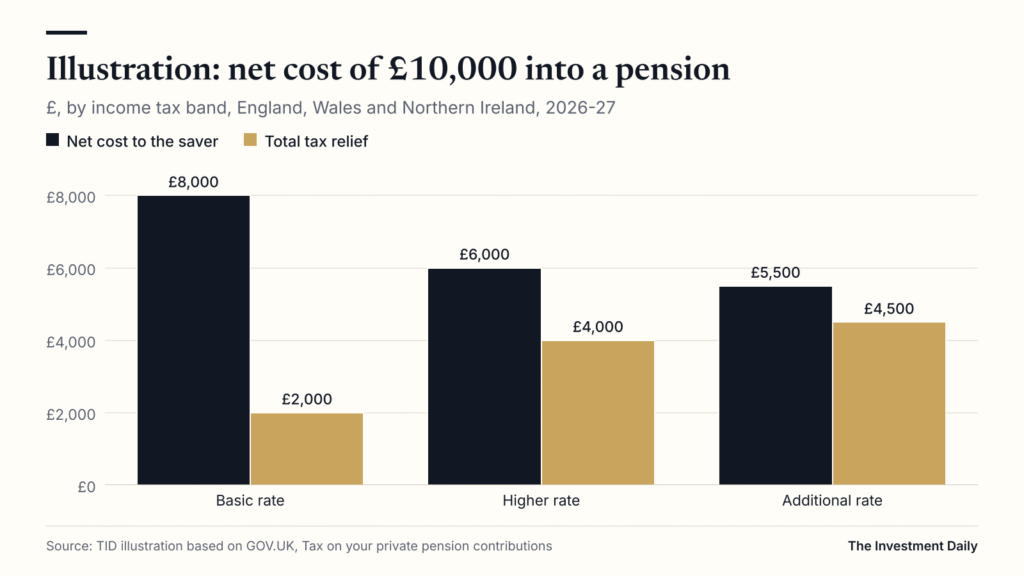
Most SIPPs use relief at source. GOV.UK says your provider “claims tax relief from the government at the basic 20% rate and adds it to your pension pot” (GOV.UK, Tax on your private pension contributions). In practice, you pay £8,000 and the provider adds £2,000, so £10,000 is invested.
Higher and additional rate taxpayers
If you pay income tax at 40% or 45%, the extra tax relief is not added automatically. In England, Wales and Northern Ireland you claim it through your Self Assessment tax return, and it is worth a further 20% or 25% on the part of your income taxed at those rates (GOV.UK). The relief comes back as a lower tax bill or a refund, not as money paid into the pension. If you do not file a tax return, GOV.UK points you to its guidance on claiming another way.
Scottish taxpayers have more bands. GOV.UK lists extra relief of 1% on income taxed at 21%, 22% on income taxed at 42%, 25% on income taxed at 45% and 28% on income taxed at 48%, claimed through Self Assessment (GOV.UK).
The limit on relief
Personal contributions qualify for relief on the higher of 100% of your UK relevant earnings or £3,600 a year gross, for UK residents under 75 (HMRC, Pension schemes rates). Someone with no earnings can therefore pay £2,880, which the provider grosses up to £3,600. GOV.UK says that if you do not pay income tax, your provider can still claim relief at 20% on contributions up to 80% of your earnings, or up to £2,880 if you have no earnings in the year (GOV.UK).
| Illustration: £10,000 gross contribution | Basic rate | Higher rate | Additional rate |
|---|---|---|---|
| You pay in | £8,000 | £8,000 | £8,000 |
| Provider adds (relief at source) | £2,000 | £2,000 | £2,000 |
| Extra relief claimed through Self Assessment | None | £2,000 | £2,500 |
| Net cost to you | £8,000 | £6,000 | £5,500 |
For illustration only. Assumes all £10,000 falls in the relevant tax band in England, Wales or Northern Ireland, and that the contribution is within your relevant earnings and allowance.
The annual allowance, carry forward and the taper
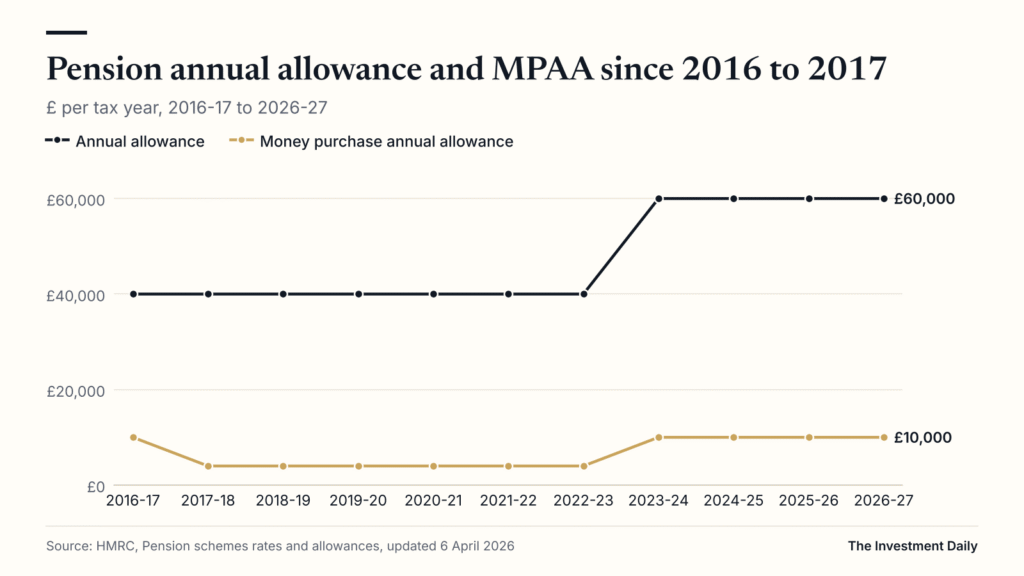
The annual allowance is “the most you can save in your pension pots in a tax year”: £60,000 in 2026 to 2027 (GOV.UK). It covers everything paid into defined contribution pensions by you or anyone else, including an employer, and the gross value of your own contributions. Annex A to Budget 2026 shows £60,000 again for 2027 to 2028 (Annex A). If you go over it, GOV.UK says “either you or your pension provider must pay the tax”.
Carry forward
GOV.UK says you might be able to carry over unused allowance “from the previous 3 tax years” (GOV.UK). HMRC’s Pensions Tax Manual sets the conditions: you must have been a member of a registered pension scheme at some point in each earlier year you carry forward from, the current year’s allowance is used first, and unused amounts are then taken “beginning with available unused annual allowance from the earliest tax year first” (HMRC, PTM055100).
Carry forward helps someone with a one-off large income, such as a bonus or the sale of a business, who wants to pay in more than £60,000 in a year. It does not lift the earnings limit: relief on personal contributions is still capped at your relevant earnings for the current year.
A carry forward example
For illustration only: a self-employed consultant has relevant earnings of £150,000 in 2026 to 2027 and wants to pay £100,000 gross into her pension. Her allowance for the year is £60,000. She was a scheme member in each of the three previous years and paid in £20,000 gross in 2023 to 2024, £30,000 in 2024 to 2025 and £40,000 in 2025 to 2026, each a year with a £60,000 limit.
That leaves unused allowance of £40,000, £30,000 and £20,000. The current year’s £60,000 is used first, then the earliest year, so carry forward of £40,000 from 2023 to 2024 covers the rest. The £30,000 and £20,000 remain available to carry forward until each year drops out of the three-year window.
The tapered annual allowance
High earners can have a smaller allowance. The taper applies where threshold income is over £200,000 and adjusted income is over £260,000 (HMRC). HMRC’s manual says the allowance “will be reduced by £1 for every £2” of adjusted income above £260,000, and for 2023-24 onwards it “cannot be reduced to be less than £10,000” (HMRC, PTM057100). Budget 2026 Annex A keeps the £260,000 adjusted income figure for 2027 to 2028.
The money purchase annual allowance
Once you flexibly access a pension, a lower limit, the money purchase annual allowance or MPAA, applies to further defined contribution saving. GOV.UK’s examples of flexible access include taking “cash or a short-term annuity from a flexi-access drawdown fund” or cash from a pot as uncrystallised funds pension lump sums (GOV.UK). The MPAA is £10,000 in 2026 to 2027 and 2027 to 2028 (Annex A), and HMRC says unused allowance from earlier years “cannot be added to it” (HMRC, PTM055100).
When you can take money out of a SIPP
The normal minimum pension age is 55. Under legislation introduced in Finance Bill 2021-22 it rises “from age 55 to 57 in April 2028”, with effect “on and after 6 April 2028” (HMRC, Increasing normal minimum pension age). Members of the firefighters, police and armed forces public service schemes are not affected.
Some people keep a lower protected pension age. HMRC’s policy paper says protection applies to members who, before 4 November 2021, had a right under their scheme rules to take benefits at an age below 57 (HMRC). Whether your scheme gives such a right, and whether it survives a pension transfer, depends on the scheme rules, which the provider can confirm before any money moves.
Access before the minimum age, except on serious ill-health grounds, is an unauthorised payment. Pension Wise warns that offers to release pension money before 55 are a common sign of a scam (Pension Wise).
Tax-free cash and the lump sum allowance
GOV.UK says “you can usually take up to 25% of the amount built up in any pension as a tax-free lump sum”, and the most you can take is £268,275, the lump sum allowance (GOV.UK, Tax when you get a pension). The rest is taxed as income when you draw it, with the provider usually deducting tax before you receive it. A separate lump sum and death benefit allowance of £1,073,100 caps tax-free lump sums in life and on death combined (Annex A).
From a SIPP, the usual routes are:
- Flexi-access drawdown: take up to 25% as tax-free cash, leave the rest invested and draw taxable income when you choose.
- Uncrystallised funds pension lump sums: take cash from the pot in stages, with usually 25% of each payment tax-free and 75% taxed as income.
- An annuity: use some or all of the pot to buy a guaranteed income from an insurer.
- Small pots: GOV.UK says you can usually take a pension worth up to £10,000 in one go, with 25% tax-free, and up to three such small pot lump sums from personal pensions (GOV.UK).
A drawdown example
For illustration only: a 60-year-old with a £200,000 pot takes £50,000 as tax-free cash and moves the other £150,000 into flexi-access drawdown. If she then draws £20,000 a year of taxable income and has no other income, the first £12,570 is covered by the personal allowance, frozen at that level for 2026 to 2027 and 2027 to 2028 (Annex A). The remaining £7,430 is taxed at 20%, or £1,486. Her first taxable withdrawal also triggers the MPAA.
The tax-free cash does not have to be taken all at once. Taking it in stages, through phased drawdown or a series of lump sums, leaves more of the pot invested, but the lump sum allowance of £268,275 still caps the total.
Taxable withdrawals are added to your other income for the year. A large withdrawal in one tax year can push part of it into the higher or additional rate band, and taking taxable income flexibly triggers the MPAA described above.
What a SIPP can invest in
HMRC’s manual says the “tax rules for registered pension schemes do not impose any restrictions on the types of asset a pension scheme can invest in” (HMRC, PTM121000). In practice, providers set their own menus. Many offer listed shares, investment trusts, funds, ETFs, gilts and corporate bonds, and some allow commercial property or unlisted shares. See our guides to global tracker funds and buying gilts.
Taxable property
The limit comes from tax charges. A SIPP is an investment-regulated pension scheme, and holding “taxable property”, meaning residential property or tangible moveable property, triggers charges (HMRC, PTM125100). HMRC says tangible moveable property “includes assets such as art, antiques, classic cars” and plant and machinery. Investment-grade gold bullion, of a purity of at least 995 thousandths in bar or wafer form, is excluded from the definition. Our guide to investing in gold covers the forms gold takes.
| Charge | Who pays | Rate |
|---|---|---|
| Unauthorised payments charge | The member | 40% of the unauthorised payment |
| Unauthorised payments surcharge | The member, where the surcharge threshold is reached | 15% |
| Scheme sanction charge | The scheme administrator | 40%, reduced where the member’s charge has been paid |
Source: HMRC, PTM121000, accessed 1 November 2026.

Charges and risks of a SIPP
The tax relief can be eroded by fees. SIPP providers charge in different ways, and none of these charges is set by HMRC:
- An administration or platform fee, either a percentage of the value or a flat yearly amount.
- Dealing commission on shares, investment trusts and ETFs.
- Fund ongoing charges, taken inside the fund price.
- Drawdown fees, where a provider charges for paying income.
- Pension transfer fees, and extra fees for commercial property or unlisted assets.
For illustration only: on a £200,000 pot, a 0.25% percentage fee would be £500 a year, while a flat fee of £300 would stay at £300. On £20,000 the same percentage fee would be £50. What matters is the total cost in pounds for the account size, investments and withdrawals expected.
Investment and provider risk
- The value of investments can fall, and you may get back less than was paid in. Past performance is not a guide to future returns.
- Choosing your own investments means you carry the risk of poor choices or too little diversification.
- Drawing too much too early can leave too little for later years.
- Provider failure: the FSCS can pay up to £85,000 per eligible person, per firm, if a firm has gone out of business and there is a shortfall, and covers bad advice given on or after 28 August 1988. It says “We can’t accept any claims that are for poor investment performance” (FSCS).
Inheritance tax on a SIPP from April 2027
Until 5 April 2027, a pension pot is usually outside your estate, because death benefits are paid at the scheme administrator’s discretion. That changes for deaths on or after 6 April 2027, when “most unused pension funds and pension death benefits” will be brought within the value of a person’s estate (HMRC, Inheritance Tax on unused pension funds and death benefits).
OOTLAR item 1.27 of Budget 2026 says the change was legislated in Finance Act 2026. It adds that Finance Bill 2026-27 will allow a prospective personal representative to direct pension scheme administrators to pay the inheritance tax due to HMRC when certain conditions are met, with effect from 6 April 2027 (OOTLAR item 1.27).
- Personal representatives, not scheme administrators, will be liable for reporting and paying any inheritance tax due on pensions.
- Death benefits passing to a surviving spouse or civil partner remain exempt.
- Death in service benefits from a registered scheme and dependants’ scheme pensions from a defined benefit arrangement are excluded.
HMRC estimates that in 2027 to 2028 around 10,500 estates will owe inheritance tax they would not otherwise have owed and about 38,500 will pay more, with an average increase of around £34,000, figures it says should be treated as a maximum (HMRC).
Income tax on death benefits
Income tax still depends on age at death. If the member died before 75, most lump sums are paid free of income tax within the lump sum and death benefit allowance; at 75 or over, the provider deducts income tax (GOV.UK, Tax on a private pension you inherit).
Budget 2026 removed the two-year rule for members who die before 75. HMRC’s policy paper of 28 October 2026 says a lump sum death benefit paid more than two years after the scheme learned of the death “will no longer be subject to a tax charge, provided the member had sufficient lump sum and death benefit allowance available”. The same applies to beneficiary drawdown income and annuities. The change has effect for payments made on or after Budget Day, 28 October 2026, and the legislation will be in Finance Bill 2026-27 (HMRC, two-year rule policy paper; OOTLAR item 1.18).
The current position therefore depends on the payment date. As at 1 November 2026, GOV.UK’s guide for beneficiaries still says that a lump sum paid more than two years after the provider is told of the death is taxable in full (GOV.UK). That describes the rule for payments made before 28 October 2026; for payments on or after that date, HMRC’s policy paper and OOTLAR item 1.18 set out the new treatment. Our tax and wrappers section covers the other wrappers affected.
Moving money into a SIPP: pension transfer rules
You can usually move other defined contribution pensions into a SIPP. A pension transfer can be made as cash, with investments sold first, or in specie, with holdings re-registered. Cash transfers leave money out of the market for the transfer period. Check exit fees, any guarantees you would give up, such as a guaranteed annuity rate, and whether a protected pension age survives the move.
Defined benefit and other safeguarded benefits need more care. Under section 48 of the Pension Schemes Act 2015, members with “safeguarded benefits worth more than £30,000” must take appropriate independent advice from an FCA-authorised adviser before transferring them (DWP, Pension benefits with a guarantee and the advice requirement).
A pension transfer is also a favoured route for scams. Pension Wise says that since January 2019 there has been a ban on cold calling about pensions, and that once a transfer has happened it is usually too late to recover the money (Pension Wise). Check the firm on the FCA register and the FCA warning list. Our guide to spotting an investment scam lists the warning signs.
Before you open a SIPP: a checklist
- Check your relevant earnings and how much allowance you have, including any carry forward from the last three tax years.
- If you pay higher or additional rate tax, check how the extra tax relief will be claimed, through Self Assessment or HMRC’s other claim route.
- Check whether you have triggered the MPAA by taking flexible income from any pension.
- Compare SIPP charges in pounds, including drawdown and pension transfer fees.
- Consider whether choosing investments yourself suits you, and check the provider’s investment menu.
- Work out how much tax-free cash you could take, and when.
- Note the rise in the minimum pension age to 57 on 6 April 2028.
- Check that your expression of wish form is up to date, and how inheritance tax on pensions from 6 April 2027 could affect your estate.
A SIPP gives the same tax relief and annual allowance as other personal pensions, with more control over investments and more responsibility for the results. Budget 2026 left the main limits unchanged for 2027 to 2028: £60,000 annual allowance, £10,000 MPAA and £268,275 of tax-free cash. The bigger changes are on death: the two-year rule has gone from 28 October 2026, and from 6 April 2027 unused SIPP funds will count for inheritance tax.