From 6 April 2027, inheritance tax on pensions changes: for deaths on or after that date, most unused pension funds and pension death benefits will count towards the value of the estate (HMRC). Until then, most pension pots pass outside the estate. Death in service benefits and dependants’ scheme pensions stay outside, and anything left to a surviving spouse or civil partner remains exempt. Budget 2026 confirmed the change, removed the two-year rule for death benefits from 28 October 2026, and made technical amendments to how personal representatives pay the tax (HMRC, OOTLAR).
What changes on 6 April 2027
Today, most defined contribution pension pots are paid out at the discretion of the scheme administrator, so they usually fall outside the member’s estate. GOV.UK’s current guidance for beneficiaries says “You do not usually pay Inheritance Tax on a lump sum because payment is usually ‘discretionary'” (GOV.UK).
That ends for deaths on or after 6 April 2027. HMRC’s policy paper says pension death benefits “will be included within the deceased’s estate even where relevant discretion exists” (HMRC, policy paper, 21 July 2025). The measure was legislated in Finance Act 2026, and the Budget 2026 overview of tax legislation and rates restates it: “Most unused pension funds and pension death benefits will be brought within the value of a person’s estate” for inheritance tax purposes from 6 April 2027 (OOTLAR item 1.27).
The timing rule for inheritance tax on pensions is simple. HMRC’s technical note says the new rules apply to deaths on or after 6 April 2027. Earlier deaths stay under the current rules, even if the benefits are paid after that date (HMRC, technical note).
The government’s estimate of who is affected is set out in its tax information and impact note. Of around 213,000 estates with inheritable pension wealth in 2027 to 2028, about 10,500 are expected to owe inheritance tax they would not otherwise have owed, and about 38,500 to pay more. The average liability is expected to rise by around £34,000. HMRC says these are static figures and should be treated as a maximum (HMRC).
What is in scope for inheritance tax on pensions
HMRC’s technical note uses the term notional pension property for the pension value that is added to the estate. It covers the amount of any benefit “that must be paid as a lump sum death benefit” and property held in a pension pot that may be used to provide death benefits (HMRC, technical note). In practice that means:
- Unused pension funds in defined contribution pensions, including SIPPs and personal pensions, whether or not the member had started drawing from them.
- Lump sums payable on death, including those from defined benefit schemes.
- Annuity and pension guarantees where a member dies within the first 10 years of becoming entitled to a pension or annuity.
- Pension property held in qualifying non-UK pension schemes and section 615(3) schemes, which the technical note says will be in scope.
What stays outside
The technical note lists excluded benefits (HMRC, technical note):
- Death in service benefits from the member’s current employment.
- Dependants’ scheme pensions, including from defined benefit and collective money purchase arrangements.
- Trivial commutation lump sums that extinguish a dependants’ scheme pension.
- Dependants’ or nominees’ annuities bought together with a member’s lifetime annuity.
Charity lump sum death benefits are not on the excluded list. The technical note says they are free of income tax even where the member was 75 or older, and count towards the general component of the estate for the reduced charity rate. Budget 2026 added that those administering an estate will be able to choose whether notional pension property is included in the general component or treated as a separate component when working out that reduced rate (OOTLAR item 1.27).
| Benefit | Counts for inheritance tax on pensions from 6 April 2027 |
|---|---|
| Unused defined contribution pot, including drawdown funds | Yes |
| Lump sum death benefit, including from a defined benefit scheme | Yes |
| Annuity guarantee where death is within 10 years of entitlement | Yes |
| Death in service benefit from current employment | No |
| Dependants’ scheme pension | No |
| Joint life or dependants’ annuity bought with the member’s annuity | No |
| Anything passing to a surviving spouse or civil partner | Included in the valuation, then exempt |
Source: HMRC, Technical note: Inheritance Tax on pensions, updated 29 May 2026.
How inheritance tax on pensions treats different pension types
The effect depends on what kind of pension the member had and how far they had drawn on it.
- Defined contribution pots: unused pension funds, whether untouched or in drawdown, are notional pension property. This is where most of the new liability will fall.
- Defined benefit schemes: a dependants’ scheme pension paid to a surviving partner or child is excluded, but a lump sum death benefit from the scheme is in scope.
- Annuities: a single life annuity ends on death and leaves nothing to tax. A guarantee period is in scope where the member dies within the first 10 years of entitlement, while a dependants’ annuity bought with the member’s annuity is excluded.
- Overseas schemes: qualifying non-UK schemes are within scope for valuation, and registered schemes established outside the UK must follow the legislation (HMRC, technical note).
In each case the scheme administrator values what would be payable on death and reports it to the personal representatives. Where a member holds several pots, each scheme administrator answers separately, so an estate with old workplace pensions may have several valuations to collect. Unused pension funds held in more than one scheme are added together with the rest of the estate.
Nil-rate bands and the spouse exemption under inheritance tax on pensions
Bringing pensions into the estate does not change the thresholds. Annex A to Budget 2026 shows the nil-rate band at £325,000 and the residence nil-rate band at £175,000 in both 2026 to 2027 and 2027 to 2028 (Annex A). The residence nil-rate band is withdrawn gradually for estates above £2m. The rate on the estate is 40%, or 36% where 10% or more of the net estate is left to charity.
GOV.UK says the threshold “can increase to £500,000” if you give your home to your children or grandchildren, and “any unused threshold can be added to your partner’s threshold when you die” (GOV.UK, Inheritance Tax). Those rules apply in the same way once pension funds are inside the estate.
Spouses and civil partners
The existing exemption for transfers between spouses and civil partners, where they are long-term UK residents, continues. The technical note says the exemption is not applied when the pension property is valued: personal representatives include the value in the estate and then claim the exemption on what passes to the spouse (HMRC). The policy paper says the government is “providing exemption for death benefits passing to a surviving spouse or civil partner” (HMRC).
Points to check
The £2m taper on the residence nil-rate band could matter for larger estates once pension property counts towards the value of the estate. HMRC’s technical note does not set out how pension property interacts with the taper, or how the nil-rate band is shared between pension and other assets. HMRC says guidance and supporting materials will be updated and published for April 2027 (HMRC, technical note).
Who pays: personal representatives and the scheme administrator
The original consultation proposed that pension schemes would pay. The final design of inheritance tax on pensions puts the duty on the estate: “Personal representatives will be liable for reporting and paying any Inheritance Tax due” (HMRC). Scheme administrators are normally not liable, unless they fail to act on a valid notice. Once pension property vests in a beneficiary, that beneficiary becomes jointly and severally liable with the personal representatives (HMRC, technical note).
The technical note sets out the mechanics and the deadlines:
- Personal representatives ask each scheme for a valuation. If the scheme administrator cannot provide it within 28 days of the request, it must give an estimate.
- Inheritance tax is due at the end of the sixth month after the death. Late payment interest runs after that.
- A withholding notice can hold back up to 50% of a beneficiary’s entitlement, from the date of death until 15 months after the end of the month of death. The scheme must acknowledge it within 14 days.
- A payment notice, under what HMRC calls the Pensions Direct Payment Scheme, tells the scheme administrator to pay tax and interest to HMRC. It must be for at least £1,000 and for an exact amount, and the scheme must pay within 35 days.
- The amount in a payment notice cannot exceed the tax and interest the person giving it is liable for. A beneficiary’s notice also cannot exceed that beneficiary’s unpaid benefits, and a notice needs funds still held in the scheme to be valid.
Budget 2026 made one change here. The technical note describes payment notices given by personal representatives and beneficiaries, and says that where there is no will a prospective personal representative, someone with reason to believe they will become one, can give a withholding notice. OOTLAR item 1.27 says Finance Bill 2026-27 will allow a prospective personal representative to direct pension scheme administrators to pay the tax due when certain conditions are met, from 6 April 2027 (OOTLAR). That matters because probate can take months and the tax is due after six.
Inheritance tax on pensions and income tax after age 75
Inheritance tax is only half the picture. Income tax on inherited pensions depends on the member’s age at death, and it continues alongside the new charge.
- Death before 75: most lump sums and drawdown funds pass free of income tax, within the lump sum and death benefit allowance (GOV.UK). That allowance is £1,073,100 (HMRC).
- Death at 75 or over: the technical note says “If the member was over age 75, all death benefits are taxable” as the beneficiary’s income (HMRC).
To stop the same money being taxed in full twice, the technical note says the portion of the benefits “corresponding to the Inheritance Tax (and interest) paid” is not counted as the beneficiary’s taxable income. Where tax is paid through a payment notice, the scheme reduces the benefits and income tax applies to the net amount. Where a beneficiary pays the inheritance tax personally, they will work with HMRC to reduce their taxable income, with further guidance to follow (HMRC).
Even with that relief, the combined rate of income tax and inheritance tax on pensions inherited from someone who died after 75 can be high, because inheritance tax is taken first and income tax is charged on what is left.
Worked examples of inheritance tax on pensions
These examples show how inheritance tax on pensions can change the bill, and how it combines with income tax. For illustration only. The examples assume deaths on or after 6 April 2027, 2027 to 2028 thresholds from Budget 2026 Annex A, no lifetime gifts, no home left to descendants, no charity gifts, and a single person with no transferred nil-rate band.
Example one: death before 75
A single woman who never married dies aged 70 with other assets of £400,000 and an unused pension pot of £300,000, left to her adult son.
| Illustration | Old rules | From 6 April 2027 |
|---|---|---|
| Other assets | £400,000 | £400,000 |
| Pension counted in the estate | Nil | £300,000 |
| Total estate | £400,000 | £700,000 |
| Nil-rate band | £325,000 | £325,000 |
| Taxable at 40% | £75,000 | £375,000 |
| Inheritance tax | £30,000 | £150,000 |
The bill rises by £120,000. Because she died before 75, the pension is free of income tax for her son, within her lump sum and death benefit allowance. How the £150,000 is shared between the pension and the other assets depends on the apportionment rules, which HMRC’s technical note does not set out in figures.
Example two: death after 75
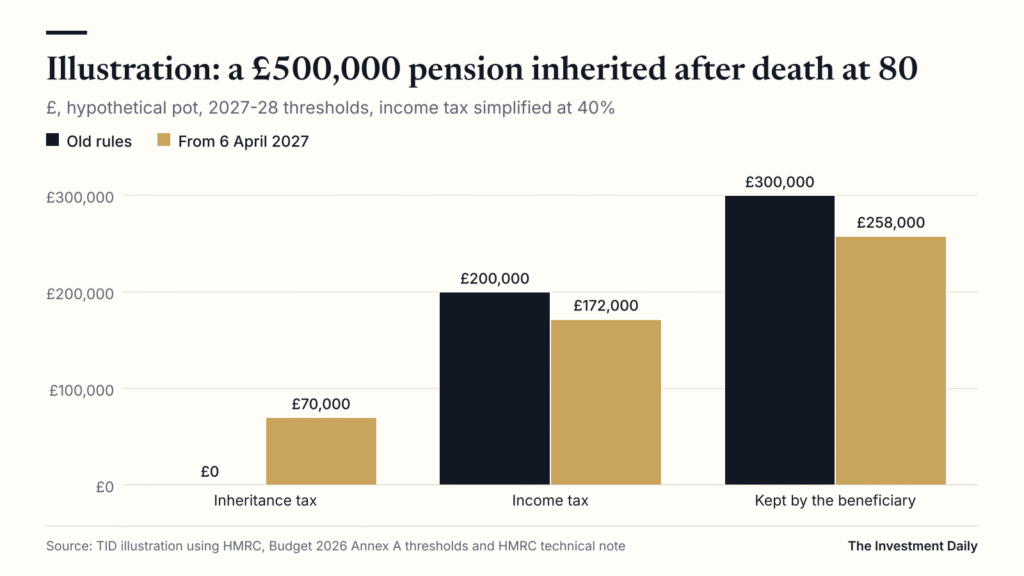
A man dies aged 80 with a pension pot of £500,000 and no other assets, having rented his home. He leaves the pension to his daughter. The £325,000 threshold leaves £175,000 taxable at 40%, so inheritance tax is £70,000, paid by a payment notice from the pension.
His daughter receives benefits worth £430,000, and income tax applies to that net amount, not to the £70,000 paid to HMRC. If she draws it over several years and, as a simplification, pays 40% income tax on all of it, the income tax is £172,000. She keeps £258,000: combined tax of £242,000, or 48.4% of the pot. Under the old rules the same benefits would have faced income tax only, £200,000 at 40%.
What Budget 2026 changed: the two-year rule and death benefit tax
Three Budget 2026 measures sit alongside inheritance tax on pensions.
The two-year rule is removed
Lump sums paid on the death of a member under 75 are normally tax-free, but under the two-year rule they became taxable if the scheme administrator paid them more than two years after learning of the death (HMRC). HMRC’s policy paper says “Tax-free lump sum death benefits will no longer be taxed just because they are not paid within 2 years” of the administrator first learning of the death. The same two-year rule is also removed for annuity payments from a drawdown fund and for money put into drawdown in overseas schemes after a death.
The measure “will have effect in relation to payments made on or after Budget Day 2026”, which was 28 October 2026 (HMRC). OOTLAR item 1.18 confirms the date (OOTLAR). As at 1 November 2026, GOV.UK’s beneficiary page still says a lump sum paid more than two years after the provider is told of the death is taxable in full (GOV.UK). That describes the rule for payments before 28 October 2026. For payments on or after that date the policy paper applies, with the legislation to follow in Finance Bill 2026-27 (OOTLAR item 1.18).
Lump sums above the allowance
Where a member who died before 75 had too little lump sum and death benefit allowance left, the excess has been taxed as the beneficiary’s pension income. OOTLAR item 1.17 says it “will no longer be treated as pension income of individual beneficiaries”. Instead, a tax charge will be raised on each beneficiary’s share of the excess at their marginal rate of income tax, with retrospective effect for lump sums paid on or after 6 April 2024 (OOTLAR item 1.17; HMRC). Consequential changes keep income tax relief where a benefit faces both taxes, for deaths on or after 6 April 2027.
Payment by prospective personal representatives
As above, item 1.27 lets a prospective personal representative direct a scheme to pay the tax, and lets the estate choose how pension property is treated for the 36% charity rate.
What families and executors can check now
None of this requires action before 6 April 2027, but the rules affect decisions people make now about drawing, saving and nominating beneficiaries. Points some families review:
- Expression of wish forms: check each scheme has up-to-date nominations, including a spouse or civil partner where intended, since that share is exempt.
- Valuations: list every pension, including old workplace schemes, and note which benefits are excluded, such as death in service.
- Age 75: for members over 75, the combined effect of inheritance tax and income tax on beneficiaries can approach half of the fund in higher rate cases, as example two shows.
- Liquidity: personal representatives need cash to pay within six months. The payment notice route lets the pension pay its own share.
- Lifetime gifts and drawdown: some families are reconsidering how much to draw and when. Regulated financial advice and tax advice cover this area, where income tax on withdrawals, gift rules and investment risk all interact.
Common misunderstandings about inheritance tax on pensions
- That only large pensions are affected. The test is the whole estate, so a modest pot added to a house and savings can take an estate over the £325,000 threshold.
- That the pension scheme pays automatically. The estate is liable; the scheme pays only on a valid payment notice.
- That death before 75 means no tax. It means no income tax in most cases. Unused pension funds still count for inheritance tax.
- That a spouse nomination wastes nothing. It is exempt, but it may defer the question to the second death, when the survivor’s estate includes what they inherited.
Our guide to tax-efficient investing in the UK covers the wrappers involved, and the tax and wrappers section collects related explainers. The timeline of decisions made before the Budget is in our pre-Budget briefing, which predates 28 October 2026.
Inheritance tax on pensions: the summary
Inheritance tax on pensions starts with deaths on or after 6 April 2027. Most unused pension funds and death benefits join the estate, with death in service benefits and dependants’ scheme pensions left out and the spouse and civil partner exemption intact.
Personal representatives report and pay, and can have the scheme pay through a payment notice. The thresholds stay at £325,000 and £175,000 for 2027 to 2028. Budget 2026 removed the two-year rule for payments from 28 October 2026 and changed how tax on lump sums above the allowance is collected. For members who die after 75, income tax still applies to what beneficiaries receive after inheritance tax.