A silver investment from the UK can take five main forms: bullion coins, bullion bars, metal held for you in a vault, exchange-traded commodities (ETCs) listed on a stock exchange, and shares in mining companies or funds that hold them. The tax treatment is what separates them. Silver bought in the UK carries VAT at 20%, unlike investment gold, while Royal Mint bullion coins such as the Britannia are legal tender and therefore outside capital gains tax. The price is set in US dollars, it is far more volatile than gold, and in 2025 its annual average rose 42%, according to the Silver Institute.
This guide explains how each kind of silver investment works, what it costs, how it is taxed after Budget 2026 and what protection you do and do not get. If you are comparing metals, our guide on how to invest in gold covers the same routes for gold.
What a silver investment gives you exposure to
Silver is two things at once. It is a precious metal that investors buy as a store of value, and it is an industrial raw material used in electronics, solar panels and brazing alloys. That double role is why the silver price can rise on investment buying in one year and fall on weak factory demand in the next.
The Silver Institute’s World Silver Survey 2026, produced by the consultancy Metals Focus and published on 15 April 2026, puts industrial use at 657.4 million ounces in 2025, 58% of total demand of 1,130.6 million ounces. Coins and bars took 217.7 million ounces, jewellery 189.3 million and silverware 42.1 million. In gold, by contrast, investment and central bank buying dominate.
Most silver is not mined for its own sake. The same survey shows that primary silver mines produced 26.1% of mined supply in 2025; the rest came as a by-product of lead and zinc (29.4%), copper (28%) and gold (15.9%) mining. Higher silver prices therefore do not quickly bring out more supply, because the output of a copper mine depends on the copper price.
Silver supply and demand: the numbers behind the price
Demand has exceeded supply for five consecutive years. The World Silver Survey 2026 records a market deficit of 40.3 million ounces in 2025, much smaller than the 254.0 million ounce shortfall of 2022, and forecasts a deficit of 46.3 million ounces in 2026. For a silver investment, deficits matter because they are met by drawing down stocks held above ground, which is why the survey pays close attention to inventories in London and New York.
| Million ounces | 2021 | 2022 | 2023 | 2024 | 2025 | 2026 forecast |
|---|---|---|---|---|---|---|
| Mine production | 825.4 | 833.7 | 810.7 | 823.6 | 846.6 | 844.1 |
| Recycling | 191.8 | 194.6 | 184.6 | 194.5 | 197.6 | 211.3 |
| Total supply | 1,018.7 | 1,030.1 | 997.0 | 1,019.6 | 1,090.4 | 1,066.4 |
| Industrial demand | 564.1 | 592.3 | 657.1 | 679.0 | 657.4 | 639.6 |
| of which photovoltaics | 88.9 | 118.1 | 192.7 | 197.5 | 186.6 | 151.0 |
| Coin and net bar demand | 285.3 | 339.5 | 244.2 | 190.9 | 217.7 | 257.6 |
| Total demand | 1,102.4 | 1,284.1 | 1,197.0 | 1,157.4 | 1,130.6 | 1,112.6 |
| Market balance | -83.7 | -254.0 | -200.1 | -137.9 | -40.3 | -46.3 |
| Net investment in ETPs | 64.9 | -117.4 | -37.3 | 67.5 | 278.1 | 30.0 |
Source: Silver Institute and Metals Focus, World Silver Survey 2026, April 2026. ETPs are exchange-traded products; their buying is shown separately from the market balance.
Two trends stand out. Solar panel makers used less silver in 2025 as high prices pushed them to “accelerate thrifting and substitution”, the Institute said, and it expects photovoltaic demand to fall 19% in 2026. Meanwhile exchange-traded products absorbed 278.1 million ounces in 2025, and global ETP holdings reached 1,317.6 million ounces at the end of the year, of which 695 million ounces sat in London vaults.
That buying had consequences. The survey describes “an unprecedented liquidity squeeze in October” 2025, when stocks in London not already committed to ETPs fell to a reported low of 136 million ounces at the end of September. It concludes that “the market has clearly entered an era of reduced stocks” and that price moves are “likely to be larger than investors have grown used to”.
The silver price: how it is set and how it has moved
The benchmark is the LBMA Silver Price, set once each working day in an electronic auction at 12 noon UK time, in US dollars per troy ounce. ICE Benchmark Administration (IBA) runs the auction and LBMA owns the benchmark, according to the LBMA. Sterling and euro prices are published but are, in LBMA’s words, “indicative prices for settlement only”. Any UK silver investment therefore carries currency risk as well as metal risk: if sterling rises against the dollar, the sterling value of the same ounce falls.
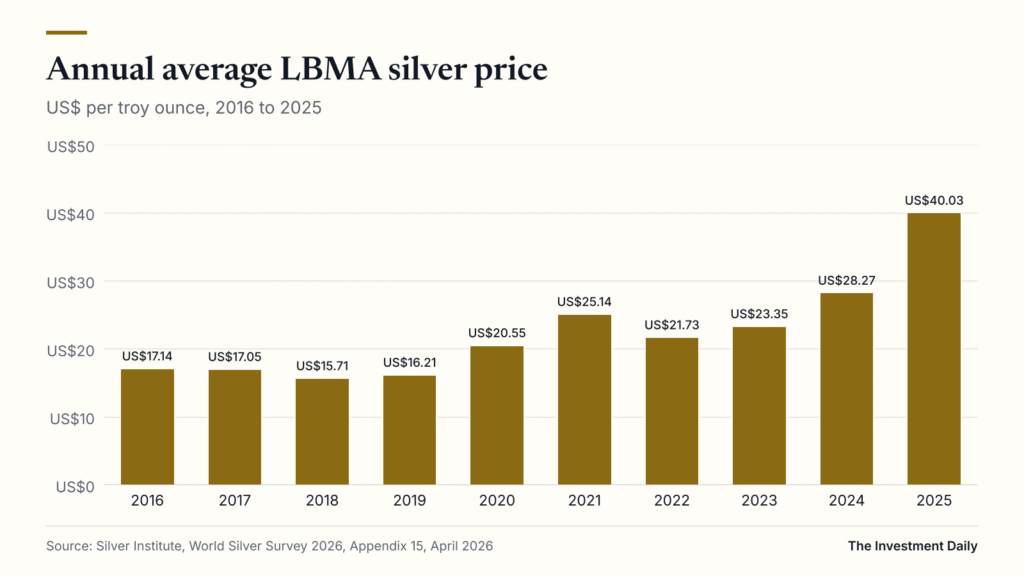
Annual averages show how long silver can go nowhere and then how fast it can move. The World Silver Survey 2026 gives the LBMA annual average as US$35.12 an ounce in 2011, US$15.71 in 2018, US$28.27 in 2024 and US$40.03 in 2025.
| Period | LBMA low (US$/oz) | LBMA high (US$/oz) | Average (US$/oz) |
|---|---|---|---|
| 2011 | 26.16 | 48.70 | 35.12 |
| 2015 | 13.71 | 18.23 | 15.68 |
| 2020 | 12.01 | 28.89 | 20.55 |
| 2024 | 22.09 | 34.51 | 28.27 |
| 2025 | 29.41 | 74.84 | 40.03 |
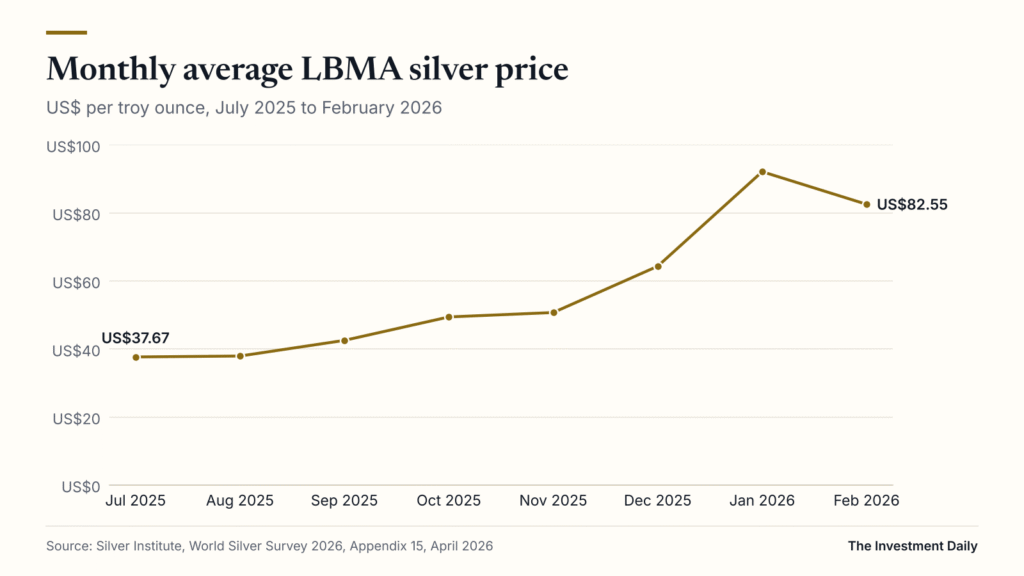
| January 2026 | 74.22 | 118.45 | 92.13 |
| February 2026 | 74.65 | 90.71 | 82.55 |
Source: Silver Institute, World Silver Survey 2026, Appendix 15 (LBMA Silver Price, daily fixes). Past performance is not a guide to future returns.
The rally ran into 2026. In its press release for the World Silver Survey 2026, the Institute said that “prices surged to an all-time high above $121 on January 29 before falling back sharply, with the metal trading in the mid-$70s in early April”. That peak is higher than the highest LBMA Silver Price for January, US$118.45, because the benchmark is set once a day at noon.
In February 2026 it noted that the ratio of the gold price to the silver price had dropped below 50, a level not seen since 2012 (Silver Institute). Check the current LBMA Silver Price on the day you deal, because figures from even a few weeks ago can be far out.
Why a silver investment is more volatile than gold
Silver and gold usually move in the same direction, but silver moves further. A market trend report on the gold:silver ratio, published by the Silver Institute in July 2026, measured a correlation coefficient of 0.795 between daily gold and silver returns from January 2006 to May 2026. It describes silver as “the more volatile and speculative of the pair” and links that to silver’s “higher price volatility, less liquid market” and weaker safe-haven demand.
History has examples of both directions. The same report describes how buying by the Hunt brothers and their partners drove silver from US$11 at the start of September 1979 to a London peak of US$49.45 on 18 January 1980. When US exchanges changed their rules to defeat the attempt to corner the market, the price fell 50% on 27 March 1980. In March 2020, as markets reacted to the pandemic, the gold:silver ratio reached an all-time peak of 125.7 on 18 March, meaning an ounce of gold bought more than 125 ounces of silver.
The ratio is a guide some investors watch, not a rule. Using data from January 1970 to May 2026, the report finds a long-run equilibrium for the ratio of 59.65, which the Institute’s July 2026 press release describes as “just under 60:1”, and says it tends to return towards that level, while warning that it is “a challenge to forecast it in the short term”. In January 2026 alone the monthly LBMA range was more than US$44 an ounce, a swing of about 60% from low to high.
Ways to invest in silver from the UK
The routes to a silver investment differ in VAT, capital gains tax, storage, liquidity and the protection you have if a firm fails. The table below summarises the main points; each route is explained underneath.
| Route | VAT on purchase | Capital gains tax | Storage | FCA regulation |
|---|---|---|---|---|
| Royal Mint silver coins (for example Britannias) | 20% if bought in the UK | Outside CGT: sterling legal tender | At home or with a vault | Not regulated: physical metal |
| Other bullion coins (foreign legal tender) | 20% if bought in the UK | Chargeable; not treated as chattels | At home or with a vault | Not regulated |
| Silver bars | 20% if bought in the UK | Chargeable, with the £6,000 chattels rule | Usually a vault | Not regulated |
| Silver ETCs | No VAT on the security | Depends on offshore fund and reporting status | Metal held by a custodian | The platform is regulated; the metal is not |
| Mining shares and funds | No VAT | Normal share rules; dividends taxed | Held on a platform | Regulated through the platform or fund |
Silver coins
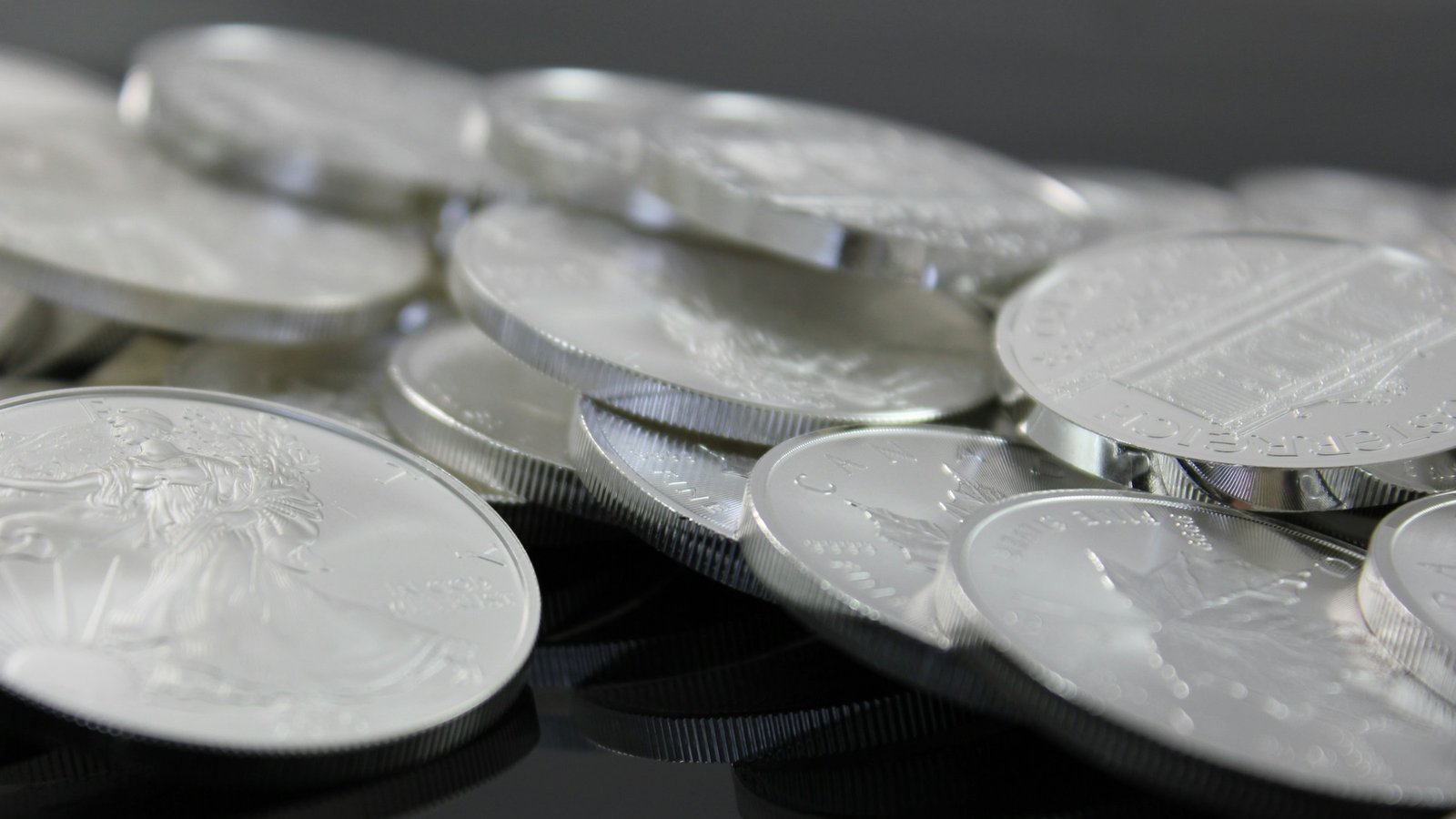
Silver coins are one way to hold silver bullion. According to the Royal Mint, all its gold, silver and platinum bullion coins, including silver Britannias, are exempt from capital gains tax for UK residents “due to their status as legal British currency”. Coins carry a premium over the metal value to cover minting and distribution, and the premium on small coins is higher per ounce than on large bars. The World Silver Survey 2026 says UK fabrication of silver coins and medals rose 44% to 9.8 million ounces in 2025, and that mints rationed silver bullion coins in early 2026 as demand outstripped supply.
Silver bars
Silver bars range from one ounce to the wholesale standard. LBMA’s Good Delivery standard, which governs bars traded in the London market, specifies bars of approximately 1,000 troy ounces for silver, against about 400 ounces for gold (LBMA). Retail silver bars are smaller. Larger silver bars usually carry a lower premium per ounce, but they are heavy and bulky: silver is worth far less per gram than gold, so the same sum takes up much more space.
Vaulted silver
Some dealers and online platforms sell physical silver bullion that stays in a professional vault. LBMA’s glossary explains the two account types: in an allocated account, specific bars are segregated and “the Client has full title to this metal”, with the dealer holding it as custodian; an unallocated account is “a general entitlement to a quantity of metal without specific bars assigned to you, much like a bank currency account”. With unallocated metal you are a creditor of the provider, so its solvency matters.
Silver ETCs
An exchange-traded commodity is a debt security that tracks the silver price and is bought and sold on a stock exchange like a share. Physically backed silver ETCs hold bars with a custodian, often in London. You avoid VAT, storage arrangements and dealer spreads on bars, but you pay an annual charge and rely on the issuer’s structure and custodian. Our guide to what an ETF is explains how exchange-traded products are priced and traded.
Silver mining shares and funds
Mining shares give indirect exposure. A miner’s profit depends on the silver price, but also on its costs, its other metals, its debts and the politics of where it digs.
The World Silver Survey 2026 puts the all-in sustaining cost of primary silver mines at US$12.21 an ounce in 2025, and says margins widened 75% as prices climbed. Mexico remained the largest producing country at 172.9 million ounces. Because most silver comes from lead, zinc, copper and gold mines, many “silver” miners are partly bets on other metals.
VAT on silver bullion: the 20% hurdle gold does not face
VAT is the single biggest difference between a gold and a silver investment for a UK buyer. The VAT Act 1994, Schedule 9, Group 15, exempts “the supply of investment gold” (legislation.gov.uk). There is no equivalent exemption for silver, so silver coins and silver bars bought from a UK dealer carry VAT at the standard rate, which GOV.UK gives as 20%. HMRC’s VAT Notice 701/21 defines investment gold only in terms of gold, such as bars of a purity of at least 995 thousandths and certain gold coins.
The World Silver Survey 2026 notes that physical investment in Europe “has been dominated by gold due to VAT on silver products”.
A worked example, for illustration only. You buy silver bullion for £1,000 plus VAT of £200, so you pay £1,200. A dealer buying it back does not refund the VAT.
If the dealer’s buying price is, say, 5% below the metal value, the silver price in sterling has to rise by about 26% before you get your £1,200 back. The same purchase in investment gold would need to cover only the spread.
- Check whether a quoted price includes VAT and whether the dealer will buy back, and at what spread.
- If metal is offered in a vault outside the UK, ask how VAT is handled now and what would be due if you later asked for delivery to a UK address.
- Silver ETCs and mining shares are securities, so no VAT is charged when you buy them.
Capital gains tax on a silver investment after Budget 2026
Budget 2026, delivered on 28 October 2026, left capital gains tax unchanged for silver holders. The Overview of Tax Legislation and Rates, Annex A, shows an annual exempt amount of £3,000 for individuals and rates of 18% and 24% for both 2026-27 and 2027-28. How a gain is taxed depends on what you own.
Sterling coins
HMRC’s Capital Gains Manual states that “coins and bank notes which are sterling currency are not chargeable assets” and that “only coins and bank notes which are legal tender are currency” (HMRC CG76881). Royal Mint silver coins are legal tender, so a gain on them is outside capital gains tax, and a loss cannot be claimed either. Our article on gold sovereigns and capital gains tax works through the same rule for gold.
Foreign bullion coins
Silver coins that are legal tender abroad are a different case. The same HMRC page says coins which are “currency of the issuing country are not treated as chattels”, so the £6,000 exemption for personal possessions does not apply to them. Gains are chargeable in the normal way.
Silver bars and the £6,000 chattels rule
A silver bar is a personal possession, or chattel. GOV.UK says you may have to pay capital gains tax when you sell a possession for £6,000 or more. If you sell for between £6,000 and £15,000, you can cap the gain at 1.667 times the amount above £6,000 (five-thirds in section 262 of the Taxation of Chargeable Gains Act 1992), and VAT you could not reclaim counts as a deductible cost (GOV.UK). GOV.UK also lists “sets of things” among possessions where the rule can apply to the set, so check how HMRC would view several bars sold together.
| Illustration only | Bar A | Bar B | Bar C |
|---|---|---|---|
| Cost including VAT | £3,000 | £3,000 | £9,000 |
| Sale proceeds | £5,500 | £7,000 | £16,000 |
| Actual gain | £2,500 | £4,000 | £7,000 |
| Chattels cap: (proceeds minus £6,000) x 1.667 | Not needed: under £6,000 | £1,667 | No effect: over £15,000 |
| Chargeable gain | £0 | £1,667 | £7,000 |
The chargeable gain is then added to your other gains for the year. After the £3,000 annual exempt amount, tax is 18% on the part that falls within your unused basic rate band and 24% above it (GOV.UK). On Bar C, a higher rate taxpayer with no other gains would pay 24% of £4,000, or £960.
ETCs, mining shares and tax wrappers
For an ETC, the first question is whether HMRC treats it as an offshore fund. HMRC’s Investment Funds Manual says “it is the investor’s responsibility to ensure that they know whether they hold an investment in an offshore fund” (HMRC IFM12152). If it is, the fund’s status matters.
HMRC’s helpsheet HS265 says that if you dispose of a reporting fund “you will be subject to Capital Gains Tax on any gain you realise”. A gain on a non-reporting fund “will normally be treated as an ‘offshore income gain'” and is charged to income tax rather than capital gains tax, so the £3,000 annual exempt amount does not cover it. Check the issuer’s tax documents and HMRC’s list of approved reporting funds, last updated on 12 October 2026.
Inside a stocks and shares ISA, you do not pay tax on “income or capital gains from investments” (GOV.UK). HMRC’s guidance for ISA managers lists securities issued by companies and admitted to trading on a recognised stock exchange among qualifying investments; listed ETCs are usually structured this way, but your ISA provider decides what it offers. Physical bullion is not among the qualifying investments on that list. Dividends from mining shares held outside a wrapper are taxed at 10.75%, 35.75% or 39.35% above the £500 dividend allowance in 2026-27 and 2027-28, according to Annex A.
Storage, insurance and the costs of a physical silver investment
Physical silver investment has costs that do not show up in the headline price. They fall into four groups.
- The premium: what you pay above the metal value, which is usually higher for small coins than for large bars.
- VAT: 20% on UK purchases, which is not refunded when you sell.
- Storage and insurance: check whether your home contents policy covers bullion and up to what value, and how a vault calculates its annual fee.
- The selling spread: the gap between a dealer’s buying price and the metal value on the day.
Weight matters more with silver than with gold. At a gold:silver ratio of 50, close to the level the Silver Institute reported in January 2026, £10,000 of silver weighs about 50 times as much as £10,000 of gold. Home storage of a large amount of physical silver is therefore impractical for many people, which pushes them towards vaults or ETCs.
ETCs charge an annual fee. Check how it is taken: where it is deducted from the metal held, the number of ounces behind each security falls slightly every year. Compare the ongoing charge, the platform fee and the dealing spread rather than the fee alone. The Gold and Commodities desk tracks product costs and flows across precious metals.
Protection, scams and what to check before you buy
Protection for a silver investment depends on the route. The FSCS says that for it to protect you, the FCA or PRA “must have authorised the provider or adviser, as well as regulated the service and product it provided”. Its limit for investments is £85,000 per eligible person, per firm, and it never pays for poor investment performance. Check any platform holding your ETCs or mining shares on the FCA register; a dealer selling you coins or bars is carrying on an activity the FCA does not regulate.
The FCA lists gold and precious metals among products it does not regulate that often feature in investment scams, and warns that “you won’t be protected if something goes wrong and you could lose all your money” (FCA). For anything the FCA does not regulate, it points victims to Report Fraud on 0300 123 2040. Our guide on how to spot an investment scam sets out the warning signs.
- Be wary of cold calls offering silver bullion held in a vault you cannot visit, or promising a guaranteed buyback.
- Check that a vault offers allocated storage, a published bar list and regular independent audits.
- For an ETC, read the prospectus on custody, the trustee and what happens if the issuer fails.
- Keep invoices showing what you paid, including VAT, for your capital gains tax records.
Silver investment: weighing the trade-offs
A silver investment buys exposure to a small, volatile market that is part precious metal and part industrial input. The World Silver Survey 2026 shows a fifth annual deficit in 2025 and record prices in early 2026, followed by a sharp fall, which is a reminder of how quickly the price can turn. Past performance is not a guide to future returns.
The UK rules shape the cost of each route more than the metal does. VAT at 20% makes physical silver expensive to buy and sell; Royal Mint coins avoid capital gains tax but not VAT; bars fall under the chattels rules; ETCs avoid VAT but need checking for offshore fund status; mining shares add company risk. Some investors hold silver as a small part of a wider mix, a subject covered in our guide to building a diversified portfolio. Whatever the route, check the total cost, the tax and the protection before you commit to a silver investment.