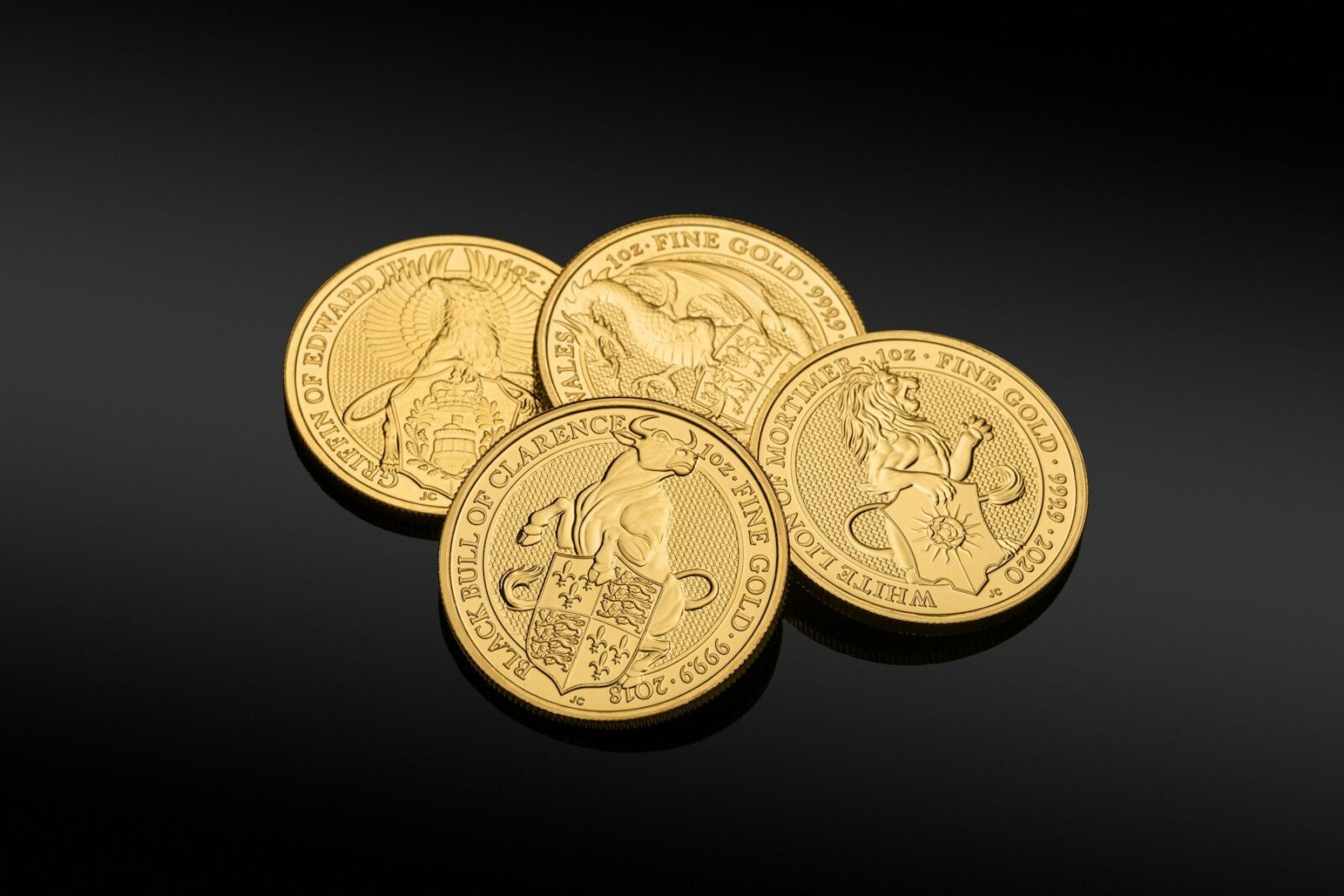
A gold sovereign bought by a UK individual is free of capital gains tax (CGT) when sold, because HMRC treats Sovereigns minted from 1837 onwards, and Britannia gold coins, as sterling currency. It is also free of VAT as investment gold. The cost that decides whether you make money is what you pay above the value of the gold inside the coin, and the price a dealer will pay to buy it back.
Why Sovereigns and Britannias are exempt from CGT
The rule sits in HMRC’s Capital Gains Manual at CG78305. It says coins count as currency only if they are legal tender when you acquire or dispose of them. It then states that Sovereigns minted in 1837 and later years and Britannia gold coins are currency and, like all sterling currency, are exempt under section 21(1)(b) of the Taxation of Chargeable Gains Act 1992. A gain on a gold sovereign is therefore not a chargeable gain, however large, and it does not use any of the £3,000 annual exempt amount.
The exemption applies to individuals and others within capital gains tax. Companies are outside these instructions and fall under the corporate foreign exchange rules instead (CG78300).
Three limits matter. First, coins that are legal tender but not sterling, such as South African Krugerrands, are chargeable assets, and the chattels exemption does not apply to them. Second, Sovereigns minted before 1837 are not currency under HMRC’s reading: they are chattels, exempt only if the disposal proceeds do not exceed the £6,000 chattels limit (CG76573), and selling several together can count as a set. Third, the exemption works both ways. A loss is allowable only if a corresponding gain would have been chargeable (CG15800), so a loss on Sovereigns cannot reduce tax on other gains.
| Coin | VAT on purchase | CGT for a UK individual |
|---|---|---|
| Sovereigns minted 1837 or later (including halves, quarters, doubles and five-sovereign pieces) | Exempt: on HMRC’s list of investment gold coins | Exempt: sterling currency |
| Britannia gold coins | Exempt where they meet the investment gold coin tests | Exempt: sterling currency |
| Sovereigns minted before 1837 | Exempt if they meet the coin tests, or share the denomination, size and fineness of a listed coin | A chattel: no gain if sold for £6,000 or less; chargeable above that |
| Krugerrands and other non-sterling legal tender | Exempt where they meet the tests or are listed | Chargeable, with no chattels exemption |
| Gold bars and wafers (995 purity or more) | Exempt | Chargeable, unless a single bar sells for £6,000 or less |
Sources: HMRC Capital Gains Manual CG78305 and CG76573; VAT Notices 701/21 and 701/21A.
VAT: which coins qualify
HMRC’s VAT Notice 701/21A, updated on 3 July 2026, says an investment gold coin is either a gold coin minted after 1800 that is at least 900 thousandths pure, is or has been legal tender in its country of origin and normally sells for no more than 180% of the open market value of its gold, or a coin on HMRC’s list. The UK entries on the list include the quarter, half, one, two and five sovereign coins. Coins outside both routes are standard-rated. Bars and wafers of at least 995 thousandths purity are also exempt under VAT Notice 701/21.
The price test applies to a coin type’s normal selling price, judged in the condition in which that type most often trades. A proof or limited edition that usually sells for more than 180% of its gold value can therefore be standard-rated even though it is made of gold, unless it is on the list. Collectors’ pricing and investors’ pricing are different markets.
Premium and spread: what you pay over the metal price
Two numbers decide the real cost of owning sovereigns, and they are often confused.
- Melt value: the weight of fine gold in the coin multiplied by the current gold price in sterling. The issuer and dealers state the gold content.
- Premium: the dealer’s selling price minus the melt value, usually expressed as a percentage of melt value. It covers minting, distribution, the dealer’s margin and demand for that coin.
- Spread: the dealer’s selling price minus the price the same dealer will pay you for the same coin on the same day. This is your round-trip cost, and the gold price has to rise by at least this much before you break even.
The CGT exemption removes tax from a gain; it does nothing about the spread. A coin with a low premium but a weak buy-back price can cost more over a round trip than one with a higher premium and a strong buy-back. Compare both, on the same day, from the same dealer.
How to compare buy and sell prices
- Note the gold price in sterling at the time you are comparing. For context, the gold price ended September 2026 at £3,149 an ounce, according to the World Gold Council; prices move through the day.
- Work out the melt value of the coin from its stated fine gold content.
- Take the dealer’s all-in selling price, including delivery, insurance and any card or payment charges.
- Ask the same dealer for its buy-back price for the same coin and condition, and the terms: who pays postage, how quickly it pays, and whether it marks down coins that are scratched or in damaged packaging.
- Calculate premium and spread as percentages and compare across dealers. Some dealers price single coins and larger quantities differently, so compare like with like.
Ignore claims that a particular year or design will rise faster. That is collector pricing, and a collector premium is exactly what can push a coin outside the VAT exemption.
Storage and insurance
Physical coins have to be kept somewhere. At home, check whether your contents insurance covers bullion and coins, the single-item limit, and whether you must declare them. A bank or private safe deposit box carries a rental fee and its own insurance terms. Some dealers offer storage, which brings back counterparty risk: you then depend on the dealer’s custody arrangements, so ask whether coins are held in your name and audited. Keep purchase invoices: they prove the coins are yours and support the CGT position if HMRC ever asks.
Scams and protection
Buying coins is not a regulated activity. The FCA lists gold and precious metals among products it does not regulate and says investors in them won’t be protected if something goes wrong, which normally means no Financial Ombudsman Service complaint and no compensation scheme claim against a failed dealer. The World Gold Council’s consumer guide lists verifying that a product is genuine and that the seller is legitimate among its five steps for buying gold safely.
Warning signs include cold calls, pressure to buy before a deadline, offers to store coins you never see, and promises to buy coins back at a fixed profit. Cold calls about pensions have been illegal since 9 January 2019 unless narrow exceptions apply, so an unsolicited call about moving pension money into sovereigns is a red flag. Our guide to spotting an investment scam lists the checks.
Where sovereigns fit
Sovereigns are one of several ways to own gold, and the CGT exemption is their main advantage over bars and listed products held outside a wrapper. Bars can sit in some pensions, and exchange-traded commodities can sit in an ISA, which shelters gains in a different way. Our cornerstone guide to how to invest in gold compares all the routes, and our guide to tax-efficient investing explains how wrappers interact. For another asset where the CGT position drives demand, see our explainer on low-coupon gilts.
UK demand for physical gold has cooled recently: the World Gold Council recorded UK bar and coin demand of 3.0 tonnes in the second quarter of 2026, down 50% on the previous quarter. Past performance is not a guide to future returns.