
UK investors usually buy an S&P 500 index fund in one of two forms: a UK-domiciled tracker fund bought through a platform, or a UCITS exchange traded fund, often domiciled in Ireland, bought on the London Stock Exchange. US-domiciled ETFs are generally not available to UK retail investors, because no US fund is a recognised scheme in the UK, according to the Financial Conduct Authority (FCA). The index is concentrated: research published by S&P Dow Jones Indices in April 2026 found that its 10 largest companies represented almost 40% of the index by mid-2025 (S&P DJI).
You also take on currency risk, because the index is priced in US dollars, and the tax position depends on where the fund is domiciled and which account holds it.
What the S&P 500 is
The S&P 500 is a share index run by S&P Dow Jones Indices. Its index page describes it as a gauge of large-cap US equities that includes 500 leading companies and covers approximately 80% of available market capitalisation (S&P DJI). It measures the shares of US-listed, US-domiciled companies only, so it is a single-country index.
Membership is decided by rules and a committee, not purely by size. The S&P U.S. Indices methodology, dated July 2026, says a company must be US-domiciled and, for the S&P 500, have a total market capitalisation of US$22.7bn or more. It must also have enough shares freely available to trade and positive GAAP net income in the most recent quarter and over the most recent four quarters combined (S&P DJI methodology).
The methodology states that “An Index Committee maintains the indices” and that the committee meets monthly. Constituents are weighted by float-adjusted market capitalisation, the value of the shares available to public investors, and changes to composition are made “on an as-needed basis” (S&P DJI methodology). An S&P 500 index fund aims to match the index’s return, before costs.
How concentrated an S&P 500 index fund is
Because the index is weighted by company size, the largest companies dominate. S&P Dow Jones Indices’ research paper In the Shadows of Giants, published in April 2026, says the 10 largest companies in the S&P 500 represented almost 40% of the index by mid-2025, a level of concentration it says had not been seen since the mid-1960s (S&P DJI research).
S&P DJI’s index brochure lists the five largest constituents at 30 June 2025 as Nvidia, Microsoft, Apple, Amazon.com and Meta Platforms (S&P DJI brochure). We name them because they are the index’s largest holdings, not as a view on any of them. The order changes as share prices move, and a fund’s latest fact sheet shows its current top holdings and their weights.
So an S&P 500 index fund is diversified across hundreds of companies, but its return depends heavily on a handful. If the largest companies fall together, the fund falls with them. That is a feature of market-capitalisation weighting, not a fault of any particular fund. Equal-weight versions of the index exist, but they are different benchmarks with different holdings and costs.
| S&P 500: selected figures | Figure |
|---|---|
| Companies included (index description) | 500 leading US companies |
| Share of available US market capitalisation covered | About 80% |
| Weight of the 10 largest companies, mid-2025 | Almost 40% |
| Minimum company market capitalisation for addition (methodology, July 2026) | US$22.7bn |
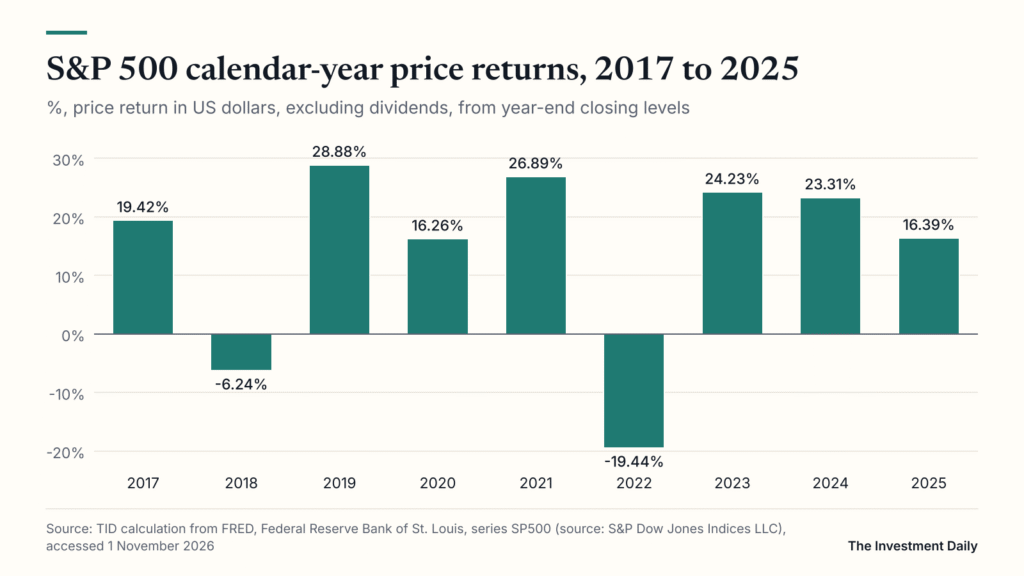
| Annualised price return, end of 2016 to end of 2025 | 13.2% (in US dollars) |
| Best and worst calendar years, 2017 to 2025 | +28.88% (2019) and -19.44% (2022) |
| Price change in 2026 to 28 October | +13.1% |
Sources: S&P DJI index page; S&P DJI research, April 2026; S&P DJI methodology; return figures are TID calculations from daily closing levels published by the Federal Reserve Bank of St. Louis, which sources the series from S&P Dow Jones Indices (FRED, series SP500).
Returns are price returns in US dollars, excluding dividends, and are not the return a UK investor received in sterling. Past performance is not a guide to future returns.
Ways to buy an S&P 500 index fund in the UK
There are three structures, and only the first two are normally open to UK retail investors.
| Feature | UK tracker fund (OEIC or unit trust) | UCITS ETF (often Irish-domiciled) | US-domiciled ETF |
|---|---|---|---|
| How you buy | From the fund manager via a platform, at a daily price | On a stock exchange during trading hours | On a US exchange |
| Available to UK retail investors | Yes | Yes, if recognised for UK marketing | Generally no: no US fund is a recognised scheme |
| Stamp duty or SDRT on purchase | None when bought from the manager | ETF transfers exempt under 2014 regulations | Not applicable |
| UK tax status to check | UK authorised fund | UK reporting fund status | Reporting fund status |
| Share classes | Accumulation or income; sometimes hedged | Accumulating or distributing; sometimes hedged | Usually distributing |
Sources: FCA PS25/20; Stamp Duty and SDRT (Exchange Traded Funds) (Exemption) Regulations 2014; HMRC HS265.
UCITS ETF recognition
Many S&P 500 ETF products sold in the UK are UCITS ETFs domiciled in the European Economic Area, such as Ireland. After Brexit they were marketed under a temporary regime.
The FCA’s roadmap for the Overseas Funds Regime, published in May 2024, says the Government found EEA states equivalent for UCITS funds in January 2024. It set the final landing slot for funds in the temporary regime to close in September 2026, with the temporary regime due to cease for non-money market schemes in December 2026 (FCA). A fund that misses its slot cannot be promoted to UK retail investors until it is recognised.
If you already hold a UCITS ETF whose status changes, check with your platform what it means for further purchases.
Why US-domiciled ETFs are hard to buy
For years, UK platforms have generally not offered US-domiciled ETFs to retail clients. In its December 2025 policy statement on consumer composite investments, the FCA addressed this directly: “Our rules do not create a barrier for retail consumers to access US ETFs.” It explained that “An overseas fund can only be marketed to UK retail investors if it is a ‘recognised scheme'”, and that “There are currently no US funds that are recognised schemes in the UK” (FCA).
The FCA described entering the UK retail market as “a commercial one for those firms”. In practice, a UK private investor who wants an S&P 500 ETF will normally be offered a UCITS ETF listed in London, often with a sterling-traded line. Under the new regime, product summaries can be used from 6 April 2026 and the rules apply in full from 8 June 2027 (FCA).
Currency risk in an S&P 500 index fund
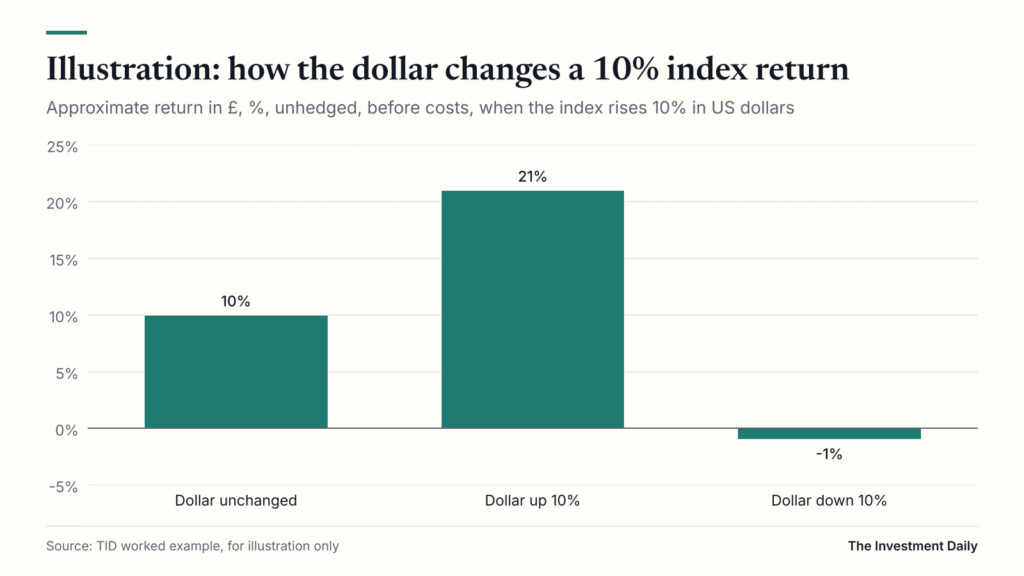
The companies in the index are valued in US dollars. A sterling-priced fund or ETF converts that value into pounds every day, so your return depends on both the index and the exchange rate. Currency risk works both ways: a stronger dollar adds to returns in sterling, a weaker dollar takes away from them.
| Illustration | Index return in US$ | Change in the dollar against sterling | Approximate return in £ (unhedged) |
|---|---|---|---|
| Dollar unchanged | +10% | 0% | +10.0% |
| Dollar strengthens | +10% | +10% | +21.0% |
| Dollar weakens | +10% | -10% | -1.0% |
| Index falls, dollar weakens | -10% | -10% | -19.0% |
The returns multiply rather than add: 1.10 multiplied by 0.90 is 0.99, a 1% loss. These figures are for illustration only and do not include costs.
Hedged share class options
Some funds offer a hedged share class, usually labelled “GBP Hedged”. The manager uses currency forwards to offset most of the movement between the dollar and the pound, so the return is closer to the index return in dollars. A hedged share class still has costs and imperfections.
- Hedging usually adds a small extra charge and transaction costs.
- The hedge also transfers the gap between US and UK short-term interest rates, which can add to or subtract from returns.
- Hedging is reset periodically, so it does not offset every move exactly.
- If the dollar strengthens while US shares fall, an unhedged holding loses less in sterling; a hedged share class gives up that possible offset as well as the possible loss.
Whether currency risk is acceptable depends on what the money is for, and on how much of the rest of your portfolio is already in dollars. Some investors with spending in sterling hedge; others regard the dollar exposure as part of diversification.

Costs of an S&P 500 index fund
Index trackers are usually among the cheaper funds, but costs differ between providers and share classes, and they compound over time. The main items to compare are:
- Ongoing charges figure. The fund’s annual running cost, the headline cost under the FCA’s new rules (FCA).
- Transaction costs. The cost of buying and selling shares inside the fund, disclosed separately.
- Tracking difference. The gap between the fund’s return and the index, which captures costs, withholding tax and how well the fund replicates the index.
- Platform and dealing fees. Your platform’s annual charge, and any commission for buying an S&P 500 ETF on the exchange.
- Spread. The gap between the buying and selling price of an ETF, which varies with the fund’s size, trading volume and the time of day.
Tracking difference in practice
Tracking difference is the most complete measure of cost because it shows what you actually lost against the index. For illustration only: if the index returned 10.00% in a year including dividends net of withholding tax and a fund returned 9.88%, the tracking difference is 0.12 percentage points. Funds publish this comparison in their annual reports and on fact sheets. Compare it over several years, because one year can be distorted by timing.
A UCITS ETF and a UK tracker fund following the same index can show different tracking differences because of their charges, how they hold the shares, whether they lend securities and how they treat withholding tax. Compare like with like: the same index, the same currency and the same share class type.
For more on comparing trackers, see index funds for UK investors and funds or ETFs: the differences that matter.
Withholding tax at fund level
US companies pay dividends net of US tax when the shareholder is not a US person. The IRS says the rate on US-source income that is not connected with a US business “is usually 30%”, reduced where a tax treaty applies (IRS). The IRS treaty table shows a 15% rate on general dividends for both the United Kingdom and Ireland (IRS), and HMRC’s treaty summary lists 15% for portfolio dividends under the UK and US convention (HMRC).
When you own an S&P 500 index fund, this withholding tax happens inside the fund. A fund that qualifies for treaty relief suffers 15% instead of 30%, and the lost tax reduces the fund’s return. For illustration only, with an assumed dividend yield of 1.2%, 15% withholding tax costs about 0.18% of the fund’s value a year. It is not shown in the ongoing charges, but it appears in the tracking difference.
You cannot reclaim fund-level withholding tax yourself, and it is not refunded when the fund sits in an ISA or pension. If you held US shares directly, a broker would normally ask for a Form W-8BEN, which the IRS says is given “to the withholding agent or payer if you are a foreign person” (IRS). That form is not needed for a UK or Irish fund, which deals with US tax itself.
Holding an S&P 500 index fund in an ISA or SIPP
A stocks and shares ISA can hold “unit trusts and investment funds”, and you do not pay UK tax on income or capital gains from investments in an ISA (GOV.UK). The adult ISA subscription limit is £20,000 for 2026 to 2027 and 2027 to 2028, and the pension annual allowance is £60,000, according to the Budget 2026 rates annex (HMRC and HMRC). Both wrappers are widely used for S&P 500 funds and ETFs.
Tax outside a wrapper
In a general investment account, dividends from an S&P 500 index fund are taxed as dividends: a £500 allowance, then 10.75%, 35.75% or 39.35% (GOV.UK; Annex A). Gains above the £3,000 annual exempt amount are taxed at 18% or 24%. These rates were unchanged by Budget 2026 for 2027 to 2028.
Offshore ETFs add a step. HMRC’s helpsheet HS265 explains that a reporting fund reports its income each year, and you are taxed on your share even if it is not paid out; the fund distribution date is “6 months after the last day of the reporting period” (HMRC). For an accumulating S&P 500 ETF, that excess reportable income is taxable as a dividend in each year. If the fund is not a reporting fund, HS265 says gains are normally taxed as income, as an offshore income gain, rather than as capital gains.
- Check that an offshore S&P 500 ETF has UK reporting fund status before buying it outside a wrapper.
- Keep the annual reports of income for accumulating ETFs; they are needed for your tax return and to adjust your base cost.
- See tax-efficient investing in the UK for the order of wrappers.
Step by step: buying an S&P 500 index fund
The mechanics are the same as for any fund or ETF on a UK platform. The order below follows the decisions in this guide.
- Pick the account. A stocks and shares ISA, a self-invested personal pension or a general investment account. The wrapper decides how dividends and gains are taxed.
- Search by index. Platforms list several S&P 500 products. Check that the fund’s stated benchmark is the S&P 500 itself, not a variant such as an equal-weight or sector version.
- Choose the structure. A UK tracker fund is bought at the next daily valuation. An S&P 500 ETF trades during market hours at a live price, with a spread.
- Choose the share class. Accumulating or distributing, and unhedged or a hedged share class. Note the ISIN.
- Read the key documents. The fact sheet, the key information document or new product summary, and for an offshore UCITS ETF its reporting fund status.
- Place the order. For an ETF, a limit order sets the most you will pay. For a fund, you enter a cash amount.
- Keep records. Contract notes and annual tax information, especially for accumulating offshore funds held outside a wrapper.
Regular monthly investing is offered by many platforms for funds and some ETFs. It spreads purchases over time, which reduces the effect of buying everything at one price, but it does not prevent losses.
Risks of an S&P 500 index fund
An S&P 500 index fund owns a broad slice of the US stock market, and it carries the risks of that market. You may get back less than you invest.
- Market risk. On a price basis the index fell 19.44% in 2022 and 6.24% in 2018, on year-end closing levels published by FRED (FRED). Falls within a year can be larger than the calendar-year figures show.
- Concentration risk. The top 10 constituents were 37.6% of the index at 31 July 2026.
- Single-country risk. All constituents are US-domiciled, so the fund depends on one economy, one currency and one set of policies.
- Currency risk. Sterling returns can differ sharply from dollar returns, unless you hold a hedged share class.
- Valuation risk. Strong past returns can leave prices high relative to earnings, which may lower future returns.
- Tracking risk. The fund may lag the index because of costs and withholding tax.
The Financial Services Compensation Scheme can protect up to £85,000 per eligible person, per firm, if an authorised firm fails, but it states: “We can’t accept any claims that are for poor investment performance” (FSCS). For a broader alternative, see global funds and trackers.
Checklist before you buy an S&P 500 index fund
An S&P 500 index fund gives low-cost access to the largest US companies, with heavy weight in a few of them, returns that depend on the dollar and tax that differs by structure. The checks are practical.
- Choose the structure: UK tracker fund or UCITS ETF, and confirm the product is available for UK retail investors.
- Decide whether to accept currency risk or use a hedged share class, and choose between accumulating and distributing.
- Compare the ongoing charges figure, transaction costs and tracking difference over several years.
- Check reporting fund status for any offshore ETF held outside an ISA or pension.
- Add platform fees, dealing commission and the spread.
- Consider how much of your overall portfolio is already in US shares, including through global funds.
Past performance is not a guide to future returns. The S&P 500’s double-digit price gains in seven of the nine years from 2017 to 2025 sit alongside losing years in 2018 and 2022. For more on ETFs generally, see what is an ETF.