
The difference in accumulation vs income funds is what happens to the dividends and interest the fund receives. Income units pay that money out to you in cash; accumulation units keep it inside the fund, which raises the price of each unit instead. Both are usually share classes of the same fund with the same portfolio and charges. Outside an ISA or pension, the tax is the same either way: HMRC says amounts reinvested “are taxed as income accruing to investors in the same way as if they had been distributed” (HMRC).
Accumulation vs income funds: the basic difference
A fund collects dividends from the shares it owns and interest from the bonds and cash it holds. After paying its charges, it has a pool of net income to hand on to investors on set dates, typically quarterly, half-yearly or yearly. What happens next depends on the share class you hold.
- Income units (often labelled “Inc” or “Dist”) pay the net income to you in cash on each distribution date. The unit price drops when the fund goes ex-distribution, because the income leaves the fund.
- Accumulation units (labelled “Acc”) keep the income in the fund. It is reinvested in the portfolio, the number of units you own stays the same and the price per unit reflects the extra assets.
So the choice in accumulation vs income funds is mostly a choice about cash flow, not about the investments. The underlying investments, the manager and the ongoing charges are normally identical across the two share classes. The prices differ because one class has kept years of income and the other has paid it out.
| Feature | Inc share class | Acc share class |
|---|---|---|
| What happens to dividends and interest | Paid to you in cash | Reinvested inside the fund |
| Number of units you hold | Unchanged unless you reinvest | Unchanged; the unit price rises instead |
| Typical label | Inc, Dist | Acc |
| Taxable outside an ISA or pension | Yes, as distributed | Yes, as a notional distribution |
| Effect on capital gains cost | None | Reinvested income added to cost where taxed |
| Often used for | Drawing an income | Building a pot over time |
Some platforms offer a third route: hold income units and ask the platform to reinvest each payment by buying more units. That compounds in a similar way but can involve small dealing costs and leaves uninvested cash between payments. Exchange traded funds use the same split, described as distributing or accumulating; see what is an ETF.
How reinvestment compounds in accumulation vs income funds
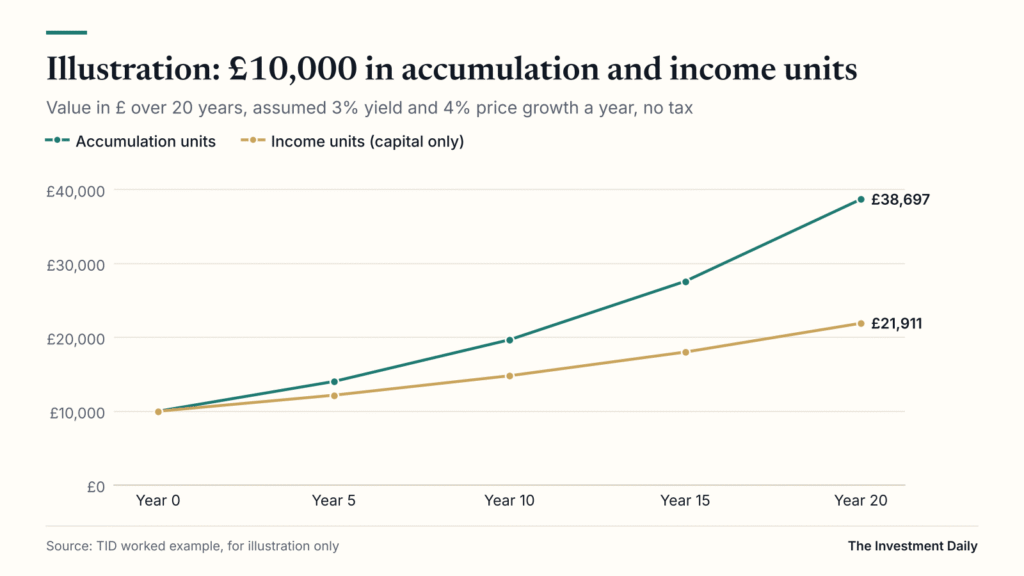
An Acc share class does automatically what an income investor would have to do by hand: put the income back to work. Over long periods that makes a large difference, because reinvested income earns its own returns. The table below is an illustration only, assuming a fund that yields 3% a year and whose holdings rise in price by 4% a year, with no tax and charges already deducted.
| Year (illustration) | Inc: capital value | Inc: income paid out to date | Acc: value |
|---|---|---|---|
| 0 | £10,000 | £0 | £10,000 |
| 5 | £12,167 | £1,625 | £14,026 |
| 10 | £14,802 | £3,602 | £19,672 |
| 20 | £21,911 | £8,933 | £38,697 |
After 20 years the income investor has capital of about £21,911 and has received about £8,933 in cash, a total of £30,844 if none of it was spent. The accumulation investor has about £38,697, because each year’s income was reinvested at the same 7% total return. Real funds do not deliver a steady return, and the price can fall as well as rise. Past performance is not a guide to future returns.
Tax on accumulation vs income funds outside an ISA
Inside a stocks and shares ISA or a pension, the comparison of accumulation vs income funds has no tax angle. GOV.UK says you do not pay tax on income or capital gains from investments in an ISA, and the adult subscription limit is £20,000 for 2026 to 2027 and 2027 to 2028 (GOV.UK; Budget 2026, Annex A). Outside a wrapper, both share classes are taxed on the income each year, so the choice of accumulation vs income funds becomes a question of paperwork as much as cash.
The key point is that accumulation units do not defer tax. HMRC’s Investment Funds Manual states that “Amounts reinvested are taxed as income accruing to investors in the same way as if they had been distributed” (HMRC). The reinvested amount is a notional distribution. You must include it on your tax return even though no cash reached your account.
Dividend distributions
Most share funds pay dividend distributions, taxed like dividends from shares. The Budget 2026 rates annex shows a dividend allowance of £500 and dividend rates of 10.75%, 35.75% and 39.35% for basic, higher and additional rate taxpayers in both 2026 to 2027 and 2027 to 2028 (Annex A; GOV.UK).
For illustration only: you hold £40,000 in the Acc class of an equity fund yielding 3%, and have no other dividends. The notional distribution is £1,200. After the £500 allowance, £700 is taxable: about £75.25 for a basic rate taxpayer, £250.25 at the higher rate and £275.45 at the additional rate. The figures are the same for income units; the only difference is that the Inc class paid you £1,200 in cash to cover it.
Interest distributions from bond funds
A fund that holds mainly bonds and cash can pay interest distributions instead. HMRC explains that a fund may show its income as yearly interest if it meets the qualifying investments test, which requires the market value of its qualifying investments to exceed 60% of all its investments throughout the distribution period (HMRC). “In the hands of investors the distribution is treated in the same way as interest received by them” (HMRC).
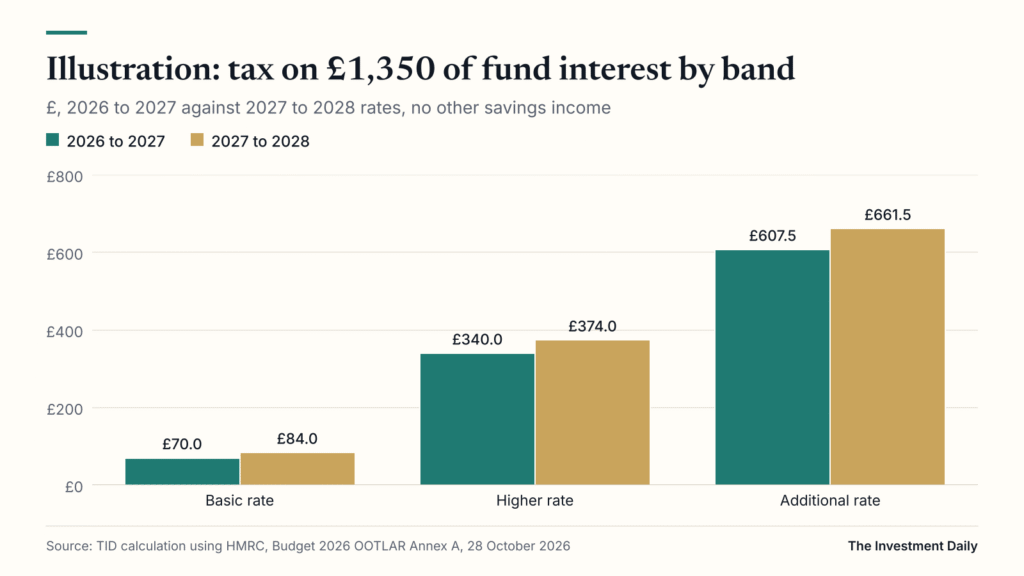
That means the Personal Savings Allowance applies, not the dividend allowance. Budget 2026 changed the rates here. Savings income is taxed at 20%, 40% and 45% in 2026 to 2027, rising to 24%, 44% and 49% from 6 April 2027; the allowance stays at £1,000 for basic rate and £500 for higher rate taxpayers (Annex A; OOTLAR item 1.1). It applies to interest distributions on both sides of the accumulation vs income funds choice.
| Illustration: £1,350 of bond fund interest, no other savings income | Tax 2026 to 2027 | Tax 2027 to 2028 |
|---|---|---|
| Basic rate (£1,000 allowance) | £70.00 | £84.00 |
| Higher rate (£500 allowance) | £340.00 | £374.00 |
| Additional rate (no allowance) | £607.50 | £661.50 |
The figures assume £30,000 in a bond fund yielding 4.5%, for illustration only. Rates are from the Budget 2026 rates annex (Annex A). GOV.UK confirms that additional rate taxpayers have a Personal Savings Allowance of £0, and the starting rate for savings is ignored here because it is only available when other taxable income is below £17,570 (GOV.UK).
Capital gains: why the cost of Acc units rises
Because you are taxed on reinvested income each year, it would be unfair to tax it again as a capital gain when you sell. HMRC’s Capital Gains Manual deals with this: “The notional distribution is treated as allowable expenditure where it is subject to Income Tax” (HMRC). In practice, each notional distribution is added to your base cost.
For illustration only: you buy accumulation units for £20,000 and over five years notional distributions of £3,000 are taxed as income. You sell for £30,000. The cost for capital gains tax is £23,000, not £20,000, so the gain is £7,000. Without the adjustment you would declare a £10,000 gain and pay tax twice on £3,000.
The annual exempt amount is £3,000 and gains above it are taxed at 18% or 24%, depending on your income, in both 2026 to 2027 and 2027 to 2028 (Annex A). Keep the annual tax vouchers that funds and platforms issue; they show the amount of each distribution and are the evidence for your base cost. Losing track of years of reinvested income can lead you to overstate the gain.
Equalisation: the first payment after you buy
One detail applies equally to both sides of the accumulation vs income funds choice. Equalisation is a mechanism that features in many authorised funds. HMRC explains that its purpose is to ensure that the rights of existing investors to share in the fund’s income “is not affected by the issue of further units or the redemption of existing units” (HMRC). It affects your first distribution after buying.
When you buy partway through a distribution period, the price includes income the fund has already earned in that period. At the first distribution, part of what you receive is a refund of that element. HMRC’s Capital Gains Manual says “This payment is not income” and treats it as a return of the initial price paid, to be deducted from the cost of the units (HMRC).
- For illustration only, you buy 1,000 Inc units halfway through a six-month period.
- At the next distribution you receive 3p per unit, £30, of which the tax voucher shows 1.5p per unit, £15, as equalisation.
- You declare £15 as income. The other £15 is a return of capital and reduces your base cost by £15.
- For an Acc class, the same split appears on the voucher, although no cash moves.
Equalisation applies only to the first distribution after purchase. From then on, the full amount is income.

Offshore funds, ETFs and excess reportable income
The same questions about accumulation vs income funds arise with ETFs. Many exchange traded funds and some funds sold in the UK are domiciled abroad, often in Ireland or Luxembourg. For UK tax, the important question is whether the fund has reporting fund status with HMRC. HMRC’s helpsheet HS265, updated 6 April 2026, describes a reporting fund as one that has applied to HMRC, been approved and maintains that status (HMRC).
A reporting fund must report its income to investors each year. If the income reported is more than the fund actually paid out, the difference is excess reportable income, and you are taxed on it even though you received nothing. This is the offshore equivalent of a notional distribution, and it matters most for accumulating ETFs, where almost all the income is excess reportable income.
When excess reportable income is taxed
HS265 says “The fund distribution date for a reporting fund is 6 months after the last day of the reporting period” (HMRC). The helpsheet says the excess is “treated as being received on the ‘fund distribution date'” (HMRC). HMRC’s own term is excess reported income; fund reports often label the same figure excess reportable income. For illustration, a fund with a reporting period ending on 30 June 2026 has a fund distribution date of 31 December 2026, which falls in the 2026 to 2027 tax year.
The character of excess reportable income depends on the fund. HS265 explains that a company fund with more than 60% of its investments in interest-bearing assets is treated as a bond fund and its income is reported as interest; other company funds report dividends (HMRC). Excess reportable income arising while you own the fund can be deducted when calculating your capital gain, so you are not taxed twice.
Non-reporting funds
If an offshore fund is not a reporting fund, the rules are harsher. HS265 says gains on disposal normally count as an offshore income gain, taxed as income rather than as a capital gain, unless an exception applies (HMRC). That removes the £3,000 annual exempt amount and the lower capital gains rates. Your fund manager can confirm status, and GOV.UK publishes a list of reporting funds.
Accumulation vs income funds when you need withdrawals
Once you start drawing money, the case for each share class looks different. Income units deliver cash on fixed dates without any selling. The amount varies with the fund’s income, and the fund may pay quarterly, half-yearly or yearly, so the cash does not arrive evenly.
With accumulation units, you create an income by selling units. That gives you control over the amount and timing, but each sale is a disposal for capital gains tax outside an ISA, and selling after a market fall means selling more units for the same cash. Some investors hold an Inc class for the natural income and an Acc class for growth, or switch share class at retirement.
A worked example of drawing an income
For illustration only, take £100,000 in a fund yielding 3%, held outside an ISA by a basic rate taxpayer with no other dividends. In the Inc class, about £3,000 a year arrives as dividends; after the £500 allowance, £2,500 is taxed at 10.75%, about £268.75. No units are sold, so there is no disposal.
In the Acc class, the same £3,000 is reinvested and taxed in exactly the same way, as a notional distribution. To draw £3,000 in cash the investor also sells units worth £3,000. Part of that sale is gain; if the units had cost £80,000 and are now worth £100,000, about 20% of each sale, £600, is gain, well within the £3,000 annual exempt amount (Annex A). Larger or repeated sales can use up the exemption.
Comparing accumulation vs income funds in this way shows that the tax on income is identical; the difference lies in the extra disposals and the record-keeping that selling units brings.
- Check whether switching between share classes of the same fund is treated as a disposal by your platform and in the fund documents.
- Check the payment dates and frequency on the fund’s fact sheet.
- Remember that a high yield can come with lower growth or with dividends paid from capital.
For income-focused investing more generally, see dividend investing after the 2026 dividend tax rise.
How to identify the share class on a fact sheet
Every share class has its own name, price and ISIN, the 12-character code that identifies it. When comparing accumulation vs income funds on a platform, check that you are looking at the right class, because search results often show several versions of the same fund side by side.
- Read the full name. Look for “Acc” or “Accumulation”, or “Inc”, “Income” or “Dist”.
- Note the ISIN and check it against the fact sheet or the key information document.
- Look at the distribution type (dividend or interest) and the distribution dates.
- Check the ongoing charges figure. It is usually the same across Acc and Inc versions of the same class, but retail, clean and institutional classes differ.
- For an offshore fund or ETF, check whether it is a UK reporting fund.
The documents themselves are changing. The FCA’s consumer composite investments regime, set out in policy statement PS25/20, replaces the PRIIPs disclosure rules with a product summary that firms could start using from 6 April 2026; the rules apply in full from 8 June 2027 (FCA). The share class details should appear in either format. For what else to check, see index funds for UK investors.
Common mistakes with accumulation vs income funds
Most errors with accumulation vs income funds come from the tax treatment and the paperwork, not the investment itself.
- Assuming accumulation units defer tax. They do not. The notional distribution is taxable each year outside a wrapper.
- Forgetting the base cost uplift. Not adding taxed notional distributions to cost overstates the gain on sale.
- Missing excess reportable income. Accumulating ETFs domiciled abroad can create taxable income with no cash paid.
- Treating interest distributions as dividends. Bond funds that pass the 60% test pay interest, taxed under the savings rules that change on 6 April 2027.
- Mixing up share classes. Buying the wrong ISIN can leave you with income you did not want, or no income when you need it.
Accumulation vs income funds: the main points
The choice in accumulation vs income funds is about where the income goes: into your account or back into the fund. The portfolio and charges are usually the same. Accumulation units compound automatically and are generally used by investors who do not need the cash; income units pay out and are generally used by investors who want regular money without selling units.
Tax is the same either way. Outside an ISA or pension, notional distributions on accumulation units are taxed as if paid, interest distributions from bond funds fall under the savings rates that rise to 24%, 44% and 49% from 6 April 2027, and offshore reporting funds can create excess reportable income. Keep your tax vouchers, add taxed notional distributions to your base cost and check reporting fund status. For more on wrappers, see tax-efficient investing in the UK and the index funds and ETFs desk.