
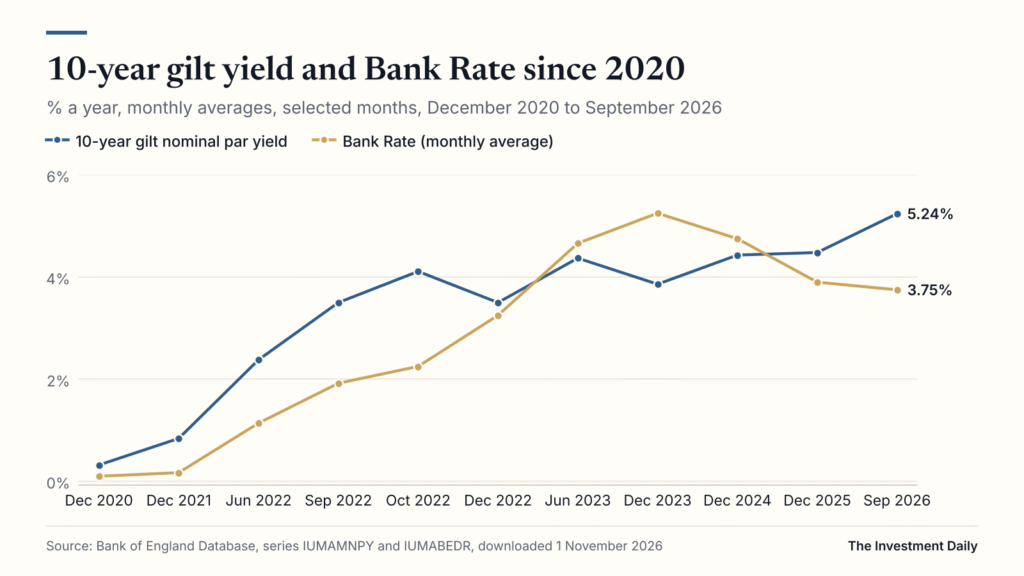
Bond funds pool investors’ money into a portfolio of gilts, corporate bonds or other debt. Unlike individual bonds, most never mature, so their value moves with interest rates and credit conditions and there is no date on which a set amount is repaid. In 2022 the 10-year gilt yield rose from an average of 0.84% in December 2021 to 3.50% a year later, Bank of England data show, and gilt prices fell sharply. Outside an ISA or pension, interest distributions from a fund more than 60% invested in interest-type assets are taxed as savings income, at 24%, 44% or 49% from 6 April 2027 after Budget 2026.
What bond funds are
A bond fund is a collective investment, usually an open-ended investment company or unit trust, or an exchange-traded fund, that holds many bonds at once. The manager buys and sells bonds to meet the fund’s objective, which may be to track an index or to beat one. Investors own units or shares in the fund, not the bonds themselves.
That structure brings three practical differences from owning individual bonds directly. You can invest small amounts and spread them across many issuers. You can usually buy or sell on any dealing day at the fund’s price. And you pay ongoing charges for management, administration and dealing inside the fund, which reduce the return.
Bond ETFs work the same way but trade on a stock exchange during market hours, at a price set by the market that is usually close to the value of the holdings. Some are domiciled outside the UK, which can change how their income is taxed. For the general differences, see funds or ETFs.
Bond funds against individual bonds: the maturity question
The biggest difference is maturity. A conventional gilt pays a fixed coupon and repays £100 per £100 nominal on a set date. Bought and held to that date, the cash outcome is known at the start, provided the issuer pays, whatever prices do in between. Our guide to how to buy gilts explains the mechanics.
Most funds have no such date. As bonds in the portfolio approach maturity, the manager sells them or lets them mature and buys new ones, keeping the fund’s profile roughly constant. So a fund’s average maturity stays much the same year after year, and its price at any future date depends on market yields at that time. There is no point at which the fund is designed to return a fixed sum.
| Feature | Individual gilt or corporate bond | Bond fund or ETF |
|---|---|---|
| Maturity | Fixed date; face value repaid if the issuer pays | Usually none; portfolio rolls continuously |
| Outcome if held | Known in advance, before default risk | Unknown; depends on future yields |
| Diversification | One issuer per holding | Many issuers in one holding |
| Minimum investment | Set by platform and price of one bond | Often low; set by platform |
| Ongoing charges | None for holding; platform fees may apply | Fund charges plus platform fees |
| Capital gains tax, outside a wrapper | Gilts exempt; qualifying corporate bonds exempt | Gains on units are chargeable |
Some providers offer fixed-maturity bond funds or ETFs that hold bonds maturing in a single year and then wind up, which brings them closer to individual bonds. They remain funds, with charges and the tax treatment of fund units.
Duration and interest rate risk in bond funds
Bond prices move in the opposite direction to yields. When market yields rise, existing bonds paying lower coupons become less valuable, and their prices fall until their yield matches the market. Duration measures how sensitive a bond or a fund is to that effect: as a rule of thumb, a fund with a duration of 10 years would lose about 10% of its value if yields rose by one percentage point across the board, and gain about 10% if they fell by one point.
Longer-dated bonds have higher duration, so funds that hold them carry more interest rate risk. A short-dated gilt fund and a long-dated gilt fund can both be invested entirely in UK government debt and still behave very differently when yields move. The fund factsheet usually states the duration, which tells you more about this risk than the fund’s name does.
A worked example, for illustration only, using the duration rule of thumb: a gilt fund with a duration of 8 years when the 10-year gilt yield rises by 2.66 percentage points, as the monthly average did between December 2021 and December 2022, would fall by roughly 21% in price before income. Real funds differ because yields at different maturities moved by different amounts and duration itself changes as yields move.
Yields now
The 10-year gilt yield, measured as the nominal par yield, averaged 5.24% in September 2026, against 0.32% in December 2020, according to the Bank of England Database (series IUMAMNPY). Bank Rate averaged 3.75% in September 2026. Higher starting yields mean more income, but they do not protect a fund from further price falls if yields rise again.
Case study: the 2022 gilt sell-off
2022 showed what interest rate risk means in practice. Bank Rate rose from a monthly average of 0.17% in December 2021 to 3.25% in December 2022 as the Bank of England responded to inflation, and gilt yields rose with it (Bank of England Database). Then, in late September 2022, long-dated gilt yields jumped within days.
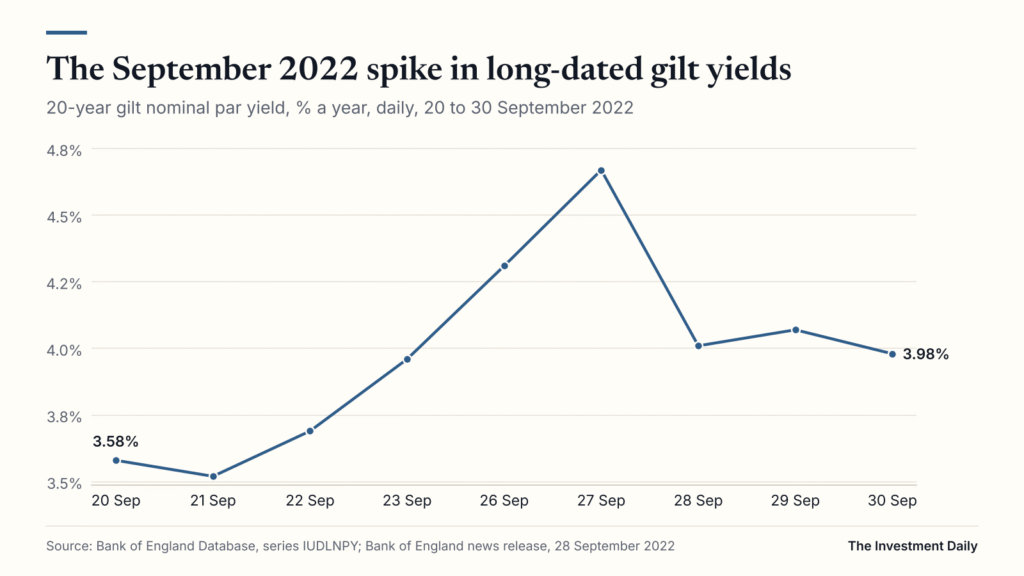
The 20-year gilt par yield was 3.69% on 22 September 2022 and 4.67% on 27 September, a rise of almost a full percentage point in three trading days, Bank of England data show (series IUDLNPY). On 28 September the Bank said the repricing was “particularly affecting long-dated UK government debt” and that continued dysfunction would pose “a material risk to UK financial stability” (Bank of England, 28 September 2022).
The Bank announced temporary purchases of long-dated gilts from 28 September, “on whatever scale is necessary”, with auctions until 14 October, fully indemnified by HM Treasury. The 20-year yield fell back to 4.01% that day. The episode hit funds holding long-dated gilts hardest, because their duration was highest.
| Date (2022) | 20-year gilt nominal par yield |
|---|---|
| 20 September | 3.58% |
| 22 September | 3.69% |
| 23 September | 3.96% |
| 26 September | 4.31% |
| 27 September | 4.67% |
| 28 September (Bank of England operation announced) | 4.01% |
| 30 September | 3.98% |
Source: Bank of England Database, series IUDLNPY, downloaded 1 November 2026.
The lesson is about time horizon and duration. An investor holding an individual gilt could still wait for its maturity date, when £100 per £100 nominal falls due. An investor in a long-dated gilt fund had no maturity date to wait for, and anyone who sold after the fall turned a paper loss into a real one.
Credit quality and the main types of bond funds
Interest rate risk is one dimension; credit risk, the chance that issuers fail to pay, is the other. A fund holding hundreds of issuers is less exposed to any single default than an investor holding a few individual bonds, but it is exposed to the credit risk of the whole market. UK government bonds are generally treated as the lowest credit risk in sterling markets. Corporate bonds pay more because investors are taking on that risk, and bonds rated below BBB minus, called high yield, pay more again.
The Investment Association classifies UK-available funds into sectors so that like can be compared with like (Investment Association, sector definitions). The main bond sectors are set out below.
| IA sector | Core rule (summary of the IA definition) |
|---|---|
| UK Gilts | At least 95% in sterling (or sterling-hedged) government-backed securities rated at least as high as the UK, with at least 80% in UK conventional gilts |
| UK Index Linked Gilts | At least 95% in sterling government-backed index-linked securities, with at least 80% in UK index-linked gilts |
| Sterling Corporate Bond | At least 80% in sterling (or sterling-hedged) corporate bonds rated BBB minus or above |
| Sterling Strategic Bond | At least 80% in sterling (or sterling-hedged) fixed interest, with the manager free to move across the credit spectrum |
| Sterling High Yield | At least 80% in sterling (or sterling-hedged) fixed interest rated below BBB minus |
| Global Government Bond | At least 80% in government-backed securities from around the world in a variety of currencies |
| Global Corporate Bond | At least 80% in BBB minus or above corporate bonds from around the world |
| Global Mixed Bond | At least 80% in bonds, with a broad mix across credit, type and currency |
| Specialist Bond | At least 80% in bonds that do not fit any other IA bond sector |
The sector tells you the core of the portfolio, not everything. The IA notes that there is no prescription for the non-core part of these definitions, and that strategic bond funds may at times look like any other fixed interest sector. The fund’s own objective, credit rating breakdown and duration give a fuller picture. Short-term money market funds sit in separate IA sectors that follow money market fund regulation; see our money market funds desk.
Bond ETFs and index-tracking bond funds
Index-tracking funds and bond ETFs aim to follow a bond index rather than beat it, usually at lower charges than actively managed funds. Bond indices are typically weighted by the amount of debt in issue. The ground rules for the FTSE Actuaries UK Gilts Index Series, for example, weight each gilt by its nominal amount outstanding (FTSE Russell, ground rules, September 2026). In a corporate bond index, that means the most heavily indebted borrowers make up the largest share. That is a feature of the method, not a judgement on credit quality, and the fund’s top holdings show it.
Bond ETFs trade on an exchange throughout the day, so the price you pay includes a dealing spread and can sit slightly above or below the value of the underlying bonds, particularly in stressed markets when the bonds themselves trade less. Open-ended funds deal once a day at a single price set from the value of the holdings. Both types can be held in a stocks and shares ISA or a SIPP, subject to what your platform offers.
Whichever structure is used, the same three questions decide how bond ETFs and funds behave: how long the bonds are, which is the duration and interest rate risk; who issued them, which is the credit risk; and in what currency they are paid. Holding individual bonds is different: the investor picks the maturity and the issuer, but carries more concentrated credit risk.
Currency and hedged share classes
Global bond funds hold bonds in dollars, euros and other currencies. If sterling rises against those currencies, the sterling value of the bonds falls, and the reverse. Exchange rate moves can be larger than the income on a high-quality bond, so currency can dominate the return of an unhedged global bond fund.
Many global bond funds therefore offer a sterling-hedged share class, which uses currency contracts to offset most exchange rate movements so that returns mainly reflect the bonds. The IA allows funds in its Global bond sectors to choose either a sterling-hedged or an unhedged primary share class, because those sectors are already diverse by bond type and currency (Investment Association). Hedging has a cost, which depends partly on the gap between interest rates in the two currencies, and the hedge is never perfect. The share class matters, because the same fund can have hedged and unhedged classes with different returns.
Yields and charges on bond funds
Fund factsheets often show more than one yield, and they measure different things.
- Distribution yield: the income the fund expects to pay over the next year as a percentage of its price. It reflects coupons received, after some charges.
- Underlying yield: income net of all fund expenses as a percentage of price, which can be lower than the distribution yield if charges are taken from capital.
- Yield to maturity or yield to worst: a portfolio average of the return if all bonds were held to maturity at today’s prices, before charges. It is the closest to the yield on an individual bond, but the fund will not actually be held to maturity.
Charges matter more here than in equity funds because expected returns are lower. A fund’s ongoing charges figure, plus any platform fee, comes straight off the yield. Where a fund takes its charges from capital rather than income, the distribution yield looks higher but the capital value is reduced, which can erode the fund over time. The fund’s key information document and prospectus set out which applies.

How bond funds are taxed
The tax on fund income depends on what the fund holds. A UK authorised fund can pay its income as an interest distribution only if the market value of its qualifying investments exceeds 60% of all its investments throughout the distribution period, according to HMRC’s Investment Funds Manual (HMRC, IFM02224). In investors’ hands, “the distribution is treated in the same way as interest received by them” (HMRC, IFM02222). Funds that fail the test pay dividend distributions instead, taxed under the dividend rules.
Since 6 April 2017, interest distributions from UK authorised funds have been paid without tax deducted (IFM02222). Outside an ISA or pension, they count as savings income and use the personal savings allowance of £1,000 for basic rate and £500 for higher rate taxpayers (OOTLAR Annex A).
Budget 2026: higher tax on interest distributions from April 2027
Interest distributions above the allowances are taxed at 20%, 40% or 45% in 2026 to 2027. Budget 2026 raised the savings rates for 2027 to 2028 to 24%, 44% and 49% across the UK, two points above the 22%, 42% and 47% set after Budget 2025 (HMRC, 29 October 2026). Dividend rates stay at 10.75%, 35.75% and 39.35%. Interest distributions are already taxed at higher rates than dividend distributions in every band, and the gap widens from April 2027.
For illustration only: a higher rate taxpayer receives £2,000 of interest distributions from funds held in a general investment account, with no other savings income. After the £500 allowance, £1,500 is taxable: £600 at 40% in 2026 to 2027, or £660 at 44% in 2027 to 2028.
Accumulation units and capital gains
Accumulation units do not avoid the tax. HMRC says reinvested amounts “are taxed as income accruing to investors in the same way as if they had been distributed” (HMRC, IFM03120). Those notional distributions are added to the cost of the units for capital gains tax, so they are not taxed twice (HMRC, HS284).
Gains on units are a separate question. HMRC’s helpsheet says units in a unit trust, and shares in an open-ended investment company, are treated as shares for capital gains tax.
So a gain on selling bond fund units is chargeable above the £3,000 annual exempt amount, at 18% or 24% (OOTLAR Annex A), even if the fund holds only gilts. A gilt held directly is different: GOV.UK lists “UK government gilts” among assets on which you do not pay capital gains tax (GOV.UK), and gains on qualifying corporate bonds held directly are also exempt under section 115 of the Taxation of Chargeable Gains Act 1992. Rules for offshore funds, including many bond ETFs, differ and are not covered here.
Inside a stocks and shares ISA or a pension, none of this applies. GOV.UK says stocks and shares ISAs can hold unit trusts and investment funds as well as government and corporate bonds, and that income and gains from investments in an ISA are not taxed (GOV.UK). The adult ISA limit is £20,000 in 2026 to 2027 and 2027 to 2028.
Bond funds: risks and what to check
These funds can lose money, and past performance is not a guide to future returns. The main risks are these.
- Interest rate risk: rising yields reduce prices, more so for funds with higher duration.
- Credit risk: defaults or downgrades reduce value, and a fund spreads but does not remove credit risk, more so in high yield and some strategic bond funds.
- Currency risk: unhedged global bond funds move with exchange rates.
- Inflation risk: fixed coupons lose purchasing power when inflation is high, unless the fund holds index-linked bonds. CPI inflation was 3.1% in August 2026, according to the Bank of England.
- No maturity: there is no date on which the fund is designed to repay a fixed amount.
- Charges: fund and platform charges come straight off a modest yield.
- Protection: a bond fund is not a bank deposit, so FSCS deposit protection does not apply. If an FCA-authorised fund manager or platform fails and there is a shortfall in the money or assets it holds for you, FSCS investment protection may pay up to £85,000 per person, per firm, but it does not cover falls in the value of the fund (FSCS).
Before buying, some investors check the fund’s IA sector and objective; its duration and how that matches their time horizon; the credit quality breakdown; whether a global fund’s share class is hedged; the ongoing charges and whether they are taken from capital; and whether the fund pays interest or dividend distributions. For an overview of how bonds fit with other assets, see bonds explained and our guide to a diversified portfolio.
In short, bond funds offer diversified access to gilts and corporate debt with daily dealing, but they swap the fixed maturity of an individual bond for a price that keeps moving with yields. Duration tells you how far, credit quality tells you how risky, and the share class tells you whether currency is part of the bet. Outside a wrapper, interest distributions from bond funds will be taxed at 24%, 44% or 49% above the allowances from 6 April 2027, and gains on the units are subject to capital gains tax.