
UK Treasury bills are short-term government IOUs that pay no interest: you buy them below their face value and receive the full face value at maturity, usually after one, three or six months. The Debt Management Office (DMO) sells them at weekly tenders, where bids must be at least £500,000 nominal, so most private investors reach Treasury bills UK platforms offer through aggregated bids, or indirectly through money market funds. The return is the discount. Outside an ISA or pension, the starting point for tax is the income tax rules on discounted securities rather than the capital gains exemption for gilts, although HMRC’s published guidance does not deal with bills by name. From January 2027 the DMO will also sell 12-month bills, according to Budget 2026.
What Treasury bills are
The DMO describes Treasury bills as “sterling denominated unconditional obligations of the UK Government with recourse to the National Loans Fund (NLF) and the Consolidated Fund” (DMO, Treasury Bills Information Memorandum, 28 March 2024). They are zero-coupon securities: there are no interest payments along the way. The whole return comes from the gap between the price paid and the face value repaid.
For anyone comparing Treasury bills UK savers can buy with a deposit account, the key point is that the return is fixed at purchase if the bill is held to maturity. Bills can be issued with maturities from 1 day to 364 days, but regular weekly tenders are typically for about 28 days, 91 days and 182 days. They are transferable in multiples of one penny and are held in the CREST and Euroclear settlement systems. Further issues with the same maturity date carry the same ISIN code and are interchangeable with the original bills.
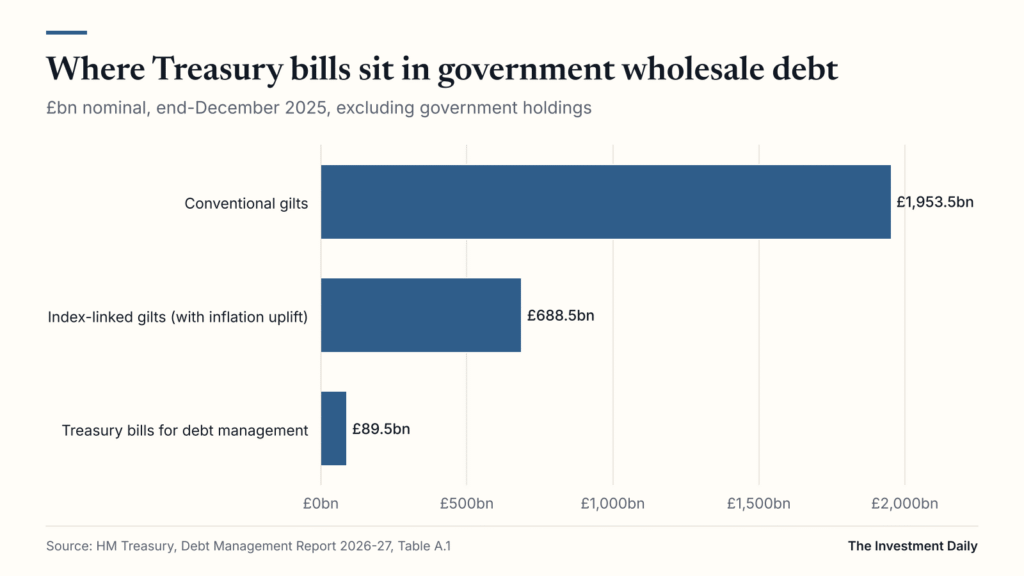
Treasury bills sit alongside gilts in the government’s marketable debt. At the end of December 2025, Treasury bills held for debt management purposes totalled £89.5bn, against £1,953.5bn of conventional gilts and £688.5bn of index-linked gilts excluding government holdings (HM Treasury, Debt Management Report 2026-27). That figure covers bills issued for debt management purposes only.
Who holds them
Respondents to the 2026 consultation described a broad investor base (HM Treasury and DMO):
- bank and building society treasuries, for short-term liquidity and regulatory buffers;
- money market funds, within the limits set by money market fund regulation;
- insurers and pension funds, for near-term liquidity;
- asset managers, hedge funds and company treasuries placing surplus cash;
- central banks, as part of foreign exchange reserves;
- retail investors, through platforms that aggregate orders into bids.
Private holders of Treasury bills UK investment platforms serve are therefore a small group in a market dominated by institutions. That shapes how bills are sold, priced and traded.
Treasury bills UK: how the weekly tenders work
The DMO holds weekly tenders on the last business day of each week, usually a Friday, for settlement on the next business day, usually a Monday. The size of each tender is announced the week before, and a calendar for each quarter is published in advance (DMO). At each weekly tender the DMO normally offers one-month, three-month and six-month bills. Its tender calendar for October to December 2026 lists weekly Friday tenders for those three maturities, and says the 28 March 2024 memorandum is still the latest edition (DMO press notice, 25 September 2026).
- Who can bid: tenders are open to Treasury Bill Primary Participants, FCA-regulated firms that bid on their own account or for clients. The DMO says 17 of the 22 participants are in the same groups as the gilt market makers (HM Treasury and DMO, January 2026).
- Minimum bid: £500,000 nominal, then multiples of £50,000.
- How bids are made: as a money market yield to three decimal places, through the Bloomberg Auction System, by 11am London time.
- Allocation: bids are ranked by yield, lowest first. Bills go to bids at or below the highest accepted yield, the cut-off, with bids at the cut-off scaled back pro rata if needed.
- Results: published soon after 11am, showing amounts bid and allotted and the lowest, average and highest accepted yields.
The rules are the same for every bid, whether it comes from a bank or from a platform pooling orders for Treasury bills UK savers want. The DMO began offering three-month and one-month bills in 2000 and six-month bills in 2003, with six-month bills at every weekly tender since March 2008 (consultation document). There are typically 26 bills in issue at any one time from the weekly tenders.
New 12-month bills from January 2027
After consulting in early 2026, the government said in May 2026 it would introduce bills around the 12-month point at weekly tenders by the end of 2026 to 2027 (HM Treasury and DMO). Budget 2026 set the date: tenders for 12-month bills will begin in January 2027, initially every four weeks, with exact dates in the DMO’s tender calendar due on 24 December 2026 (HM Treasury, Budget 2026, Annex A). A standing repo facility for Treasury bills, aimed at dealers, is also due to open in January 2027.
Discount pricing: from yield to price
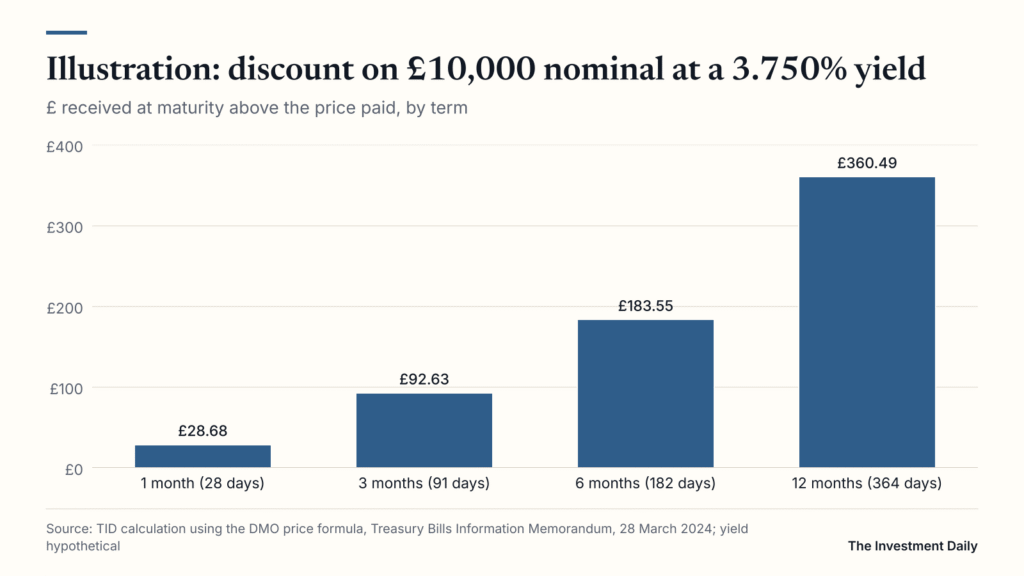
Bills are priced from a yield using the formula in the DMO’s memorandum: the price equals the nominal value divided by one plus the yield multiplied by the days to maturity over 36,500 (DMO). Written out, P = N ÷ (1 + y × n ÷ 36,500), where y is the yield in per cent and n the number of calendar days from settlement to maturity. The result is rounded to the nearest penny.
The table applies that formula to £10,000 nominal at a yield of 3.750%, the same level as Bank Rate in September 2026. The yield is hypothetical and for illustration only; actual tender yields are set by bidding and published by the DMO.
| Maturity (illustration, 3.750% yield) | Days | Price paid for £10,000 nominal | Discount received at maturity |
|---|---|---|---|
| One month | 28 | £9,971.32 | £28.68 |
| Three months | 91 | £9,907.37 | £92.63 |
| Six months | 182 | £9,816.45 | £183.55 |
| 12 months (from January 2027) | 364 | £9,639.51 | £360.49 |
Yield and discount rate are not the same
Some sources quote a discount rate rather than a yield, which can confuse anyone comparing Treasury bills UK quotes from different places. The discount rate measures the discount as a share of the face value; the yield measures it as a share of the price you actually pay. For the three-month example above, the yield is 3.750% but the equivalent discount rate is about 3.715%. The DMO issues and settles bills on the yield basis, so that is the figure to compare with savings rates.
The yield on a bill is also an annualised simple rate. A saver who rolls three-month bills four times a year earns slightly more than the quoted yield, because each maturity is reinvested, but only if future tenders clear at the same yield, which nobody can know in advance.
Why the government issues Treasury bills
For the government, Treasury bills do two jobs. For cash management, the DMO says it aims to “rough tune the seasonal pattern of flows mainly through weekly issuance of Treasury bills”, smoothing a cash position that follows tax and spending dates (DMO). For debt management, a net increase in the stock of bills contributes to the year’s financing alongside gilt sales.
Budget 2026 raised the planned net contribution of Treasury bills to debt financing in 2026 to 2027 to £8bn, up £3bn from the £5bn in the April 2026 remit. The DMO’s net financing requirement for the year is forecast at £258.6bn, with £250.6bn to come from gilt sales (HM Treasury, Budget 2026). Bills therefore remain a small part of government borrowing, but the government has said it wants a deeper market, and the supply of Treasury bills UK investors can buy is set to widen with the new 12-month maturity.
How private investors buy Treasury bills UK platforms offer
The £500,000 minimum at weekly tenders rules out most individuals bidding directly, which is why the route to Treasury bills UK investors use is almost always a platform. Responses to the 2026 consultation described how retail access works in practice: online investment platforms aggregate retail orders into bids at the DMO’s weekly tenders, and retail participation is “small but growing” (HM Treasury and DMO, consultation response, May 2026). Platform minimums, charges and the maturities offered are set by each platform and vary.
Respondents also said retail investors mostly hold bills to maturity, because of the friction in selling early and the lack of a liquid secondary market for individuals, and that most retail orders are placed inside ISAs and SIPPs. Availability is uneven across brokers. Responding in May 2026, the government said it would not take forward specific measures to promote retail participation for now. Budget 2026 added 12-month bills and a repo facility for dealers, but nothing in it changes how individuals buy: the £500,000 minimum and the Primary Participant route in the DMO’s memorandum still apply.
Indirect routes: money market funds and short-dated gilts
Many investors hold Treasury bills without knowing it. Consultation respondents listed money market funds that include bills among the main holders, and named short-dated gilts as a common substitute for both institutional and retail investors, citing their capital gains tax treatment and deeper secondary market (consultation response). Money market funds bring daily dealing and diversification across issuers, but charges and fund risks of their own. Our money market funds desk covers how they work, including how fund distributions are taxed, which differs from the deeply discounted securities treatment of a bill held directly.
ISA rules matter here. The consultation response noted that the government was then developing rules on “cash-like” investments in stocks and shares ISAs, linked to the planned cut in the cash ISA limit. Budget 2026 then kept the cash ISA limit at £20,000 for all adult savers from April 2027 (OOTLAR item 2.5). How the ISA rules will treat Treasury bills and money market funds after that reversal was not set out in the documents we reviewed, so check your platform’s current terms.

Tax on Treasury bills UK investors hold outside an ISA
The tax position is the main difference between Treasury bills and gilts for a private investor. Consultation respondents said most retail orders of Treasury bills UK platforms handle are placed inside ISAs and SIPPs. Gilts are exempt from capital gains tax: a gain on gilt-edged securities “shall not be a chargeable gain” under section 115 of the Taxation of Chargeable Gains Act 1992. That exemption applies to gilt-edged securities as defined in Schedule 9 of the Act, and neither that definition nor the HMRC guidance we reviewed mentions Treasury bills.
Consultation respondents called the difference in tax treatment between discount instruments such as bills and low-coupon gilts “the most frequently cited barrier” to retail demand. The response records that difference but does not set out the tax rules themselves.
What the rules on discounted securities say
Part 4, Chapter 8 of the Income Tax (Trading and Other Income) Act 2005 charges income tax on profits on the disposal of deeply discounted securities, and treats those profits as income even where they would not otherwise be income (ITTOIA 2005, section 427). HMRC’s manual says the chapter charges the profit on sale or redemption to income tax “regardless of whether the profit is capital or income” (HMRC, SAIM2230).
Under section 430, a security is deeply discounted if the amount payable on redemption exceeds the issue price by more than 0.5% for each year of the redemption period, with part years counted in twelfths (HMRC, SAIM3020). Section 432 takes shares, and gilt-edged securities that are not strips, out of the regime. On that test, the threshold for a three-month security is 0.125% of the redemption amount; at the illustrative 3.750% yield, a three-month bill’s discount is about 0.93% of face value.
HMRC’s manual adds that most discounted securities, though not gilts other than strips, fall within the definition, and that discounts outside it are treated as interest where they are income rather than capital. Where a discount is taxed as income, it is savings income: section 18 of the Income Tax Act 2007 lists both interest and profits from deeply discounted securities as savings income.
HMRC’s Savings and Investment Manual does not mention Treasury bills by name, and we have not found HMRC guidance that sets out their treatment for individuals. How the rules apply to a particular holding is therefore a point to check in HMRC’s guidance or with a tax adviser before relying on the figures below.
- Timing under the rules: the deeply discounted securities rules charge profits arising on disposals in the tax year, and redemption counts as a disposal (HMRC, SAIM3070).
- No tax deducted: the DMO says payments to holders are made without withholding or deduction for UK taxes unless required by law.
- Losses: relief for losses on deeply discounted securities was abolished for transfers and redemptions on or after 27 March 2003, with one exception for government securities and a transitional rule for listed securities held since before that date (HMRC, SAIM3080).
Allowances and the 2027 rate rise
Where the discount is taxed as savings income, it can be covered by the personal savings allowance of £1,000 for basic rate and £500 for higher rate taxpayers, and by the starting rate for savings (OOTLAR Annex A). Above those, it is taxed at 20%, 40% or 45% in 2026 to 2027 and, after Budget 2026, at 24%, 44% or 49% from 6 April 2027 (HMRC).
A worked example, for illustration only and assuming the discounts are taxed as savings income: a higher rate taxpayer rolls £50,000 through four consecutive three-month bills at a constant 3.750% yield, reinvesting each time, with no other savings income. The discounts total about £1,896.25 over the year. After the £500 allowance, tax is about £558.50 at 40%, or £614.35 at 44% if the bills mature in 2027 to 2028. Inside an ISA or a SIPP, the same discounts would not be taxed.
Worked example: a three-month bill bought through a platform
This example is hypothetical and for illustration only. It follows the steps most Treasury bills UK investors go through when a platform bids at the weekly tender on their behalf.
- Choose the account. The same bill can sit in an ISA, a SIPP or a general investment account; only the last is taxed.
- Place the order. The platform sets its own order deadline, which has to fall before the DMO’s 11am cut-off on tender day so that orders can be combined into one bid.
- The tender clears. Suppose the three-month bill clears at 3.750%. The investor pays £9,907.37 for each £10,000 nominal, plus any platform charge.
- Settlement. The bill settles on the next business day, usually the Monday, and appears in the account.
- Maturity. About 91 days later, £10,000 is paid into the account. The investor can take the cash or roll into a new bill at the yield then available.
In a general investment account, and assuming the £92.63 discount is taxed as savings income in the tax year in which the bill matures, the tax for an investor whose personal savings allowance is already used is £18.53 at 20% or £22.23 at 24% from 6 April 2027 for a basic rate taxpayer, and £37.05 at 40% or £40.76 at 44% for a higher rate taxpayer.
Compare a short-dated gilt bought at a price below £100. Its coupons are taxable, but the rise to £100 at maturity is a gain on a gilt-edged security and so not chargeable to capital gains tax. That is why consultation respondents said investors outside wrappers may favour low-coupon, short-dated gilts over Treasury bills, whose whole return comes from a discount. Inside an ISA or SIPP, that difference disappears.
Treasury bills compared with gilts and savings
Treasury bills compete with several other places to hold cash for up to a year, including short-dated gilts, fixed-rate savings and money market funds. For Treasury bills UK savers hold outside a wrapper, tax is often the deciding difference. The table sets out the main points.
| Feature | Treasury bills | Short-dated gilts | Fixed-rate savings | Money market funds |
|---|---|---|---|---|
| Issuer | UK government | UK government | Bank or building society | Fund holding short-term instruments |
| Typical term | 1, 3 or 6 months; 12 months from January 2027 | Any remaining life | Commonly 1 to 5 years | No maturity; daily dealing |
| Return | Discount to face value | Coupon plus any gain to £100 | Fixed interest | Variable, after fund charges |
| Tax outside a wrapper | Discount generally treated as income; check HMRC guidance | Coupon taxed as savings income; gain free of CGT | Interest taxed as savings income | Depends on fund type |
| Protection | Government obligation; not an FSCS deposit | Government obligation; not an FSCS deposit | FSCS up to £120,000 per licence | Fund assets; not an FSCS deposit |
For savings, the Bank of England’s averages for September 2026 put one-year fixed rate bonds at 4.35% and easy access accounts at 2.06%, with Bank Rate at 3.75% (Bank of England). FSCS deposit cover is £120,000 per person per authorised firm (FSCS). For gilts, see how to buy gilts and low-coupon gilts and capital gains tax, which shows why the tax gap can favour gilts for higher rate taxpayers outside a wrapper.
Risks to understand
- Selling before maturity: bills are priced from market yields, so a bill sold early can fetch more or less than its purchase price plus the discount earned so far. Consultation respondents said retail investors may not be aware of mark-to-market movements.
- Liquidity: respondents described a limited secondary market for individual investors, so for most retail holders bills work as hold-to-maturity instruments.
- Reinvestment risk: yields at future weekly tenders may be lower, as they can be on short-dated gilts and savings, so rolling bills does not lock in a rate beyond each bill’s term.
- Allocation risk: at an oversubscribed tender, bids at the cut-off yield can be scaled back, and bids above the cut-off get nothing.
- Platform terms: access, minimums and charges vary, and charges reduce the return on what is a short-dated, modest-yielding instrument.
- Tax: outside a wrapper the discount does not get the capital gains exemption that gilts have, and where it is taxed as savings income the rates rise from 6 April 2027. HMRC’s guidance does not address bills by name.
- Platform failure: bills bought through a platform are held for you by the platform or its custodian, not as a bank deposit. If an FCA-authorised investment firm fails and there is a shortfall in the assets it holds for you, the FSCS may pay up to £85,000 per person, per firm; it does not cover falls in value (FSCS).
Treasury bills UK investors: what to check before buying
- Which wrapper the bill would sit in. Inside an ISA or SIPP, the discount is not taxed; outside, check HMRC’s guidance on discounted securities, or a tax adviser, for how it will be taxed.
- Check how your platform buys bills: at the weekly tender, or in the secondary market, and with what minimum and charges.
- Compare the yield, not the discount rate, with savings rates and with short-dated gilts after tax.
- Whether the maturity date fits when the money may be needed, since selling early can mean a different price.
- Check the DMO’s published tender results for the yields recently achieved.
- Note which tax year each bill matures in, especially around 6 April 2027.
In short, Treasury bills are the UK government’s shortest debt, sold weekly at a discount by the DMO with a £500,000 minimum bid, and reached by most individuals through platforms or money market funds. Outside a wrapper the discount does not get the capital gains exemption that gilts have: the income tax rules on discounted securities are the starting point, and taxable savings income above the allowances is charged at 24%, 44% or 49% from April 2027. For anyone weighing Treasury bills UK platforms offer against gilts or savings, the after-tax yield, the term and the platform’s terms decide the comparison.