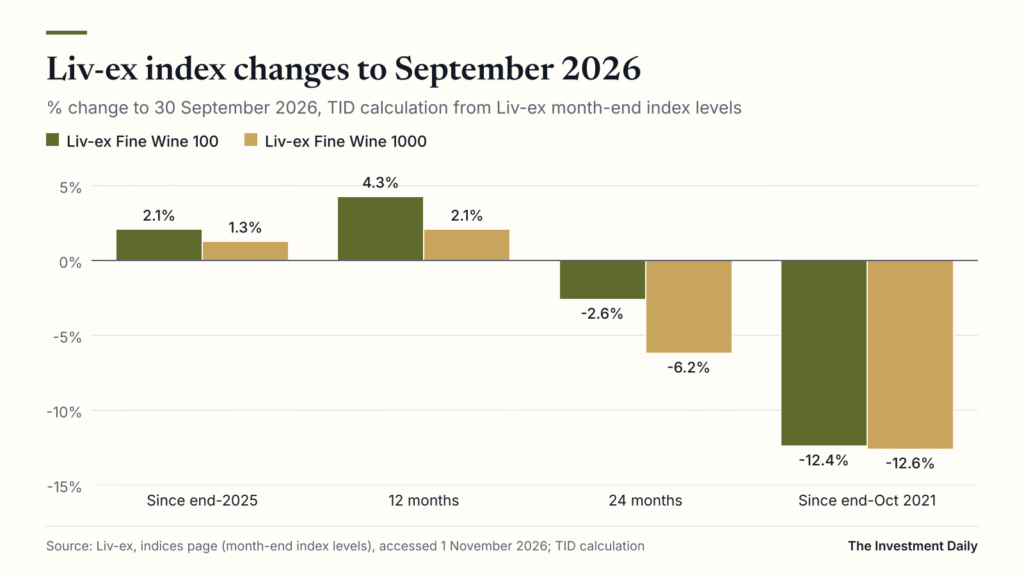
Wine investment means buying cases of fine wine, usually from top Bordeaux, Burgundy, Champagne and Italian producers, keeping them in a bonded warehouse and hoping to sell later at a higher price. Returns come only from price rises, with no income, and storage, insurance and dealing costs come off the top. Prices have been weak: Liv-ex data show its broadest index, the Fine Wine 1000, 12.6% below its October 2021 level at the end of September 2026 and 2.1% higher than a year earlier. HMRC may treat some wine as a wasting asset, outside capital gains tax, but that depends on the facts.
This explainer covers how the market and its indices work, the duty and VAT position of wine in bond, the costs, capital gains tax, how hard it can be to sell, and how wine features in investment scams. For other collectables, see our guides to art as an investment and whisky casks.
How wine investment works
The investment-grade part of the wine market is narrow. It is made up of wines from a small number of producers with a long record of ageing well and a secondary market where cases trade between merchants, collectors and brokers. A central venue for trade between wine businesses is Liv-ex, the London International Vintners Exchange, founded in 2000, which says it has more than 500 members in 42 countries (Liv-ex). Its trading membership is reserved for professional buyers and sellers, “typically wine merchants” (Liv-ex FAQs).
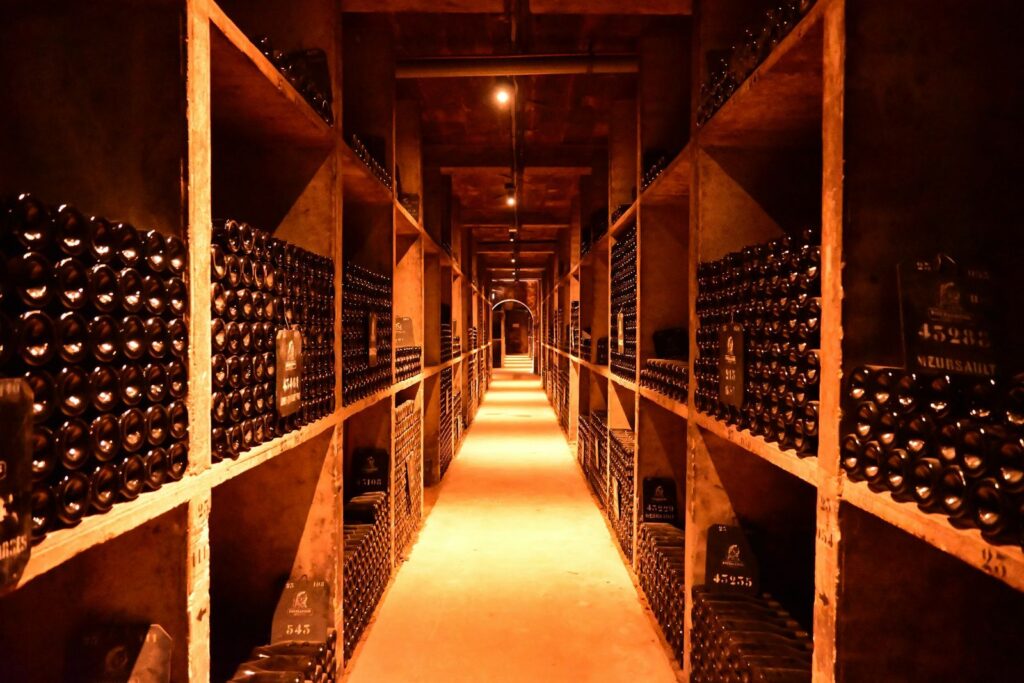
A private investor normally buys through a wine merchant or a specialist wine investment company. The wine is bought “in bond”, meaning it stays in a bonded warehouse with excise duty and VAT suspended, and the merchant arranges storage in the investor’s name. When the investor sells, the merchant or broker finds a buyer, often through the same exchange, and the wine moves between accounts in the warehouse without leaving it.
- You own physical goods, not a share in a fund, so check that each case is recorded in your own name at the bonded warehouse.
- There is no yield. The only return is the difference between the buying and selling price, less costs.
- Prices are agreed between buyer and seller; bids and offers on the exchange give a reference point.
What the Liv-ex Fine Wine 100 and other indices measure
The Liv-ex indices have tracked “the prices of the world’s most traded fine wines” since 2000, using the Liv-ex Mid Price, which Liv-ex describes as “independent, transaction based data” (Liv-ex). An index level is a market reference price, not the price a private seller would receive after costs.
Three indices are the most quoted. The Liv-ex Fine Wine 100 is described by Liv-ex as “the industry leading benchmark for monitoring fine wine prices” and “represents the price movement of 100 of the most sought-after fine wines on the secondary market”. The Fine Wine 50 tracks the ten most recent vintages of the five Bordeaux first growths. The Fine Wine 1000 tracks 1,000 wines through seven regional sub-indices: Bordeaux 500, Bordeaux Legends 40, Burgundy 150, Champagne 50, Rhone 100, Italy 100 and Rest of the World 60.
| Index | Level, 30 September 2026 | Since end-2025 | 12 months | 24 months | Since end-October 2021 |
|---|---|---|---|---|---|
| Liv-ex Fine Wine 50 | 291.2 | 0.4% | 2.3% | -7.2% | -24.9% |
| Liv-ex Fine Wine 100 | 326.3 | 2.1% | 4.3% | -2.6% | -12.4% |
| Liv-ex Fine Wine 1000 | 354.2 | 1.3% | 2.1% | -6.2% | -12.6% |
| Liv-ex Bordeaux 500 | 275.6 | -0.2% | 0.4% | -9.3% | -20.6% |
Source: Liv-ex, indices page, month-end index levels (accessed 1 November 2026); changes are TID calculations from those levels, all to 30 September 2026, the latest month-end published for the Liv-ex Fine Wine 100, Fine Wine 1000 and Bordeaux 500. Index changes exclude storage, insurance, dealing costs and tax. Past performance is not a guide to future returns.
The table shows a market recovering slowly from a long fall. Liv-ex’s January 2026 report said the Fine Wine 1000 “closed 2025 down 4.5%”. Its December 2025 report said “fine wine prices are at their lowest in five years”, while also recording the first gains in its major indices since early 2023 (Liv-ex). The longer-run figures show that a wine investment bought at the end of October 2021 at Liv-ex Fine Wine 100 prices would still have been well under water at the end of September 2026, before any costs.
What moves fine wine prices
Liv-ex’s own commentary through 2025 and 2026 points to a few recurring forces. Demand from particular countries matters a great deal. Liv-ex said in October 2026 that after “the withdrawal of US buyers in early-mid 2025 (a consequence of Trump’s tariff threats), prices fell quickly”, and that European buyers then stepped in (Liv-ex). UK buyers now account for about 30% of traded volume on the exchange, against 74% in 2005, according to its November 2025 report.
The market is also split by region, producer and vintage. In its review of the market presented at the Drinks Business conference in September 2026, Liv-ex said “the overwhelming trend in the market is inconsistency” and that “not all wines have found their floor”. It added that the Fine Wine 1000 “in real terms is back to where it was in 2015” (Liv-ex). An index such as the Liv-ex Fine Wine 100 can rise while the particular wines you hold fall.
Scarcity works slowly. Each vintage is fixed in size, and the stock falls as bottles are drunk, which Liv-ex calls “consumption-induced scarcity”. That can support older vintages, but it does not stop prices falling when buyers withdraw, as 2023 to 2025 showed.
Wine in bond: duty, VAT and storage
Investment wine is normally bought and kept in bond. HMRC’s VAT Notice 702/10 describes a tax warehouse as “an authorised place where goods subject to excise duty are produced, processed, held, received or dispatched under duty suspension arrangements”. While wine in bond stays there, alcohol duty is suspended, and “no VAT is due on a supply of goods made in a tax warehouse as long as that supply is followed by another supply of the goods while they’re still warehoused”.
The tax arrives when the wine leaves for home use. The last buyer pays the VAT on their purchase “together with the excise duty when the goods are removed to home use”, and the notice says “you must include any excise duty in the value” when working out the VAT. Bonded warehouse storage charges are normally zero-rated while the goods are in bond, but services zero-rated in this way can be taxed later when the goods are removed to home use.
| Alcohol duty on wine | From 1 February 2026 | From 1 February 2027 (Budget 2026) |
|---|---|---|
| Wine at least 3.5% but less than 8.5% ABV, per litre of pure alcohol | £26.61 | £27.82 |
| Wine at least 8.5% and not exceeding 22% ABV, per litre of pure alcohol | £30.62 | £32.01 |
| Illustration only: duty on a 75cl bottle at 13.5% ABV | £3.10 | £3.24 |
Source: HMRC, Alcohol Duty rates; Budget 2026 OOTLAR Annex A. The bottle figure is our calculation: 0.75 litres x 13.5% x the rate.
Budget 2026 changed the duty rates. The Overview of Tax Legislation and Rates says the government will “increase Alcohol Duty rates on alcoholic products in line with Retail Prices Index (RPI) inflation”, with the new rates applying from 1 February 2027 (OOTLAR, item 1.69). This matters to a wine investment only if you take wine out of bond, but it also affects the price a UK buyer who wants to drink the wine will pay.
A worked example, for illustration only.
You buy a 12-bottle case of wine in bond for £1,200 and later decide to drink it. On removal on or after 1 February 2027, duty at the new rate would be about £38.89 (12 bottles x 0.75 litres x 13.5% x £32.01). VAT at 20% on £1,238.89 adds £247.78. The case would cost £1,486.67, before any delivery or storage charges.
The costs of a wine investment
Costs determine whether a wine investment makes money. They fall into four groups, and each varies widely between firms, so ask for every charge in writing before you buy.
- The buying margin: the gap between what a wine merchant or investment company charges you and the market price. Compare the price quoted with recent market prices for the same wine and vintage where you can.
- Storage: a fee for keeping the wine in bond; ask how it is calculated and how often it can rise.
- Insurance: ask what it covers, the value insured and whether it is included in the storage fee.
- Selling costs: a commission or spread when you sell, and any fee for transferring the wine to another account.
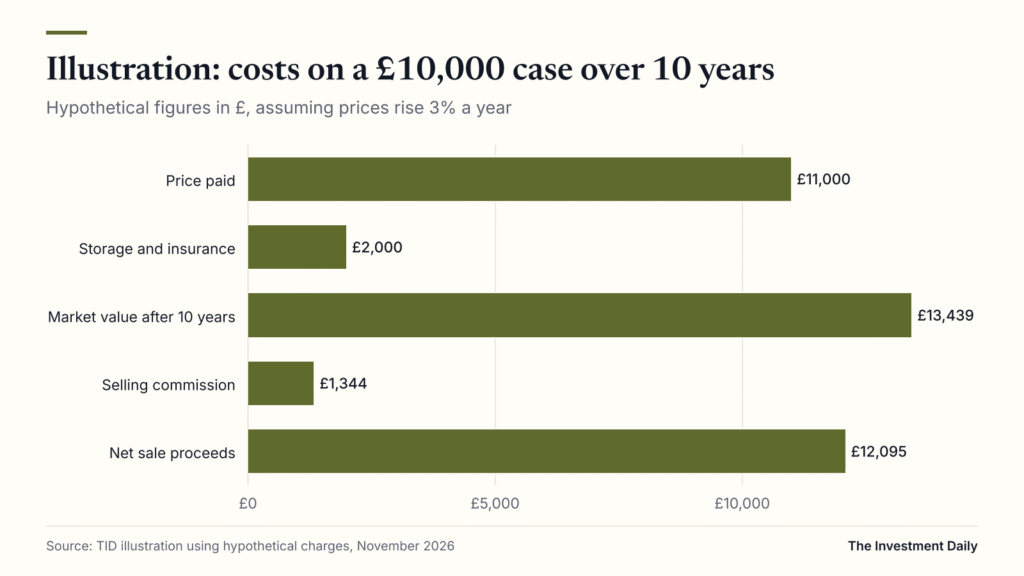
| Illustration only | Amount |
|---|---|
| Market value of a case when bought | £10,000 |
| Price paid, including a hypothetical 10% buying margin | £11,000 |
| Hypothetical storage and insurance, £200 a year for 10 years | £2,000 |
| Market value after 10 years if prices rise 3% a year | £13,439 |
| Hypothetical selling commission at 10% | £1,344 |
| Net sale proceeds | £12,095 |
| Total outlay (price paid plus storage and insurance) | £13,000 |
| Result after 10 years | £905 loss |
The figures are hypothetical, not typical charges, but they show the arithmetic. In this example, market prices rising 3% a year for a decade still leave a loss once margins and storage are paid. The bonded warehouse fees and selling costs in your own agreement will set how much the market has to rise before you break even.
Capital gains tax on wine investment: the wasting asset rule
Wine held as an investment, rather than as stock in a trade, falls under the capital gains tax rules for personal possessions, or chattels. Two exemptions can apply, set out in HMRC’s Capital Gains Manual at CG76901.
The wasting asset exemption
A wasting asset is “an asset with a predictable life not exceeding fifty years at the time when it was acquired”. A chattel that is a wasting asset is exempt from capital gains tax, unless capital allowances were or could have been claimed on it or a special rule in section 45(3B) applies (HMRC CG76721). The flip side is that a loss on a wasting asset is generally not allowable either.
HMRC’s view is that the definition “would clearly apply to cheap table wine which may turn to vinegar within a relatively short period”, but “would certainly not apply to port and other fortified wines”, which have “a very long storage life”. For fine wines in between, HMRC says “the basic consideration, in our view, is whether the wine has turned to vinegar or has merely matured”, and notes that most wine is drunk well before it is 50 years old.
For fine wine, the manual does not give a simple answer. It notes that fine wine is not unusually kept, or some samples of it are kept, for substantial periods, sometimes well in excess of 50 years, which is the dividing line for a wasting asset, and it says HMRC will look at the facts of each case. The manual says its view was first set out in Tax Bulletin 42, published in August 1999. Whether a particular wine investment is a wasting asset cannot be assumed: it turns on the wine, the facts and the evidence, so read the full passage in CG76901, or ask a tax adviser, before relying on it.
The £6,000 chattels exemption and the set rule
If the wasting asset rule does not apply, the chattels exemption may. HMRC says bottled wines and spirits “are chattels” and disposals for £6,000 or less are exempt. Above £6,000, section 262 of the Taxation of Chargeable Gains Act 1992 caps the chargeable gain at five-thirds of the amount by which the proceeds exceed £6,000. GOV.UK expresses this as multiplying the excess by 1.667 and applies it to sales between £6,000 and £15,000; above £15,000 the cap is higher than any possible gain.
Selling bottles separately does not always help. HMRC says bottles sold to the same person “may form a set”, depending on whether they are “similar and complementary”, meaning from the same vineyard and vintage, and whether they are worth more together. Where the set rule in section 262(4) applies, the separate items are treated as one asset with only one £6,000 limit (HMRC CG76631).
Rates, and when trading rules apply
Any chargeable gain on wine investment is added to your other gains. Budget 2026 left the annual exempt amount at £3,000 and the rates at 18% and 24% for 2026-27 and 2027-28, according to OOTLAR Annex A. Capital gains tax applies only if you are investing.
If HMRC concluded you were trading in wine, profits would be taxed as trading income instead. HMRC’s badges of trade include the number of transactions, the interval between purchase and sale and how the purchase was financed, and it says no single badge is conclusive.
| Illustration only | Case A: table wine | Case B: fine wine, single case | Case C: fine wine, not wasting |
|---|---|---|---|
| Cost | £2,000 | £3,000 | £8,000 |
| Sale proceeds | £3,000 | £9,000 | £20,000 |
| Wasting asset | Yes: exempt | Depends on facts | No |
| If not wasting: chattels cap | Not needed | (£9,000 minus £6,000) x 5/3 = £5,000 | No effect: over £15,000 |
| Chargeable gain if not exempt | £0 | £5,000: the cap is lower than the actual gain of £6,000 | £12,000 |
On Case C, a higher rate taxpayer with no other gains would pay capital gains tax at 24% on £9,000, after the £3,000 exempt amount, which is £2,160.
Liquidity: selling a wine investment
Wine is easy to buy and can be slow to sell. There is no market maker obliged to quote a price, and private investors usually sell through a wine merchant or broker, who needs a buyer at a price both sides accept. In falling markets bids thin out. Liv-ex’s December 2025 report noted that bids on the exchange had reached £31m, “the highest since April 2023”, which shows how far demand had dropped before.
Several things can slow or reduce a sale:
- Provenance: keep records showing where the wine has been stored since you bought it, because a buyer will want to know.
- Condition and packaging: keep original cases and packaging, and ask the warehouse to record the condition on arrival.
- Case size: ask whether a broker will handle part cases or single bottles before you split a case.
- The firm: if the wine merchant that sold you the wine has closed, you may need to arrange storage transfer and a new broker yourself.
Some investors hold wine as a small part of a much broader mix of assets. Our guide to building a diversified portfolio explains how illiquid assets fit, and why money you may need within a few years is usually kept elsewhere.
Wine investment scams and the lack of protection
Wine features regularly in investment fraud. The FCA lists wine, alongside whisky, fine art and precious metals, among products “we don’t regulate” that often feature in scams, and warns: “If you do, you won’t be protected if something goes wrong and you could lose all your money” (FCA). For anything it does not regulate, the FCA directs people to Report Fraud on 0300 123 2040; it updated its page in December 2025 to refer to Report Fraud instead of Action Fraud.
The protection gap is wide. The FSCS says it can only protect you where the FCA or PRA “must have authorised the provider or adviser, as well as regulated the service and product it provided”. The Financial Ombudsman Service can help with investment complaints “as long as the business you’re complaining about is regulated by the Financial Conduct Authority”. A wine merchant selling you cases in bond is not carrying on a regulated activity, so neither route is normally open.
Common warning signs include:
- A cold call, email or social media message offering wine as an investment with high or guaranteed returns.
- Pressure to buy quickly, or a price far above what you can find for the same wine elsewhere.
- No account in your name at an independent bonded warehouse, or a refusal to give the warehouse’s details.
- An offer to buy back wine you already hold if you pay a fee first, which the FCA describes as a recovery room scam.
Our guides on how to spot an investment scam and recovery scams explain the patterns in more detail.
Wine investment: what to check before you commit
A wine investment is a bet on the prices of a narrow group of wines, held as physical goods in a warehouse, with no income and no regulatory safety net. At the end of September 2026 the Liv-ex Fine Wine 100 and Fine Wine 1000 were both more than 12% below their October 2021 levels, and Liv-ex itself describes the market as inconsistent, with some wines yet to find a floor.
- Confirm that each case is held as wine in bond in your own name at an authorised bonded warehouse, and ask for the warehouse’s direct contact details.
- Get every cost in writing from the wine merchant: the buying margin, storage, insurance and the selling commission.
- Compare the price you are quoted with market prices for the same wine and vintage.
- Check how you would sell, who would sell for you and how long it might take.
- Take tax advice if a large gain is possible, because the wasting asset rule depends on the facts.
- Check the firm on the FCA’s warning list and remember that the FCA does not regulate wine.
Past performance is not a guide to future returns. More on collectables sits on our passion assets desk.