Stamp duty on shares is a 0.5% tax paid by the buyer when you purchase existing shares in a UK company. Most purchases are electronic, so the tax is Stamp Duty Reserve Tax (SDRT) and is taken automatically when you buy, according to GOV.UK. Paper transfers over £1,000 pay Stamp Duty at the same 0.5%, rounded up to the nearest £5. AIM shares that are not listed elsewhere, ETFs, most funds bought from the manager, foreign shares and gilts are generally exempt. Budget 2026 confirmed that a new Securities Transfer Tax will replace both taxes from late 2027.
This explainer covers how the charge works, what is exempt, why investment trusts pay it and open-ended funds do not, the higher 1.5% rate, what the tax raises and what the 2027 reform means for private investors.
How stamp duty on shares works
“Stamp duty on shares” is used loosely to describe two taxes. Stamp Duty is the older tax on documents, now mainly paper stock transfer forms. Stamp Duty Reserve Tax, which rests on the Finance Act 1986, applies to agreements to transfer shares, and it is what applies to almost every electronic trade today. Both are charged at 0.5% on UK shares, and HMRC refers to them collectively as Stamp Taxes on Shares.
The tax falls on the buyer. GOV.UK says that when you buy shares “you usually pay a tax or duty of 0.5% on the transaction” (GOV.UK, tax when you buy shares). You usually pay tax based on the price you pay for the shares. If you pay with something other than cash, the tax is worked out on the value of what you gave.
According to GOV.UK, you pay tax when you buy:
- existing shares in a company incorporated in the UK
- shares in a foreign company that has a share register in the UK
- an option to buy shares
- an interest in shares, such as an interest in the money from selling them
- rights arising from shares, such as rights you have when new shares are issued
Selling does not trigger the tax for the seller, and the charge does not depend on whether you make a profit. Because GOV.UK’s exemptions do not include buying through an ISA or a pension, stamp duty on shares applies to purchases of UK shares inside those accounts too. For the basics of dealing, see how to invest in shares.
Stamp Duty Reserve Tax: the electronic charge
Most UK shares are held electronically in CREST, the settlement system, usually through a broker’s nominee account. GOV.UK says: “You’ll pay Stamp Duty Reserve Tax (SDRT) if you buy shares electronically through the ‘CREST’ system”, and that “SDRT is charged at 0.5% when you buy shares electronically” (GOV.UK). The tax is taken automatically when you buy, so there is nothing for the investor to file.
On a platform the Stamp Duty Reserve Tax appears as a separate line on the contract note, next to the dealing commission. It is not rounded, so a £3,000 purchase pays £15 and a £3,333 purchase pays £16.67, for illustration only.
Off-market transactions, such as a private sale arranged outside CREST, still carry SDRT. GOV.UK says tax “is not deducted automatically” when you buy off-market, so you must send HMRC written notice with the details of the transaction and pay it yourself. Interest is charged on late payment and you may get a penalty.
| Rule | Electronic (SDRT) | Paper transfer (Stamp Duty) |
|---|---|---|
| Rate on UK shares | 0.5% | 0.5% |
| Rounding | None | Rounded up to the nearest £5 |
| Small transactions | No threshold | Nothing to pay if £1,000 or less |
| How it is paid | Collected automatically through CREST | Form to HMRC’s Stamp Office and payment within 30 days |
| Who pays | Buyer | Buyer |
Sources: GOV.UK, buying shares electronically; GOV.UK, stock transfer forms; Budget 2026 OOTLAR Annex A.
Paper transfers and the £1,000 threshold
Shares bought with a stock transfer form, such as certificated shares in a private company or a family transfer for value, pay Stamp Duty rather than SDRT. GOV.UK says the duty applies if the transaction is over £1,000, and that “You pay 0.5% duty, which will be rounded up to the nearest £5” (GOV.UK). Its own example: shares worth £1,050 produce 0.5% of £5.25, which is rounded up to £10.
You must send a copy of the signed and dated form to HMRC’s Stamp Office within 30 days, and pay the duty within the same 30 days. The Budget 2026 rates annex confirms the standard rate, the rounding and that there is no Stamp Duty “where the certified consideration is less than £1,000” (OOTLAR Annex A).
What is exempt from stamp duty on shares
Many investments that private investors buy every day do not pay stamp duty on shares at all. The main exemptions are below. Each has conditions, so check the contract note.
AIM and other growth market shares
Shares admitted to trading on a recognised growth market, but not listed on that or any other market, are exempt from SDRT. HMRC’s manual says the exemption “was introduced on 28 April 2014” (HMRC, STSM041270). The London Stock Exchange says that since that date SDRT and Stamp Duty “have not been chargeable on transactions in eligible securities” on AIM (London Stock Exchange). An AIM company that is also listed on another market may not qualify.
For investors who buy smaller companies, the AIM exemption changes dealing costs. On £10,000 of AIM shares that qualify, there is no 0.5% charge; on £10,000 of Main Market shares in a UK company, the charge is £50, for illustration only. The exemption follows the security, not the investor, so AIM shares bought in an ISA, a pension or a general account are all exempt if the conditions are met.
ETFs and funds bought from the manager
HMRC’s manual says an agreement to transfer units in an ETF “is exempt from SDRT”, and an instrument transferring units in an ETF is not subject to Stamp Duty, under regulations made in 2014 (HMRC, STSM101065). GOV.UK also lists buying shares in an open-ended investment company or units in a unit trust directly from the fund manager among transactions that do not pay (GOV.UK). Our guide to funds and ETFs explains the structures.
Foreign shares
GOV.UK says that buying foreign shares outside the UK generally does not attract Stamp Duty or SDRT, though other taxes may apply. The exception is a foreign company with a share register in the UK, which is within the charge.
Gilts and bonds
Debt is treated differently from shares. HMRC’s manual says “most ‘plain vanilla’ loan capital is exempt” from Stamp Duty and SDRT, but that loan capital which can be converted into shares, or carries certain rights to interest, can be chargeable (HMRC, STSM031100). Gilts can therefore be bought without this charge; see how to buy gilts for the costs that do apply.
New issues, gifts and newly listed companies
- New shares. GOV.UK says subscribing to a new issue of shares does not pay, which covers most share offers and placings at issue.
- Gifts. Shares given to you for nothing do not pay.
- UK listing relief. For agreements made on or after 27 November 2025, shares in companies newly listed on a UK regulated market on or after that date are exempt from the 0.5% SDRT charge for the first 3 years after listing. The relief does not apply to the 1.5% charge or to transfers that are part of a takeover involving a change of control (HMRC policy paper, 26 November 2025).
| Investment | Stamp duty on shares when you buy | Source |
|---|---|---|
| Main Market shares in a UK company | 0.5% | GOV.UK |
| UK investment trust shares | 0.5% | GOV.UK; AIC |
| AIM shares not listed elsewhere | Exempt since 28 April 2014 | HMRC STSM041270 |
| ETF units | Exempt | HMRC STSM101065 |
| OEIC shares or unit trust units bought from the manager | Exempt | GOV.UK |
| Foreign shares bought outside the UK | Generally exempt | GOV.UK |
| Plain vanilla bonds, including gilts | Generally exempt | HMRC STSM031100 |
| New share issues | Exempt | GOV.UK |
| Newly listed UK companies, first three years | Exempt from 0.5% SDRT | HMRC, UK listing relief |
Investment trusts and the 0.5% charge
Investment trusts are companies whose shares trade on the stock exchange, so buying the shares of a UK-incorporated investment trust is buying existing shares in a UK company. That brings them within stamp duty on shares at 0.5%, exactly like any other listed company.
Open-ended funds are treated differently when bought from the manager, and ETFs are exempt. The Association of Investment Companies has campaigned on this difference, saying in January 2023 that the tax “is not levied on competing open-ended funds, which gain an unfair advantage” (AIC, 24 January 2023). Nothing in Budget 2026 changes the position for investment trusts, and the policy papers for the new Securities Transfer Tax do not announce a separate exemption for them.
For a long-term holder the 0.5% is paid once, on purchase. For someone who trades often, it is paid on every purchase. On a £10,000 purchase it is £50, for illustration only.
Investment trusts compared with ETFs
Two investors each put £10,000 into a global equity portfolio, for illustration only. One buys a UK investment trust and pays £50 in Stamp Duty Reserve Tax. The other buys an ETF and pays nothing, because ETF units are exempt. If each sells and buys again every year for five years, the investment trust buyer pays the charge on every purchase, while the ETF buyer still pays none. Investment trusts and ETFs differ in many other ways, from gearing to discounts and charges, so the tax is one factor among several.
The 1.5% higher rate
A higher rate of 1.5% applies when shares are transferred into some depositary receipt schemes or clearance services, according to GOV.UK. These are arrangements, used mainly by international banks and exchanges, through which UK shares are held and traded outside the UK register. The Budget 2026 rates annex lists Stamp Duty and SDRT at 1.5% on transfers to clearance services and depositary receipt issuers, and 1.5% Stamp Duty with 0.5% SDRT on transfers of bearer instruments (OOTLAR Annex A).
Private investors rarely pay the 1.5% rate directly. The government’s consultation outcome on the reform says the 1.5% charge does not apply to issues of securities, and that the government is removing the charge on transfers of bearer instruments as part of the new Securities Transfer Tax (HMRC consultation outcome, 13 July 2026).

How much stamp duty on shares raises
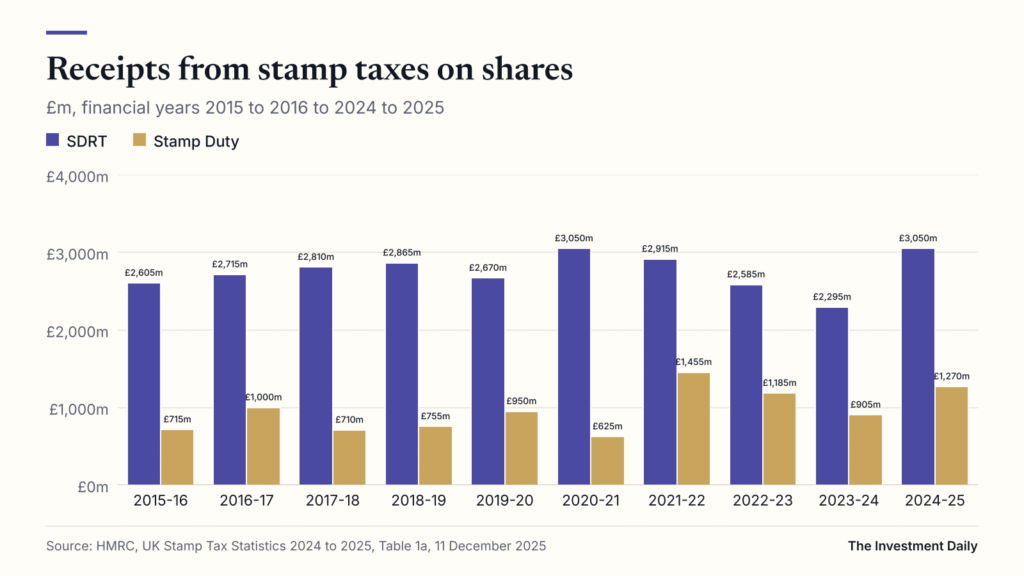
HMRC’s Annual Stamp Tax Statistics, published on 11 December 2025, show that stamp taxes on shares raised £4,320m in 2024 to 2025, up 35% from £3,200m in 2023 to 2024 (HMRC, Annual Stamp Tax Statistics 2024 to 2025). SDRT brought in £3,050m and Stamp Duty £1,270m. Total stamp tax receipts, including stamp duty land tax, were £18,205m.
| Financial year | SDRT (£m) | Stamp Duty on shares (£m) | All shares (£m) |
|---|---|---|---|
| 2020 to 2021 | 3,050 | 625 | 3,675 |
| 2021 to 2022 | 2,915 | 1,455 | 4,370 |
| 2022 to 2023 | 2,585 | 1,185 | 3,775 |
| 2023 to 2024 | 2,295 | 905 | 3,200 |
| 2024 to 2025 | 3,050 | 1,270 | 4,320 |
Source: HMRC, UK Stamp Tax Statistics 2024 to 2025, Table 1a. Receipts are rounded to the nearest £5m and may not sum.
Receipts move with share prices and trading volumes, and Stamp Duty receipts also reflect large one-off paper transactions such as takeovers. That is why the paper-based tax can swing by hundreds of millions of pounds from year to year while the electronic charge on everyday trading is steadier.
Stamp taxes on shares are the smaller part of the stamp tax family. Stamp duty land tax raised £13,885m in 2024 to 2025, so shares accounted for roughly a quarter of the £18,205m total, on HMRC’s figures. The two are separate taxes with separate rules: stamp duty land tax is paid on property, stamp duty on shares on securities.
Budget 2026: Securities Transfer Tax replaces stamp duty on shares
Budget 2026, delivered on 28 October 2026, confirmed the reform announced at Budget 2025. The government’s overview of tax legislation says it “will introduce legislation in Finance Bill 2026-27 to introduce the Securities Transfer Tax from late 2027”, that “The Securities Transfer Tax will replace Stamp Duty and Stamp Duty Reserve Tax”, and that the legislation “will come into force in late 2027 via a commencement order” (Budget 2026 OOTLAR, item 1.64). The exact commencement date will be set by that order.
HMRC’s policy paper, first published on 13 July 2026 and updated on 28 October 2026, says: “The Securities Transfer Tax (STT) is a single, self-assessed tax on the transfer of securities. It will replace Stamp Duty (SD) and Stamp Duty Reserve Tax (SDRT) (collectively called Stamp Taxes on Shares (STS)).” It says the measure modernises the regime “by simplifying and fully digitising the administration and payment of tax on transactions in securities”, removing the need for paper-based reporting and payment processes (HMRC policy paper).
The paper also sets out transitional arrangements. Savings provisions will keep Stamp Duty and SDRT for transfers entered into before the commencement date but not due to be reported or paid until on or after it, for a period of 4 years from the commencement of the new tax.
What changes for private investors
- The rate. The policy paper does not state a rate for the Securities Transfer Tax. The Budget 2026 rates annex says: “The Standard Rate and Higher Rate will continue to apply under the Securities Transfer Tax” (OOTLAR Annex A). The rates themselves will be set in the legislation.
- Paperwork. The policy paper says individuals who buy or sell UK securities off market, and who report and pay the tax themselves rather than through an agent, will need to register to use the new digital system for reporting and paying it. Trades settled through CREST are expected to need only minor changes to that system.
- Accounting for the tax. HMRC says “the basic principles for accounting for tax on the transfer of securities will remain broadly unchanged” from the existing regime, in its assessment of the impact on businesses.
- Exemptions. The policy paper says the new legislation will cover exemptions, but it does not list which existing reliefs, such as the AIM exemption, carry over. The rates annex says there will be no charge on transfers of bearer instruments or of interests in partnerships under the new tax.
The examples in this guide use the rules in force on 1 November 2026. Until the commencement order is made, stamp duty on shares and SDRT continue to apply as they do now.
Stamp duty on shares: costs in practice and what to check
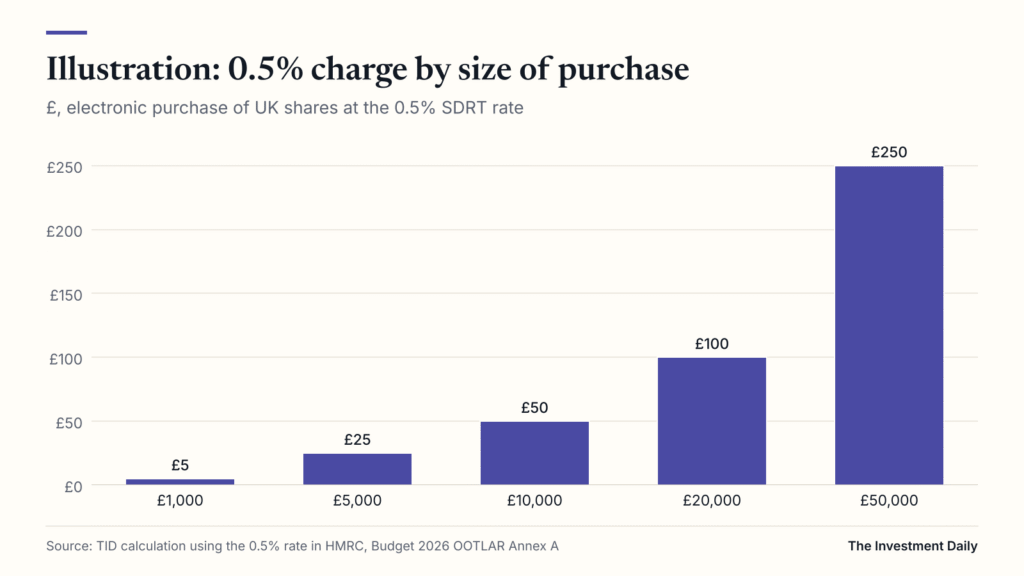
For a buy-and-hold investor, stamp duty on shares is a one-off cost of 0.5% on purchases of UK shares, paid alongside dealing commission and the spread between buying and selling prices. The table shows the arithmetic at different deal sizes, for illustration only.
| Illustration only | Electronic purchase (SDRT 0.5%) | Paper purchase (Stamp Duty, rounded up to £5) |
|---|---|---|
| £900 | £4.50 | £0 (£1,000 or less) |
| £1,050 | £5.25 | £10 |
| £5,000 | £25 | £25 |
| £20,000 | £100 | £100 |
| £50,000 | £250 | £250 |
The tax is part of the cost of buying. GOV.UK’s guidance on company gains lists Stamp Duty among the costs that can be deducted when working out a gain (GOV.UK); individuals can check HMRC’s capital gains guidance on allowable costs before completing a return.
- Read the contract note: it shows whether SDRT was charged and how much.
- Check the market. AIM shares that are not listed elsewhere are exempt, but a company can move between markets.
- Compare structures. An investment trust and an ETF tracking similar assets are taxed differently on purchase.
- Remember the charge in an ISA. The account removes tax on dividends and gains, not the 0.5% on purchases made inside it.
- Factor in turnover. Frequent buying multiplies a 0.5% cost.
- Watch for the Securities Transfer Tax commencement order in 2027.
Common misunderstandings
- The £1,000 threshold applies to electronic trades. It does not. It applies only to Stamp Duty on paper transfers; Stamp Duty Reserve Tax has no threshold.
- All AIM shares are exempt. Only AIM shares that are not listed on any other market qualify.
- All funds are exempt. ETFs and funds bought from the manager are; investment trusts are companies and pay 0.5%.
- Sellers pay. The buyer pays.
- The new tax means a new rate. HMRC describes a single, self-assessed tax replacing the two existing ones from late 2027, and the Budget 2026 rates annex says the standard rate and higher rate will continue to apply under it.
Stamp duty on shares is a small, predictable cost, but it is not the only one, and costs reduce returns whatever happens to share prices. Share prices can fall as well as rise and past performance is not a guide to future returns. More on UK equities is on the UK shares desk, and our ETF guide explains why ETFs avoid the charge.