The W-8BEN form is a US tax document that tells the payer of US income that you are not a US person and, for UK residents, lets you claim the lower rate of US tax set by the UK-US tax treaty. Without it, US dividends paid to a foreign person are usually taxed at 30% at source, according to the IRS. With it, the treaty caps the US withholding tax on portfolio dividends at 15%. You give the form to your broker or platform, not to the IRS, and it normally lasts until the end of the third calendar year after you sign it.
This guide explains what the form does, how platforms collect it, how dividends from US companies are treated in an ISA, a SIPP and a general account, how to report them to HMRC, and the separate question of US estate tax.
What the W-8BEN form is
Its full title is “Certificate of Foreign Status of Beneficial Owner for United States Tax Withholding and Reporting (Individuals)”. The IRS says to give Form W-8BEN to the withholding agent or payer if you are a foreign person, when they ask for it, whether or not you are claiming a reduced rate. The current revision of the form, and of its instructions, is dated October 2021.
The form does two jobs. Part I identifies you as the beneficial owner and certifies that you are not a US person, including your tax identifying number. Part II, which is optional, claims the benefits of a tax treaty between the US and your country of residence. For a UK resident that is the 2001 UK-US tax treaty, as amended by a 2002 protocol, which entered into force on 31 March 2003 and has applied to withholding taxes since 1 May 2003 (HMRC, DT19850).
The W-8BEN form is only for individuals. The IRS instructions say it should not be used by a US citizen, even one living outside the US, or by any other US person, and that foreign entities use Form W-8BEN-E instead. A company, a trust or a pension scheme therefore does not sign a W-8BEN.
- Who signs it: the individual who is the beneficial owner of the income, generally the person who must include it in gross income under US tax principles.
- Who receives it: the broker, platform, bank or other withholding agent. The IRS says: “Do not send Form W-8BEN to the IRS.”
- What it covers: US-source income such as dividends from US shares and US-listed funds held in the account.
US withholding tax on dividends: 30% or 15%
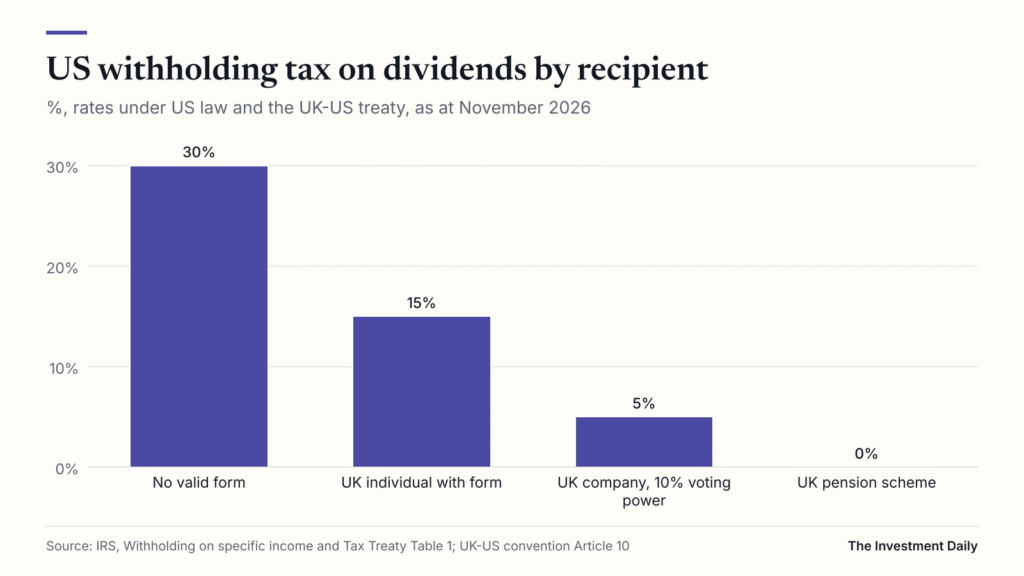
The US taxes income it sources to itself, including dividends paid by US companies, even when the shareholder lives abroad. The IRS says that for US-source income not connected with a US trade or business “the rate is usually 30%”, and that withholding agents must apply the statutory rate “unless a reduced rate or exemption under a tax treaty applies”.
The UK-US tax treaty reduces that. Article 10 caps US tax on dividends paid to a UK resident beneficial owner at “15 per cent. of the gross amount of the dividends” in ordinary cases (UK-US convention). A 5% rate applies only to a company holding at least 10% of the voting power of the paying company, and dividends beneficially owned by a pension scheme are exempt (HMRC, DT19852). The IRS treaty table for the United Kingdom shows the same 15% and 5% rates for dividends paid by US corporations and 0% on most interest (IRS Tax Treaty Table 1).
| Who receives the US dividend | US withholding tax | Source |
|---|---|---|
| Foreign person, no valid form | 30% | IRS |
| UK resident individual with a valid W-8BEN form | 15% treaty rate | UK-US treaty, Article 10(2)(b) |
| UK company owning at least 10% of the voting power | 5% | HMRC DT19852 |
| UK pension scheme, dividends not from a business it carries on | 0% (exempt) | UK-US treaty, Article 10(3)(b) |
The IRS instructions put the consequence plainly: failure to provide a Form W-8BEN when requested “may lead to withholding at the foreign-person withholding rate of 30%” (IRS). For illustration only, on a US$1,000 dividend that is the difference between receiving US$700 and US$850 in cash.
Interest, funds and REITs
The IRS table shows 0% US tax on most interest paid to UK residents under Article 11 of the UK-US tax treaty, although some contingent interest is taxed at 15%. Dividends from US real estate investment trusts and from regulated investment companies, the US legal form of most US-listed funds, can also qualify for the 15% treaty rate, but the IRS notes that the REIT rate applies only to certain beneficial owners (IRS Table 1, footnote mm).
How platforms collect the W-8BEN form
Most UK investors never see a paper copy. Platforms and brokers that offer US shares usually ask you to complete the W-8BEN form online when you first try to buy a US security, and some will not let you trade until it is done. The IRS allows this: “A withholding agent may allow you to provide this form with an electronic signature.” It adds that simply typing your name into the signature line is not an electronic signature, so platforms build in their own confirmation step (IRS instructions).
The parts of the form that matter to a UK resident
- Your details. Name and address as the platform holds them, which should match your UK tax residence for a UK treaty claim.
- Line 6a, foreign tax identifying number. The IRS requires the tax identifying number issued by your jurisdiction of tax residence in some cases, for example for an account held at a US office of a financial institution, unless an exception applies, and says it may also be given when claiming treaty benefits. Platforms say which UK reference they ask for.
- Line 9, treaty country. You “identify the country where you claim to be a resident for income tax treaty purposes”: the United Kingdom.
- Line 10, special rates and conditions. The IRS says this is used only if you are claiming treaty benefits that need conditions not covered elsewhere. A UK individual claiming the ordinary 15% dividend rate does not normally need it.
- Certification and signature. You sign to certify that the information is correct, electronically if the platform allows it.
If you have more than one broker, each needs its own form. The form is held by the withholding agent that asked for it, so a form given to one platform does not cover an account elsewhere.
When a W-8BEN form expires
The IRS instructions say a W-8BEN form generally remains valid from the date it is signed until “the last day of the third succeeding calendar year”, unless a change in circumstances makes any information on it incorrect (IRS). The calendar year in which you sign does not count as one of the three.
| Date signed | Normally valid until |
|---|---|
| 15 March 2026 | 31 December 2029 |
| 1 November 2026 | 31 December 2029 |
| 2 January 2027 | 31 December 2030 |
Platforms usually remind you to renew near the end of the period. If the form lapses, the platform may start withholding at 30% on dividends until a new one is in place. Excess US tax withheld at source is not something HMRC refunds, and it cannot be fully set against UK tax, as explained below.
A change of circumstances ends validity early. Moving abroad, becoming a US citizen or resident, or changing your name are examples. The IRS says you “must notify the withholding agent, payer, or FFI with which you hold an account within 30 days” of a change that makes the form incorrect (IRS). Someone who leaves the UK would generally need a new form claiming the treaty of their new country, if there is one.
US shares in an ISA
A stocks and shares ISA can hold shares in companies, funds and bonds (GOV.UK), and many platforms let you hold US-listed shares inside one. GOV.UK says: “You do not pay tax on dividends from shares in an ISA” (GOV.UK, tax on dividends). That is a UK tax rule. It does not bind the US.
US withholding tax still applies to dividends received in an ISA. The treaty exemption in Article 10(3)(b) is for pension schemes, and an ISA is not a pension scheme. With a valid W-8BEN form the rate is the 15% treaty rate; without one it can be 30%.
Because there is no UK tax on ISA dividends, there is no UK tax for the US tax to be credited against: HMRC’s helpsheet limits the credit to “the lower of” the foreign tax and the UK tax on that income (HMRC, HS263). The 15% treaty rate is a final cost in an ISA, and foreign tax credit relief is not available there.
For a dividend-focused investor, that 15% is part of the cost of owning US shares. Capital growth is not affected by US withholding tax on dividends, so its impact depends on how much of the return comes from income. Our guide to tax-efficient investing in the UK explains the order in which some investors use ISAs, pensions and general accounts.
US shares in a SIPP: the pension exemption
Pensions are treated differently under the UK-US tax treaty. Article 10(3)(b) says dividends shall not be taxed in the US if the beneficial owner is “a pension scheme, provided that such dividends are not derived from the carrying on of a business, directly or indirectly, by such pension scheme” (UK-US convention). Article 3 defines a pension scheme as an arrangement established in one of the countries that is generally exempt from income tax there and operates principally to provide pension or retirement benefits.
A self-invested personal pension is a UK registered pension scheme, so US dividends paid to it can in principle be exempt from US withholding tax. But the claim is made by the pension scheme, through its own documentation, not by you on a W-8BEN form, because the IRS says foreign entities use other forms. Whether the exemption is actually applied depends on the scheme administrator and the custody chain, so the rate obtained can differ between providers. A SIPP provider can say what rate it obtains on US dividends and how it claims it.
Whatever the US position, income and gains inside a registered pension are not taxed in the UK while they stay in the scheme. Withdrawals are taxed under the pension rules.
Reporting US dividends to HMRC
Outside an ISA or pension, in a general investment account, US dividends are taxable in the UK. GOV.UK says: “If you are UK resident, you’ll normally pay tax on your foreign income”, and that if you need to pay tax “you usually report your foreign income in a Self Assessment tax return” (GOV.UK, tax on foreign income). Foreign dividends go on the foreign supplementary pages, SA106.
The UK rates are the dividend rates. For 2026 to 2027 and 2027 to 2028 they are 10.75% at the ordinary rate, 35.75% at the upper rate and 39.35% at the additional rate, with a £500 dividend allowance, according to the Budget 2026 rates annex. Budget 2026 on 28 October 2026 left those rates and the allowance unchanged for 2027 to 2028. Dividends are converted into sterling for your return.
Foreign tax credit relief
To stop the same dividend being taxed fully twice, the UK gives foreign tax credit relief. The treaty says US tax is “allowed as a credit against any United Kingdom tax computed by reference to the same profits, income or chargeable gains” (Article 24). HMRC’s helpsheet sets the limits: the credit is the lower of the foreign tax paid, or allowed by the treaty, and the UK tax on that income (HMRC, HS263). In its example, where a treaty limits foreign tax to 15%, only 15% can be claimed, and HMRC says the excess may be recoverable from the foreign tax authority instead.
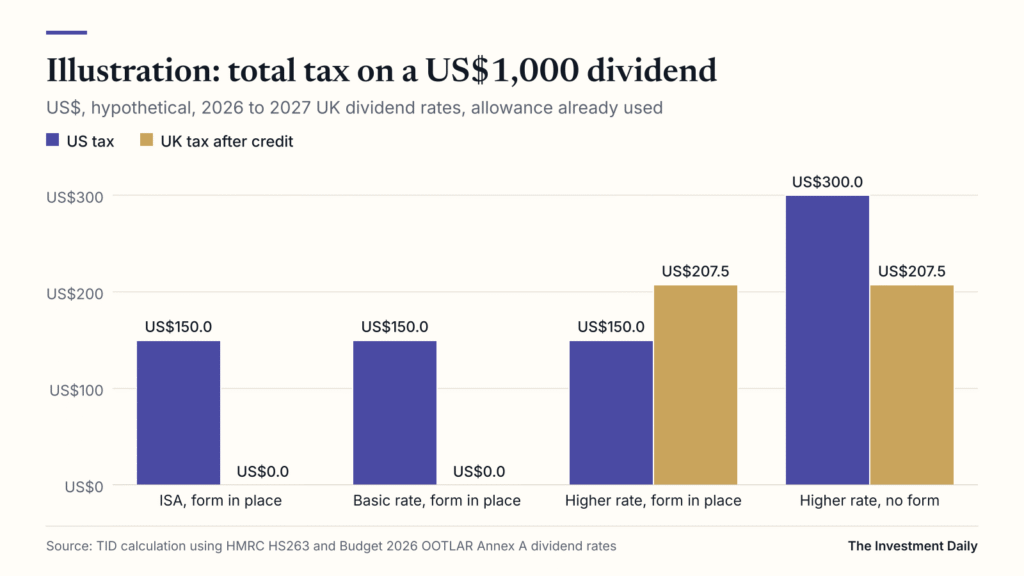
The worked example uses hypothetical figures for illustration only: a US$1,000 dividend in a general account in 2026 to 2027, with the £500 dividend allowance already used on other dividends and exchange-rate effects ignored.
| Illustration only | US tax withheld | UK tax before credit | Foreign tax credit relief | UK tax payable | Total tax |
|---|---|---|---|---|---|
| Basic-rate taxpayer, W-8BEN form in place | US$150 | US$107.50 (10.75%) | US$107.50 | US$0 | US$150 |
| Higher-rate taxpayer, W-8BEN form in place | US$150 | US$357.50 (35.75%) | US$150 | US$207.50 | US$357.50 |
| Higher-rate taxpayer, no form | US$300 | US$357.50 | US$150 (treaty limit) | US$207.50 | US$507.50 |
| Stocks and shares ISA, W-8BEN form in place | US$150 | US$0 | None | US$0 | US$150 |
Two points follow. For a basic-rate taxpayer, UK tax on the dividend is less than the 15% US tax, so part of the US tax goes unrelieved. And for anyone, missing the W-8BEN form means the extra US$150 above the treaty rate is not creditable in the UK; it can only be reclaimed from the US, which is not straightforward for an individual.
Platforms usually issue an annual tax statement for a general account showing each dividend gross, the US tax withheld and the net amount. Those figures are what you need to claim foreign tax credit relief, and HMRC’s helpsheet says the restricted amount of foreign tax should be included on the foreign supplementary pages, SA106 (HMRC, HS263). HMRC says a separate calculation is needed for each item of income, rather than combining them.
Capital gains are a UK matter
The W-8BEN form is about income. When you sell US shares held outside an ISA or pension, the gain is reported in the UK and taxed at 18% or 24% in 2026 to 2027, after the £3,000 annual exempt amount, according to the Budget 2026 rates annex. Gains and losses are worked out in sterling, so currency movements affect them.

US estate tax: the other cross-border issue
The W-8BEN form deals with income tax, and the UK-US tax treaty it relies on covers taxes on income and capital gains. Neither deals with US estate tax, which can apply to non-US people who die owning US assets. The IRS lists “Stock of corporations organized in or under U.S. law” as US-situated property, even if the certificates are held abroad or registered to a nominee, and says a nonresident’s executor must file a US estate tax return, Form 706-NA, if the value of US-situated assets “exceeds $60,000”.
The IRS also says estate tax treaties between the US and other countries “often provide more favorable tax treatment to nonresidents”, and that executors should check whether one applies. UK residents holding large amounts of US shares directly, through a platform, sometimes take advice on this point. Holding US shares through a UK or Irish fund can change the analysis, because the investor then owns units in a fund rather than US shares directly. Our guide to what an ETF is explains how funds hold their investments.
The UK has its own inheritance tax, with a nil-rate band of £325,000 and a residence nil-rate band of £175,000 (Budget 2026 rates annex). UK and US rules can both apply to the same estate.
W-8BEN form: common mistakes and what to check
- Not completing the form before the first dividend. Dividends paid before the form is accepted can be taxed at 30%.
- Letting it lapse. The form normally runs to the end of the third calendar year after the year it was signed, so the signing date matters.
- Assuming an ISA removes US tax. It removes UK tax only. The 15% treaty rate still applies to US dividends in an ISA.
- Not claiming foreign tax credit relief in a general account. If you pay UK tax on US dividends, the 15% US tax can be credited, up to the UK tax on that income.
- Claiming credit above the treaty rate. HMRC only gives foreign tax credit relief for tax allowed by the treaty.
- Forgetting to update after moving. A change of country makes the old form incorrect, and you have 30 days to tell the withholding agent.
- Signing one if you are a US citizen. US citizens are US persons wherever they live and use different forms.
The W-8BEN form is administration rather than an investment decision, but it changes the after-tax return on income from US shares. With the form, the UK-US tax treaty limits US withholding tax to 15% for an individual. Without it, 30% can be withheld, and the excess is hard to recover. Platforms can confirm whether a valid form is on file and the date it was signed.
US shares carry their own risks, including currency movements against sterling, and past performance is not a guide to future returns. For the basics of buying shares, see how to invest in shares, and for UK dividend tax see dividend investing after the 2026 dividend tax rise. More guides sit on the Equities desk.