Limited company buy to let means the properties are owned by a company, usually one you set up and control, rather than by you personally. The company pays corporation tax on its rental profit, at 19% on profits up to £50,000 and 25% above £250,000 according to HMRC’s Budget 2026 rates annex, and it can deduct mortgage interest in full.
Individual landlords cannot: they get a tax credit at a fixed rate instead. The catch is that the money is still inside the company, and taking it out as dividends is taxed again. Buying through a company also carries the higher rates of stamp duty land tax, and moving existing properties into one can trigger capital gains tax.
Budget 2026, delivered on 28 October 2026, made the comparison sharper. From 6 April 2027 individuals will pay separate property income rates of 24%, 44% and 49% in England, Wales and Northern Ireland (Budget 2026 OOTLAR, item 1.2). Companies are outside that change. This guide sets out each tax in turn, with worked examples, so you can see where the numbers come from.
How limited company buy to let works
A company is a separate legal person. In limited company buy to let the company buys the property, takes out the mortgage, signs the tenancy and receives the rent. You are its director and shareholder. You own the shares; you do not own the house.
That separation drives almost everything in this guide. The company’s profits are taxed under company tax rules, not income tax rules. Your personal tax only arises when value passes from the company to you, typically as salary, dividends, interest on a loan you made to the company, or when the company is sold or wound up.
Most landlords who use this structure set up a new private company limited by shares for the purpose, often called a special purpose vehicle by lenders. The term is a lending label rather than a legal category. What matters to the tax rules is that the company carries on a property business letting residential property.
- The company pays corporation tax on rental profit after deducting costs, including all finance costs.
- You pay income tax when you take money out, at dividend rates if you take dividends.
- The company pays stamp duty land tax when it buys, normally at the higher rates for additional dwellings.
- When the company sells a property, any gain is charged to corporation tax, not capital gains tax.
Corporation tax on rental profits
For the financial years starting 1 April 2026, 1 April 2027 and 1 April 2028, the main rate of corporation tax is 25% and the small profits rate is 19%, with a lower limit of £50,000 and an upper limit of £250,000, according to Annex A of the Budget 2026 OOTLAR. Budget 2026 confirmed that the 25% main rate and 19% small profits rate are maintained for the financial year beginning 1 April 2028 (OOTLAR item 1.38).
Profits between the two limits pay the main rate reduced by marginal relief, calculated with a fraction of 3/200 (Annex A). In practice the effective rate on a company’s profit rises gradually from 19% to 25% across that band. A small portfolio with taxable profit below £50,000 pays 19% on all of it.
| Company taxable profit | Rate | Source |
|---|---|---|
| Up to £50,000 | 19% small profits rate | OOTLAR Annex A |
| £50,001 to £250,000 | 25% main rate less marginal relief (fraction 3/200) | OOTLAR Annex A |
| Over £250,000 | 25% main rate | OOTLAR Annex A |
The company’s tax bill is worked out on its accounting period. Allowable costs include letting agent fees, repairs, insurance, accountancy, ground rent and service charges, and, in a company, interest and other finance costs on the mortgage. Capital spending, such as an extension, is not deducted from rental profit; it is added to the cost of the property for when it is sold.
The property income rates announced in Budget 2026 do not apply to companies. HMRC’s tax information and impact note says the measure will affect “individuals and partnerships who receive income from letting property”, along with savers, trustees and personal representatives (HMRC, 29 October 2026). Companies are not in that list.
Mortgage interest: section 24 and the company alternative
The single biggest reason landlords look at limited company buy to let is the restriction on finance costs for individuals, commonly called section 24 after the section of the Finance (No. 2) Act 2015 that introduced it (HMRC, PIM2054). The restriction was phased in from 2017 to 2018, and since 2020 to 2021 an individual letting residential property cannot deduct mortgage interest from rental income. Instead they get a tax reduction worth a fixed percentage of the interest.
HMRC’s Property Income Manual is explicit about who escapes the rule: “Companies carrying on property business are not affected” (HMRC, PIM2054). The same page says loans wholly for commercial property are also outside the restriction. So a company deducts its mortgage interest in full, just like any other business expense, and pays tax only on what is left.
For individuals the tax reduction is the relievable amount multiplied by a rate. Section 274AA of the Income Tax (Trading and Other Income) Act 2005, as amended by Schedule 1 to the Finance Act 2026, sets that rate as the “property basic rate of income tax for the year” for 2027 to 2028 and later years (ITTOIA 2005, section 274AA, on legislation.gov.uk).
Budget 2026 announced that the property basic rate will be 24% from 6 April 2027, with legislation to follow in Finance Bill 2026-27 (Budget 2026 OOTLAR, item 1.2). On that basis the section 24 credit for landlords in England, Wales and Northern Ireland rises from 20% to 24% from 6 April 2027, while the tax on the profit rises too.
The credit is capped. HMRC’s worked guidance says the reduction is the basic-rate value of the lowest of three figures: finance costs not deducted in the year plus any brought forward, property profits after losses brought forward, and adjusted total income above the personal allowance (HMRC case studies). Anything unused carries forward. A company has no equivalent cap because interest is simply a deduction.
Why the credit matters most to higher-rate landlords
A basic-rate landlord pays tax at the property basic rate on profit before interest and gets a credit at the same rate on the interest. The two roughly cancel. A higher-rate landlord pays 44% on profit before interest from April 2027, but gets only 24% back on the interest. That gap is the core of the case for limited company buy to let. The more of the rent that goes on interest, the wider that gap becomes, and in heavily mortgaged portfolios the tax can exceed the cash profit.
The April 2027 property rates and limited company buy to let
From 6 April 2027 an individual’s property income will be taxed at 24% in the basic rate band, 44% in the higher rate band and 49% in the additional rate band, in England, Wales and Northern Ireland (HMRC tax information and impact note). Before Budget 2026, section 7 of the Finance Act 2026 had set separate property rates of 22%, 42% and 47% for that year (Finance Act 2026, section 7); Budget 2026 adds a further two percentage points, to be legislated in Finance Bill 2026-27. Scotland and Wales have been given the power to set their own property rates.
Income tax thresholds stay frozen: the personal allowance is £12,570 and the basic rate band £37,700 in 2026 to 2027 and 2027 to 2028, with the additional rate starting at £125,140 (OOTLAR Annex A). None of this touches profit kept inside a limited company buy to let structure, which still pays 19% to 25%.
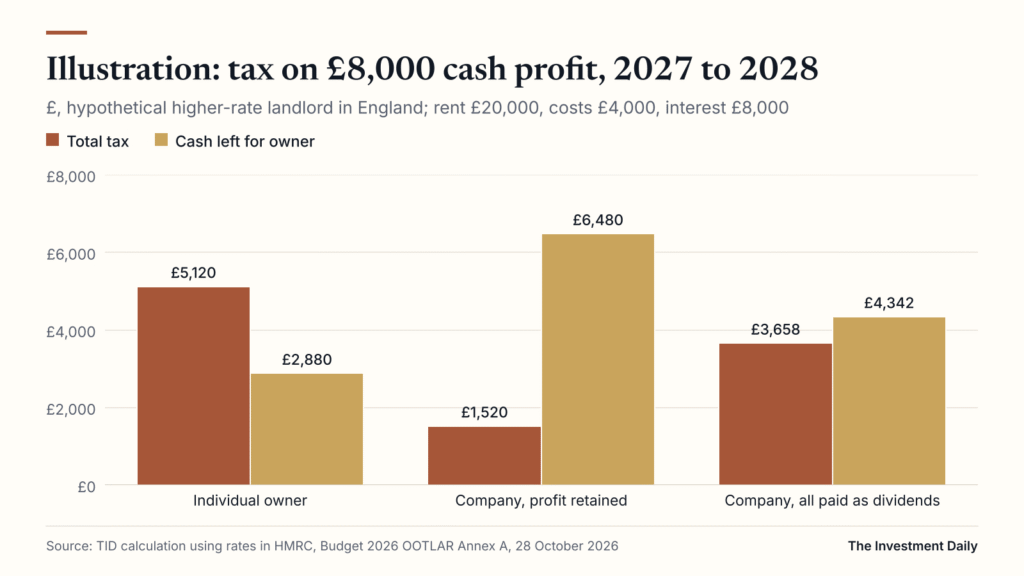
To see how section 24 and the new rates compare with limited company buy to let, the worked example below uses hypothetical figures for illustration only. It assumes a landlord in England whose salary already uses the whole basic rate band and whose total income, including the rent, stays below £100,000, a full tax year 2027 to 2028, rent of £20,000, running costs of £4,000 and mortgage interest of £8,000, and a company with no other income and a 12-month accounting period.
| Illustration only | Individual, higher rate, 2027 to 2028 | Company, profit retained | Company, all profit paid as dividend |
|---|---|---|---|
| Rent less running costs | £16,000 | £16,000 | £16,000 |
| Mortgage interest deducted | £0 (credit instead) | £8,000 | £8,000 |
| Taxable profit | £16,000 | £8,000 | £8,000 |
| Tax on profit | £7,040 at 44% | £1,520 at 19% | £1,520 at 19% |
| Finance cost credit | minus £1,920 (24% of £8,000) | Not applicable | Not applicable |
| Dividend tax on £6,480 | Not applicable | None yet | £2,138 (35.75% on £5,980 after the £500 allowance) |
| Total tax | £5,120 | £1,520 | £3,658 |
| Cash left for the owner | £2,880 | £6,480 inside the company | £4,342 |
For comparison, the same individual in 2026 to 2027 would pay 40% on £16,000, which is £6,400, less a 20% credit of £1,600, a total of £4,800. The Budget 2026 rates therefore add £320 a year in this example. The company figures exclude the extra accountancy, filing and mortgage costs that a company usually carries, which narrow the gap.
Run the same numbers for a basic-rate landlord whose £16,000 sits entirely within the basic rate band and the result flips. Personally they would pay 24% of £16,000, which is £3,840, less the £1,920 credit: £1,920 in total. Through the company, corporation tax of £1,520 plus dividend tax at 10.75% on £5,980, which is £643, gives £2,163 if all the profit is paid out. In this example, limited company buy to let does not save a basic-rate landlord tax on income that is drawn every year.
Getting money out: dividend tax and other routes
Profit inside a company is not yours to spend until it is paid out. Dividends are the most common route. For 2026 to 2027 and 2027 to 2028 the dividend tax rates are 10.75% at the ordinary rate, 35.75% at the upper rate and 39.35% at the additional rate, with a dividend allowance of £500 (OOTLAR Annex A). Dividends are paid from post-tax profit, so the company has already paid tax on them.
Dividend tax is the reason limited company buy to let works best for landlords who can leave profits in the company, to pay down debt or buy more property. If every pound is drawn each year, two layers of tax apply and the advantage shrinks or disappears, as the worked example shows.
- Dividends. Taxed at dividend rates above the £500 allowance. A company can only pay dividends out of distributable profits.
- Salary. Deductible for the company but subject to income tax and National Insurance, and the director needs to do real work for it to be justified as a business expense.
- Repaying a director’s loan. If you lent the company money to buy property, it can repay you without further tax. Interest the company pays you on the loan is deductible for it and taxable on you as savings income, at 24%, 44% or 49% from 6 April 2027 (OOTLAR Annex A).
- Sale or winding up. Selling the shares or liquidating the company brings capital gains tax rules into play, at 18% or 24% for individuals in 2026 to 2027 (OOTLAR Annex A).
Budget 2026 also confirmed that the government is proceeding with plans to modernise how company distributions to individual shareholders are taxed, with draft legislation in 2027 and changes taking effect from April 2028 (OOTLAR item 2.15). The detail is not yet published. It is relevant to anyone expecting to draw dividends from a property company over many years. For background on how dividends are taxed in general, see our guide to dividend investing after the 2026 dividend tax rise.

Stamp duty land tax when a company buys
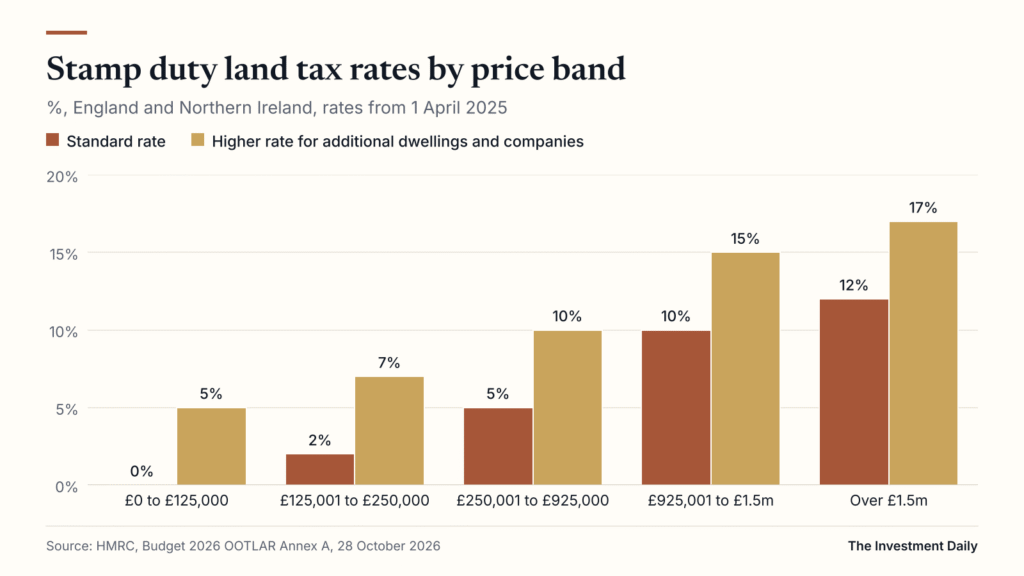
Companies buying residential property in England and Northern Ireland pay stamp duty land tax. HMRC’s guidance says “There is a 5% surcharge on residential properties bought by companies” (HMRC, SDLT: corporate bodies). Its guidance on additional properties adds that companies must pay the higher rates for any residential property they buy if it costs £40,000 or more and is not subject to a lease with more than 21 years left (HMRC, SDLT: buying an additional residential property). An individual buying a first and only home does not pay the surcharge; a company always does once those conditions are met.
| Price band (from 1 April 2025) | Standard residential rate | Higher rate for additional dwellings and companies |
|---|---|---|
| £0 to £125,000 | 0% | 5% |
| £125,001 to £250,000 | 2% | 7% |
| £250,001 to £925,000 | 5% | 10% |
| £925,001 to £1.5m | 10% | 15% |
| Over £1.5m | 12% | 17% |
Source: Budget 2026 OOTLAR Annex A. Scotland and Wales have their own land taxes with different rates.
For illustration only: a company buying a £250,000 flat pays 5% on the first £125,000, which is £6,250, and 7% on the next £125,000, which is £8,750, a total of £15,000. An individual buying the same flat at standard rates would pay £2,500. But a landlord who already owns a home would also pay the higher rates personally, so for an existing landlord, limited company buy to let does not, on its own, add stamp duty land tax on a new purchase.
Above £500,000 a different rule applies. HMRC says stamp duty land tax “is charged at 17% on residential properties costing more than £500,000 bought by certain corporate bodies” (HMRC). Relief from the 17% rate may be available if the property is used in a property rental business, but the conditions must be met.
Companies owning UK residential property worth more than £500,000 may also fall within the Annual Tax on Enveloped Dwellings, where the charge for 1 April 2026 to 31 March 2027 starts at £4,600 a year for a property worth more than £500,000 and up to £1m (GOV.UK, ATED). There is a relief for property let to a third party on a commercial basis and not occupied by anyone connected with the owner, but where it reduces the charge to nil the company still has to file a Relief Declaration Return (GOV.UK, ATED reliefs).
Moving existing properties into limited company buy to let
Buying new property through a company is one decision. Transferring properties you already own into one is a different and often far more expensive one, because the company has to buy them from you.
Capital gains tax at market value
GOV.UK’s connected persons rules say individuals are connected with a company if they have control of it (GOV.UK, connected persons). HMRC’s Capital Gains Manual says connected persons are treated as parties to a transaction “otherwise than by way of bargain at arm’s length”, so the disposal is valued at market value whatever the company actually pays (HMRC, CG14560). You are taxed on the gain since you bought each property, at 18% or 24%, after the £3,000 annual exempt amount (OOTLAR Annex A).
Stamp duty land tax at market value
The company also pays stamp duty land tax on the transfer. Where the buyer is a company and the seller is connected with it, HMRC’s manual says “The chargeable consideration for such transfers will be not less than the market value at the effective date” (HMRC, SDLTM30220). On a portfolio, at the higher rates, this can be a large sum.
Incorporation relief
Incorporation relief, under section 162 of the Taxation of Chargeable Gains Act 1992, can postpone the capital gains tax. It applies where a person transfers a business as a going concern with the whole of its assets, other than cash, to a company wholly or partly in exchange for shares; the gain is rolled over by reducing the base cost of the shares (HMRC, CG65700). Tax is then deferred until the shares are sold.
The rules changed for transfers made on or after 6 April 2026. Section 39 of the Finance Act 2026 amended section 162 so that relief applies only if the person “makes a claim in respect of the transfer”, and repealed the section 162A election to disapply it, with effect for “transfers of businesses made on or after 6 April 2026” (Finance Act 2026, section 39). HMRC’s manual confirms: “For transfers taking place on or after 6 April 2026 a claim is required” (HMRC, CG65700). For transfers before that date the relief was automatic where the conditions were met.
The claim must be made by the first anniversary of 31 January following the tax year of transfer, so a transfer in July 2026 must be claimed by 31 January 2029 (HMRC, CG65735). HMRC says the claim is normally made in or with the tax return for the year of transfer. The GOV.UK summary page still says the relief is automatic (GOV.UK, Incorporation Relief), and the latest HS276 helpsheet covers 2025 to 2026, when that was true; for transfers on or after 6 April 2026 the Finance Act 2026 rule applies.
The hard question is whether a letting portfolio is a business for this purpose. Holding a few properties and collecting rent may be treated as an investment rather than a business, and relief is then not available. The answer depends on the facts, such as how much time and activity the landlord puts in. Because incorporation relief only defers the gain and does not remove the stamp duty land tax, many landlords take regulated tax advice before transferring anything.
Mortgages, running costs and Companies House duties
Company buy-to-let mortgages are a separate part of the lending market. Product choice and rates are set by each lender, and lenders may ask directors for personal guarantees, so the limited liability of the company may not protect you from the mortgage debt. Remortgaging properties into a company can also bring arrangement fees, valuation fees and early repayment charges on the existing personal loans.
A company also has legal duties that a personal landlord does not. Companies House charges £100 to incorporate a company online and £50 for an online confirmation statement, fees that took effect from 1 February 2026 (Companies House fees; Companies House, 2026 fee changes). According to GOV.UK, a company must file annual accounts with Companies House within 9 months of its financial year end (21 months from registration for first accounts), file its Company Tax Return within 12 months of the end of the accounting period, and pay corporation tax within 9 months and 1 day (GOV.UK, accounts and tax returns).
| Duty | Deadline or cost | Source |
|---|---|---|
| Incorporate online | £100 | Companies House |
| Confirmation statement, online | £50 | Companies House |
| Annual accounts to Companies House | 9 months after year end | GOV.UK |
| Pay corporation tax | 9 months and 1 day after the accounting period | GOV.UK |
| Company Tax Return | 12 months after the accounting period | GOV.UK |
Accountancy for a company is usually more expensive than for a personal Self Assessment return. Those costs are deductible for the company, but they come out of every year’s profit, which is why small portfolios sometimes gain little from incorporating.
Selling a property owned by the company
When a company sells a property, the gain is charged to corporation tax, not to capital gains tax. GOV.UK says companies can adjust the cost for inflation using Indexation Allowance only for assets held before December 2017, and only up to that date (GOV.UK, work out a chargeable gain). Getting the sale proceeds out to you is then a second taxable step, as a dividend or on winding up.
Common mistakes with limited company buy to let
- Comparing only the corporation tax rate with your income tax rate, and forgetting dividend tax on money you draw.
- Assuming an existing portfolio can move into a company tax-free. Capital gains tax and stamp duty land tax are both based on market value.
- Treating incorporation relief as automatic. For transfers from 6 April 2026 it has to be claimed.
- Ignoring the cost of running a company, from accounts to filing fees, when the portfolio is small.
- Forgetting that the company, not you, owns the property. Living in it, or letting a relative use it rent-free, has tax consequences for the company and can affect reliefs such as ATED relief.
- Relying on articles written before 28 October 2026 for the April 2027 rates. Budget 2026 raised the property rates to 24%, 44% and 49% and the section 24 credit now follows the property basic rate.
Property is only one route into the asset class. Some investors get rental exposure without owning houses at all, through real estate investment trusts. Our guide to property as an investment compares the main options.
Limited company buy to let: what to check before deciding
Limited company buy to let is a tax structure, not an investment in itself. The rental market, the mortgage rate and the property’s condition matter as much as the tax. The structure changes who pays tax, when and at what rate, and it brings costs and duties of its own.
- Your tax band. The gap between 44% on profit and a 24% credit on interest is what a company removes, because section 24 does not apply to it. Basic-rate landlords gain far less from limited company buy to let.
- Whether you need the income. Profit left in the company is taxed once. Profit drawn as dividends pays dividend tax at 10.75%, 35.75% or 39.35% as well.
- How much debt is involved. The higher the mortgage interest as a share of rent, the bigger the effect of section 24 on a personal landlord.
- The costs of moving. For existing property, model capital gains tax and stamp duty land tax at market value, and whether incorporation relief could apply.
- Running costs. Accounts, filing fees, company mortgage pricing and any ATED returns.
- What is still changing. The distributions reform from April 2028 and the property rates from 6 April 2027 are both new. Check the Budget 2026 OOTLAR for detail as legislation is published.
Limited company buy to let suits some landlords and not others, and the arithmetic depends on figures only you have. Tax rules can change again, property values can fall, and rental income is never guaranteed. Our buy-to-let and landlord tax section covers the personal side of the rules, and tax and wrappers explains how different accounts are taxed.