
Structured products are fixed-term plans whose return follows a formula linked to an index such as the FTSE 100. A structured deposit is a bank deposit, so your capital is not exposed to the market and is covered by the FSCS up to £120,000. A structured investment, such as an “autocall” plan, is a note issued by a bank, so your capital is exposed to the market and to the bank’s failure. The FCA’s 2015 review found £21.5bn invested by about 1.3 million customers in 1,452 structured deposits and capital protected plans sold by the nine firms it reviewed from June 2008 to May 2013 (FCA TR15/2).
This explainer sets out how the payoffs work, with a hypothetical FTSE 100 autocall, the counterparty risk and FSCS protection, the costs built into the price, the FCA’s rules on product information and fair value, and how returns are taxed after Budget 2026. For plain savings and bonds, see our cash savings desk and gilts or a savings account.
What structured products are
The FCA describes structured products as “compound financial instruments that have the characteristics of combining a base instrument (typically a medium term note) with an embedded derivative that provides economic exposure to reference assets, indices or other economic values”. They are “generally manufactured by bank structuring desks” and, for retail investors, usually sold through a separate distributor such as an adviser or plan provider (FCA TR15/2).
The FCA’s review distinguishes three kinds. Each has the same basic shape, a formula applied over a fixed term, but a very different risk.
- A structured capital at risk product, which the FCA calls a SCARP: if the reference index performs within set limits you get your capital back, “but if not, the customer could lose some or all of the initial capital invested”.
- A capital protected structured product: it “promises to provide a minimum return of 100% of the initial capital invested so long as the issuer(s) of the financial instrument(s) underlying the product remain(s) solvent”.
- A structured deposit: “a deposit paid on terms under which any interest or premium will be paid, or is at risk, according to a formula” linked to an index, a stock or a commodity.
The sales figures in the FCA’s review cover structured deposits and capital protected products only, so they leave out capital at risk plans such as most autocalls.
Structured deposit or structured investment: the difference that matters
The labels can look similar in a brochure. The legal form decides who owes you the money, what happens if they fail, and how the return is taxed.
| Feature | Structured deposit | Structured investment (capital at risk) |
|---|---|---|
| What you own | A deposit with a bank or building society | A security, usually a note, issued by a bank or its subsidiary |
| Market risk to capital | None at maturity; the index affects only the return | Capital can be lost if the index ends below a barrier |
| If the issuer fails | FSCS deposit protection up to £120,000 per person per bank | You are a creditor of the issuer; no FSCS protection for its default |
| Typical return | A share of index growth, or a fixed amount if a condition is met | A fixed amount for each year if a condition is met |
| Tax outside a wrapper | Return generally treated as interest (savings income) | Depends on terms: capital gains or savings income |
The FSCS protection limit for deposits rose to £120,000 on 1 December 2025, according to the FSCS. The PRA’s Depositor Protection rules require banks to report structured deposit accounts for compensation purposes and say that, where the return cannot be calculated until maturity, the balance to report is “the total of the principal, any attributable contractual minimum return and any interest accrued prior to the product start date”. In other words, the protection covers what you put in and any guaranteed minimum, not an index-linked return that has not yet been fixed.
How a FTSE 100 autocall works: an illustration
An autocall, or kick-out plan, is a type of capital at risk plan that can be linked to the FTSE 100. On set dates, usually each anniversary, the plan checks the index. If the FTSE 100 is at or above a trigger level, the plan matures early and pays back your capital plus a fixed return for each year elapsed. If it never triggers, what you get back at the end depends on whether the index has fallen below a barrier.
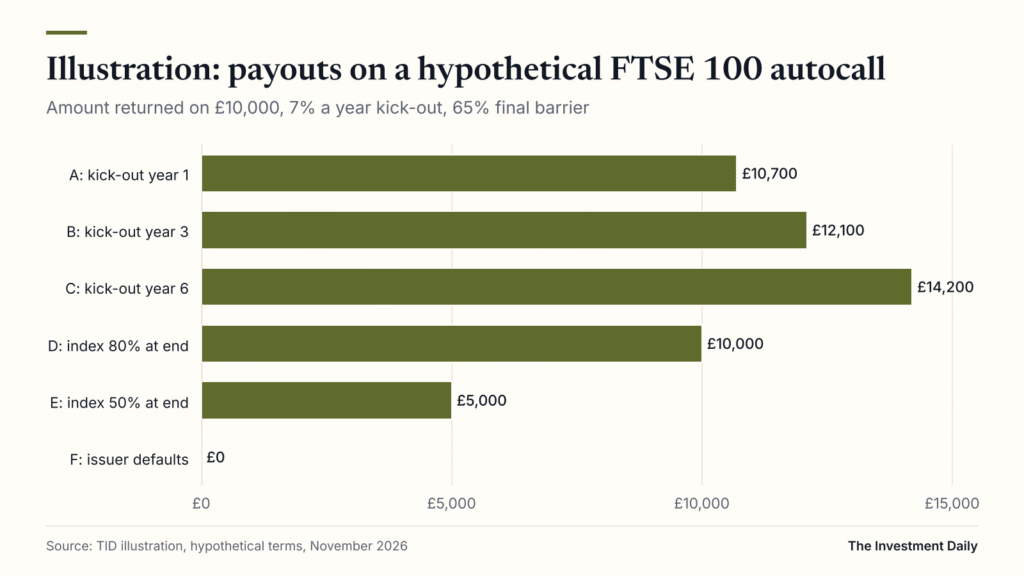
The example below is hypothetical, for illustration only. It is a six-year FTSE 100 autocall with £10,000 invested, a kick-out trigger at 100% of the starting index level on each anniversary, a return of 7% for each year elapsed, and a 65% barrier tested only on the final date.
| Illustration only: scenario | When it ends | FTSE 100 on that date, % of start | Amount returned |
|---|---|---|---|
| A: index above start at first anniversary | Year 1 | 102% | £10,700 |
| B: index first back above start in year 3 | Year 3 | 101% | £12,100 |
| C: index only reaches start at the final date | Year 6 | 100% | £14,200 |
| D: index down but above the barrier | Year 6 | 80% | £10,000 |
| E: index below the barrier | Year 6 | 50% | £5,000 |
| F: issuing bank defaults | Any time | Irrelevant | Possibly nothing |
Three features are easy to miss. In scenario E the loss tracks the index fall in full, so a fall below the barrier turns a “protected” plan into a 50% loss. Gains are capped: in scenario A the investor gets 7% even if the FTSE 100 had risen 20%. And the formula uses the index level, so you do not receive the dividends paid by FTSE 100 companies, which an index fund investor would.
For comparison, also hypothetical: £10,000 in a six-year fixed deposit at 3% a year, compounded, would grow to about £11,941 with no market risk. The FCA’s behavioural research found that investors “significantly overestimated the expected returns of all structured deposits tied to the FTSE index”, by 80% on average, equivalent to 1.9% a year, and that most ranked them above “best buy cash term deposits, which offered 3% per year” although the structured deposits “would have been likely to return less than this” (FCA TR15/2).
Counterparty risk: the lesson of Lehman Brothers
All structured products are promises. Even a plan described as capital protected is, in the FCA’s words, protected only “so long as the issuer(s) of the financial instrument(s) underlying the product remain(s) solvent”, and the FCA notes that this repayment “is not affected by the market risk factors but is subject to counterparty (credit) risk”. The formula only matters if the bank behind it can pay.
Lehman Brothers showed what that means. The Bank of England’s October 2008 Financial Stability Report records that Lehman Brothers filed for bankruptcy on 15 September 2008, and that “some investors lost access to funds that had been held by Lehman Brothers”. Any structured plan that relied on a Lehman company as issuer or counterparty was exposed to that default, whatever the FTSE 100 did afterwards. Holders of such plans became creditors of a failed company rather than holders of an index-linked return.
Counterparty risk is not only about outright failure. If the issuing bank’s credit weakens during the term, the price it will pay to buy a plan back before maturity can fall even when the index has not moved. The FCA’s review notes that the buy-back price is “largely driven by issuer appetite and the pricing of their credit in markets at the time” and the cost of unwinding the bank’s hedge.
- Check which legal entity issues the note and which entity guarantees it.
- Check the issuer’s credit rating, and whether a plan spreads its counterparty risk across several banks.
- Read the section of the product document headed “What happens if” the manufacturer “is unable to pay out”.
FSCS protection for structured products
FSCS protection depends on the legal form. For a structured deposit, deposit protection applies up to £120,000 per eligible person, per bank, building society or credit union, according to the FSCS.
For a structured investment, the position is narrower. The FSCS investment limit is £85,000 per person per firm, but it applies only where an authorised firm has failed and “the PRA or the FCA must have authorised the provider or adviser, as well as regulated the service and product it provided” (FSCS). It says it cannot accept claims “for poor investment performance”. The default of the bank that issued the note is a credit loss, not a claim the FSCS pays.
The FSCS can help where the firm that arranged or administered the plan fails. In a 2024 case study, it describes an investor in “a structured fixed-term investment product” whose wealth management firm went into administration; the plan was matured a day early, he received about £1,400 less than he should have, and the FSCS paid him the difference (FSCS).
Claims for unsuitable advice can also be covered if the adviser’s firm has failed, provided the advice was given on or after 28 August 1988.
The costs built into structured products
Structured products rarely show a single annual charge in the way a fund does. The bank’s margin, the distributor’s fees and the cost of the derivatives are built into the terms: the trigger level, the fixed return and the barrier. A plan offering 7% a year might have offered more if less had been taken out at the start. You cannot see that margin from the headline terms alone.
The FCA expected firms to test value before launch. Its 2015 review said the better firms set “an appropriate hurdle rate (or threshold)” reflecting “the opportunity cost of the returns available from other, less risky alternative products”, such as cash, and checked whether modelled returns cleared it. Under the Consumer Duty, firms must now show that the price a customer pays “is reasonable compared to the overall benefits they receive”, which the FCA calls fair value (FCA).
Leaving early is another cost. Plans are “designed to be held to maturity”, the FCA says, pricing data on secondary markets is usually available only through advisers or private banks, and “in most situations the product holder is essentially captive, with the firm being the only source of secondary market liquidity”.
FCA rules: PRIIPs, consumer composite investments and the Consumer Duty
Since January 2018, structured investment products and structured deposits sold to retail investors have needed a Key Information Document under the PRIIPs rules. The FCA lists “structured investment products (whatever their form)” and “structured deposits” among products in scope, and describes the KID as “a stand-alone, standardised document” of up to three sides of A4 (FCA). For structured products, its required sections include one on the risks and what you could get in return, and one on what happens if the manufacturer is unable to pay out.
That regime is being replaced. The FCA says “the PRIIPs Regulations have now been repealed and replaced by the Consumer Composite Investments Regulations”. Under its final rules in PS25/20, the legislation commenced on 6 April 2026, opening an optional transition period in which manufacturers can choose between a new “product summary” and their existing disclosures, and the new rules come fully into effect on 8 June 2027. During the transition you may see either a KID or a product summary for structured products.
The Consumer Duty applies on top. The FCA’s principle is that “a firm must act to deliver good outcomes for retail customers”, with four outcomes covering products and services, price and value, consumer understanding and consumer support. For structured products, that means a defined target market, fair value against alternatives and information that customers can understand.
| Rule or regime | What it requires | Key dates |
|---|---|---|
| PRIIPs Key Information Document | A standard document of up to three A4 sides on risks, returns, costs and what happens if the manufacturer cannot pay | From January 2018; repealed and replaced |
| Consumer Composite Investments (PS25/20) | A product summary with standardised information on costs, risk, return and past performance | Legislation commenced 6 April 2026; fully in force 8 June 2027 |
| Consumer Duty | Good outcomes for retail customers, including fair value and consumer understanding | In force; FCA guidance updated 23 October 2026 |
| FSCS deposit protection | Covers structured deposits up to £120,000 per person per bank | Limit raised on 1 December 2025 |

Tax on structured products after Budget 2026
How structured products are taxed depends on the legal form and the exact terms, so read the tax section of the plan document and check with the provider. The main routes are these.
Structured deposits
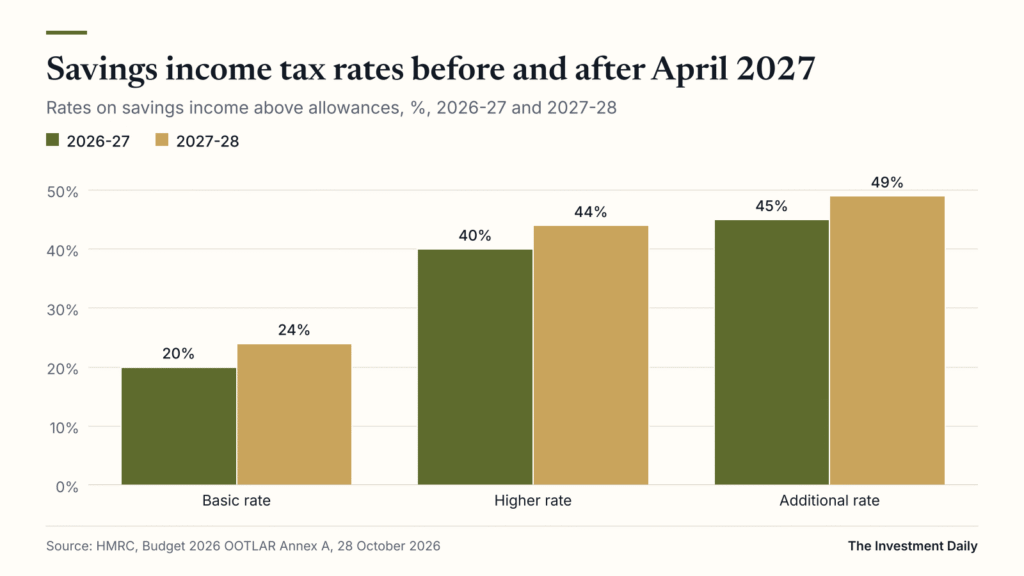
The FCA describes the return on a structured deposit as “interest or premium” paid according to a formula. Interest is “savings income” under section 18 of the Income Tax Act 2007, so it counts against the Personal Savings Allowance of £1,000 for basic rate and £500 for higher rate taxpayers. Budget 2026 confirmed that savings income rates rise from 20%, 40% and 45% in 2026-27 to 24%, 44% and 49% from 6 April 2027, according to OOTLAR Annex A. That matters because a structured deposit can pay several years’ return in one go at maturity.
A hypothetical example. A higher rate taxpayer receives a £1,500 return on a structured deposit in 2027-28 and has no other savings income. Assuming the whole return is taxed in that year, £500 is covered by the allowance and £1,000 is taxed at 44%, so the tax is £440. In 2026-27, at 40%, it would have been £400.
Structured investments: capital gains or income
For notes, the test is in the deeply discounted securities rules. Profits on deeply discounted securities are charged to income tax (ITTOIA 2005, section 427) and count as savings income. But “excluded indexed securities”, whose redemption amount follows the change in an index of chargeable assets such as shares, are “outside the deeply discounted security rules, and are instead taxed under the capital gains rules”, HMRC says (HMRC SAIM3050).
The capital protection test decides which side a plan falls on. A plan can still be an excluded indexed security if its guaranteed minimum repayment is not more than 10% of the issue price (ITTOIA 2005, section 433): HMRC explains that “unless they can lose at least 90% of the amount invested it is not an excluded indexed security, and will be a deeply discounted security”.
For FTSE 100 plans where principal is fully at risk below a threshold, HMRC says that “provided that there is a realistic prospect of such an event occurring”, they will be treated as having capital protection of 10% or less.
| Illustration only: £10,000 plan, gain of £2,100 | Taxed as a capital gain | Taxed as savings income (higher rate, 2027-28) |
|---|---|---|
| Allowance | £3,000 annual exempt amount | £500 Personal Savings Allowance |
| Taxable amount | £0, if no other gains | £1,600 |
| Rate | 18% or 24% | 44% |
| Tax | £0 | £704 |
Capital gains tax rates are 18% and 24%, with an annual exempt amount of £3,000, in 2026-27 and 2027-28; Budget 2026 did not change them. Losses on a plan taxed under capital gains rules can usually be set against other gains. Inside a stocks and shares ISA or a pension, none of this applies: GOV.UK says you do not pay tax on “income or capital gains from investments in an ISA” (GOV.UK), although whether a particular plan can be held in an ISA depends on its form and the provider.
Structured products: what to check before you invest
Structured products swap open-ended market exposure for a formula with a fixed term, a capped return and, for capital at risk plans, a barrier below which losses run in full. They depend entirely on the bank behind them. The FCA’s research found that investors tended to overestimate what they would earn, and the costs are built into the terms rather than shown as a fee.
- Establish whether it is a structured deposit or a structured investment, and which legal entity owes you the money.
- Read the formula in full: trigger levels, barrier, observation dates and how the barrier is tested.
- Find the worst outcome in the product summary or KID, and how likely the document says it is.
- Compare the return with a fixed-rate deposit or a gilt held for the same term.
- Allow for the dividends you would not receive, and ask what an early exit would cost.
- Check what FSCS protection applies, and to what: the deposit, the adviser, or nothing.
- Ask how the return will be taxed, and in which tax year.
Past performance is not a guide to future returns. For index exposure without a formula, see our guide to index funds; for other alternatives, the Alternatives desk.