
An innovative finance ISA is a tax-free wrapper for loans rather than shares or cash. GOV.UK says it can include peer-to-peer loans, “loans that are given to other people or businesses without using a bank”, and crowdfunding debentures, which means investing in a business by buying its debt (GOV.UK). Interest and gains inside it are free of UK tax, and subscriptions count towards the same £20,000 annual ISA allowance as other ISAs. The trade-off is risk: borrowers can default, money can be locked in, and the FCA says loan-based crowdfunding does not have FSCS protection.
This explainer covers what the account can hold, how the allowance works after Budget 2026, what happens when borrowers or platforms fail, how the tax compares with holding the same loans outside an ISA, and what HMRC’s statistics show.
What an innovative finance ISA is
There are four types of adult ISA: cash, stocks and shares, innovative finance and the Lifetime ISA (GOV.UK). The innovative finance ISA was designed for lending-based investments arranged through online platforms. In most cases the ISA manager is the platform itself, and the money you subscribe is lent on to individual or business borrowers, either loan by loan or through a pooled lending product.
The return is interest paid by borrowers, minus the platform’s fees and minus any losses when borrowers do not repay. Unlike a cash ISA, the interest rate is not a promise by a bank. It is a target that depends on borrowers keeping up their payments.
- What you own: a share in loans to people or businesses, or debt securities issued by companies or charities.
- Who manages it: an ISA manager approved by HMRC, usually also the lending platform.
- Tax: no UK income tax on interest and no capital gains tax inside the wrapper.
- Protection: not the same as a cash ISA. FSCS says money held with a UK-authorised bank or building society that fails is protected up to £120,000 per eligible person, per institution, a limit that rose on 1 December 2025 (FSCS, deposit protection); peer-to-peer loans are not deposits.
What an innovative finance ISA can hold
HMRC’s guidance for ISA managers, last updated on 6 April 2026, lists the qualifying investments (HMRC, innovative finance ISA investments). They are wider than the name suggests.
| Qualifying investment | What HMRC says it covers |
|---|---|
| Peer-to-peer loans | Loans managed by an operator authorised under the Financial Services and Markets Act 2000 with permissions including operating an electronic lending system |
| Crowdfunding debentures | Crowdfunded debt securities issued by companies, and bonds issued by registered charities, arranged by a person with FCA permissions through an electronic system operated in the UK or EEA |
| Alternative finance arrangements | Arrangements within sections 564A and 564E of the Income Tax Act 2007: “savings products providing similar types of return to a deposit savings account” |
| Less-liquid investments | Investments that could be held in a stocks and shares ISA but “cannot be readily liquidated within 30 days”, including open-ended property funds meeting the criteria |
| Cryptoasset Exchange Traded Notes | Debt securities traded on a venue operated by a UK-recognised stock exchange whose return tracks an unregulated asset; added to the guidance on 6 April 2026 |
| Cash | Held in sterling, with a deposit-taker or a building society account designated as an ISA account |
Two general conditions apply. HMRC says “the investor must not be connected with the issuer of the investment”, and the investment must not be connected with anything held outside the wrapper. So you cannot use an innovative finance ISA to lend to your own company.
Two changes took effect on 6 April 2026. GOV.UK says cryptoasset exchange traded notes cannot be held in a stocks and shares ISA unless they were held there before that date, and “need to be held in an innovative finance ISA”; long-term asset funds cannot be held in an innovative finance ISA unless they were held there before that date (GOV.UK). HMRC’s guidance adds that crowdfunding debenture investors are treated as clients of the platform, which “offers the investor FCA regulatory protections and recourse to the Financial Ombudsman”.
Peer-to-peer loans and crowdfunding debentures compared
In practice most accounts hold one of the first two. With peer-to-peer loans, your money is lent to individuals or businesses under loan agreements arranged by the platform, usually spread across many borrowers. Crowdfunding debentures are debt securities: you buy a bond issued by one company or charity, through a platform, and your return depends on that single issuer repaying. A portfolio of crowdfunding debentures can therefore be concentrated in a handful of issuers, while peer-to-peer loans are often spread more widely. Neither is usually traded on a stock exchange.
Other investments that look similar, such as listed retail bonds and gilts, belong in a stocks and shares ISA instead, where they can normally be sold on an exchange during market hours. Our guide to corporate and retail bonds covers those.
The £20,000 ISA allowance after Budget 2026
The adult ISA subscription limit is £20,000 for 2026 to 2027 and 2027 to 2028, according to the Budget 2026 rates annex. GOV.UK says you can save up to £20,000 “in one account or split the allowance across multiple accounts” (GOV.UK). Money paid into an innovative finance ISA uses up part of the same ISA allowance as cash, stocks and shares and Lifetime ISA subscriptions.
Transfers and the ISA allowance
You do not have to use new money. GOV.UK says you can move all or part of the savings in an ISA to another provider, whether the money was paid in this year or in previous years, by contacting the provider you want to move to and filling out a transfer form.
It warns that if you withdraw the money instead, “you will not be able to reinvest that part of your tax-free allowance again” (GOV.UK, transferring your ISA). Moving money out can be harder: GOV.UK says you can transfer cash from an innovative finance ISA to another provider, but you may not be able to transfer other investments, and providers may have restrictions or charges.
Budget 2026, delivered on 28 October 2026, reversed the planned cut to the cash ISA limit. The government “will retain the cash ISA limit at £20,000 for all savers over 18 years old from April 2027”, with secondary legislation to be laid in November 2026 (Budget 2026 OOTLAR, item 2.5). The Budget also said the government will explore a new incentive for first-time stocks and shares ISA investors. It announced no change specific to the innovative finance ISA.
| ISA rule | 2026 to 2027 | Source |
|---|---|---|
| Overall adult ISA allowance | £20,000 | OOTLAR Annex A |
| Cash ISA limit from April 2027 | £20,000 kept for all adult savers | OOTLAR item 2.5 |
| Junior ISA and Child Trust Fund limit | £9,000 | OOTLAR Annex A |
| ISA manager compliance powers | New suspension and penalty powers from 6 April 2028 | OOTLAR item 1.86 |
For how the different wrappers fit together, see tax-efficient investing in the UK.
How peer-to-peer lending returns work
The FCA describes peer-to-peer crowdfunding as connecting “people who want to borrow money directly with those willing to lend it” (FCA InvestSmart). The lender’s return comes from the interest borrowers pay. What the lender keeps depends on three things: the interest rate, the platform’s fees and the losses on loans that are not repaid.
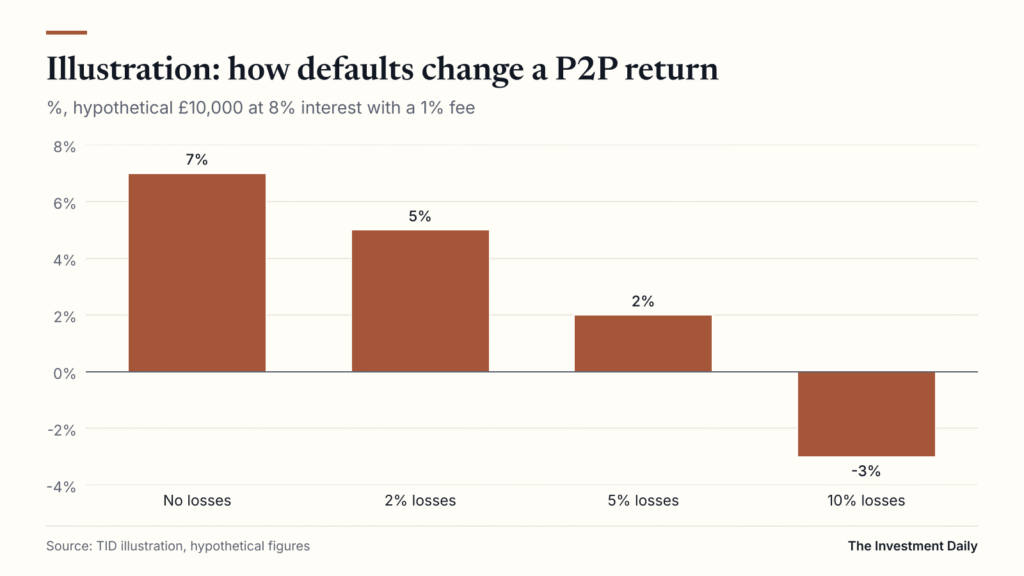
Defaults matter more than the headline rate. The worked example uses hypothetical figures for illustration only: £10,000 lent at an average 8% interest, with a 1% annual platform fee, across four scenarios for losses from defaults after any recoveries.
| Illustration only | No losses | 2% losses | 5% losses | 10% losses |
|---|---|---|---|---|
| Interest at 8% | £800 | £800 | £800 | £800 |
| Platform fee at 1% | minus £100 | minus £100 | minus £100 | minus £100 |
| Losses on defaulted loans | £0 | minus £200 | minus £500 | minus £1,000 |
| Net return for the year | £700 (7%) | £500 (5%) | £200 (2%) | minus £300 (minus 3%) |
Losses also tend to arrive together. In an economic downturn more borrowers fall behind at the same time, recoveries take longer and property security may be worth less. A rate that looks generous in good years can turn into a loss in a bad one. Diversifying across many small loans reduces the effect of any single default, but it does not protect against a rise in defaults across the whole loan book.
FSCS protection and the Financial Ombudsman
This is the biggest difference from a cash ISA. The FCA says that for loan-based (peer-to-peer) or investment-based crowdfunding “you won’t have access to the Financial Services Compensation Scheme (FSCS)” (FCA). FSCS itself says “FSCS protection in this area is very limited”, that it does not cover poor investment performance, and that it may be able to pay compensation if you received unsuitable advice to invest (FSCS, 11 May 2023).
For regulated investments where an authorised firm fails on or after 1 April 2019, FSCS investment protection is up to £85,000 per eligible person, per firm, but FSCS says “We can’t accept any claims that are for poor investment performance” (FSCS). A borrower defaulting on a peer-to-peer loan is a loss on the investment, not a firm failing to return your money.
The FCA’s rules for peer-to-peer platforms
Platforms are regulated even though the loans are not protected. In policy statement PS19/14, published in June 2019, the FCA introduced a requirement for an appropriateness assessment of an investor’s knowledge and experience of peer-to-peer investments “where no advice has been given to the investor”, with platforms required to implement the changes by 9 December 2019 (FCA, PS19/14).
The FCA said it was placing a limit on investments in P2P agreements for retail customers new to the sector “of 10 per cent of investable assets”, and that the limit would not apply to new retail customers who have received regulated financial advice (FCA press release, 4 June 2019).
The FCA’s later rules on promoting high-risk investments, which took effect from 1 February 2023, group P2P agreements with other “Restricted Mass Market Investments”. It said ordinary retail investors confirm that they will limit their exposure to such investments to no more than 10% of their net assets, and that the investment must be considered appropriate for them (FCA, PS22/10).
So FSCS protection for an innovative finance ISA is not comparable with the deposit protection behind a bank cash ISA or the investment protection behind a stocks and shares ISA held with an authorised platform. Where FSCS protection might apply, it is likely to be in narrow cases, such as unsuitable advice, and FSCS suggests asking the provider directly what protection applies before investing.
- Cash held in the ISA is placed with a deposit-taker, according to HMRC’s guidance, but whether and how it is protected depends on the arrangements, which the provider can explain.
- Complaints. The FCA says the Financial Ombudsman Service settles complaints about authorised firms (FCA). That covers how the firm treated you, not whether borrowers repaid.
- Check the firm. FSCS points investors to the FCA register to check whether a platform is authorised.

When borrowers or platforms fail, and getting money out
The FCA warns: “If the company you’ve invested in fails, you might lose all the money you have invested”, and “You also may not be able to get your money back quickly, or at all should you need it” (FCA). Some platforms let you sell loans to other lenders, but the FCA says you may not get back all of the money you invested.
Platform failure is a separate risk from borrower default. If the platform that administers the loans stops trading, collecting repayments and passing them to lenders depends on what arrangements are in place to keep administering the loan book. FSCS says a platform failing “could make it very difficult to access your money or you may lose it altogether” (FSCS). The account terms set out what would happen.
Withdrawals and transfers
HMRC’s guidance says “The rights to transfer or withdraw non-cash investments in an Innovative Finance ISA” are explained in the account’s terms and conditions (HMRC). Loans usually run to fixed terms, so access before maturity may depend on finding another lender to buy your share. Transfers to another ISA manager may only be possible in cash, after loans repay.
Investments can also lose ISA eligibility. HMRC says that when that happens “the manager will have 30 days in which to either divest (potentially at a loss)”, keeping the proceeds in the ISA, or transfer the investment out of the wrapper.
Tax inside and outside the wrapper
Outside an ISA, peer-to-peer interest is taxed as savings income. HMRC says “The interest received from peer to peer loans is taxable in the same way as any other interest received” (HMRC, peer to peer lending). From 6 April 2027 savings income rates rise to 24%, 44% and 49% across the UK, from 20%, 40% and 45% in 2026 to 2027, under Budget 2026 (HMRC impact note; OOTLAR Annex A). The Personal Savings Allowance stays at £1,000 for basic-rate and £500 for higher-rate taxpayers, and the starting rate for savings remains 0% on up to £5,000.
Because peer-to-peer interest is savings income, it shares those allowances with bank and building society interest and with interest on bonds held outside an ISA. A saver whose bank interest already uses the Personal Savings Allowance pays tax on every pound of peer-to-peer interest outside a wrapper, at the savings income rate for their band.
Outside an ISA there is one advantage: relief for bad debts. HMRC says relief applies “when there is no reasonable prospect of the peer to peer loan being repaid”, but it can only be set against interest on other peer-to-peer loans, not against other income (HMRC). Inside an innovative finance ISA there is no taxable interest, so that relief has nothing to work against.
| Illustration only: interest of £1,200 a year, 2027 to 2028 | Basic-rate taxpayer | Higher-rate taxpayer |
|---|---|---|
| Personal Savings Allowance | £1,000 | £500 |
| Taxable interest outside an ISA | £200 | £700 |
| Tax at 24% or 44% | £48 | £308 |
| Tax inside an innovative finance ISA | £0 | £0 |
The example assumes no other savings income uses the allowance and ignores the starting rate for savings. The ISA’s tax advantage is largest for higher-rate taxpayers with interest above the Personal Savings Allowance, but it does nothing to reduce the risk of the loans. Government and corporate bonds, which GOV.UK lists among the investments a stocks and shares ISA can include, are another way to hold interest-paying assets in a wrapper. Our cash savings section explains how savings interest is taxed.
What HMRC statistics show about the innovative finance ISA
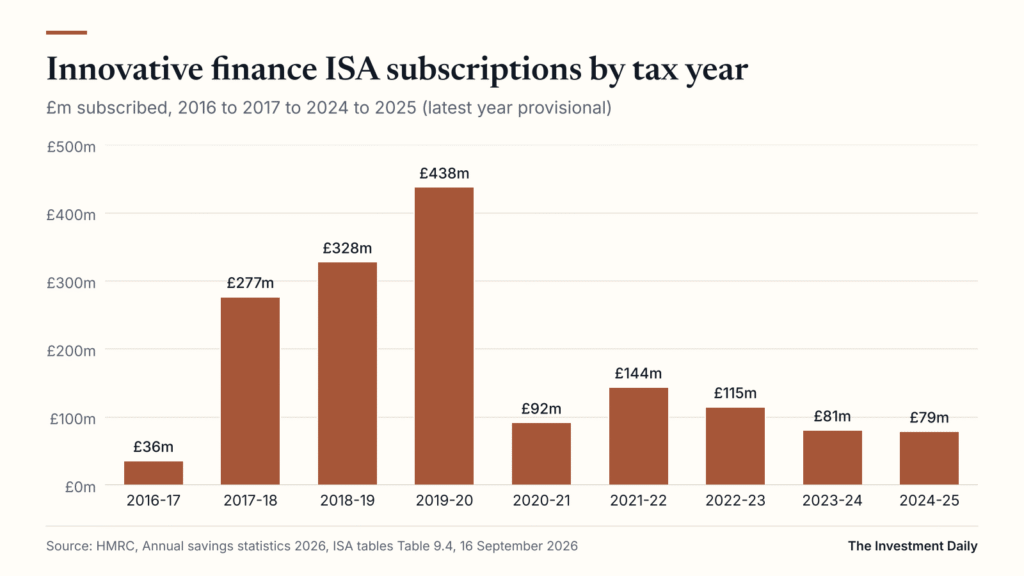
The innovative finance ISA has always been a very small part of the ISA market. HMRC’s Annual savings statistics 2026, published on 16 September 2026, show £79m subscribed to innovative finance ISAs in 2024 to 2025 (a provisional figure) across about 9,000 accounts, against £135,678m subscribed to all adult ISAs that year (HMRC, ISA tables, September 2026, Table 9.4). HMRC’s commentary says the number of innovative finance ISAs subscribed to “continues on decreasing year-on-year”, with a reduction of 30.8% in 2024 to 2025 (HMRC commentary, September 2026).
| Tax year | Accounts subscribed (thousands) | Amount subscribed (£m) | Average subscription (£) |
|---|---|---|---|
| 2016 to 2017 | 5 | 36 | 7,200 |
| 2017 to 2018 | 49 | 277 | 5,653 |
| 2018 to 2019 | 38 | 328 | 8,632 |
| 2019 to 2020 | 34 | 438 | 12,882 |
| 2020 to 2021 | 16 | 92 | 5,750 |
| 2021 to 2022 | 17 | 144 | 8,520 |
| 2022 to 2023 | 17 | 115 | 6,906 |
| 2023 to 2024 | 13 | 81 | 5,968 |
| 2024 to 2025 (provisional) | 9 | 79 | 9,045 |
Source: HMRC, Annual savings statistics 2026, Table 9.4. HMRC says the figures come from the annual returns ISA managers must make, with adjustments for missing and incorrect returns. The same tables put the market value of the innovative finance component at £567m at 5 April 2025, of which £522m was outstanding loan principal and £45m cash, out of £951,936m in all adult ISAs and PEPs (Table 9.6). The peak was £995m at 5 April 2020.
The figures show a market that grew to 2019 to 2020 and then shrank. Subscriptions fell from £438m in 2019 to 2020 to £92m the following year and have stayed below £150m since, while the number of accounts subscribed to fell from 49,000 in 2017 to 2018 to about 9,000. Over the same period total adult ISA subscriptions rose, so the innovative finance share of the market has fallen.
Innovative finance ISA: risks and what to check
An innovative finance ISA changes the tax on lending, not the risk. The FCA’s general guidance is that you “should put no more than 10% of your total net assets in high-risk investments” (FCA InvestSmart).
- Authorisation. The FCA register shows whether a platform is authorised and what permissions it has, which HMRC’s rules require, and the platform can confirm it is an HMRC-approved ISA manager.
- What the money is lent to. Consumer loans, business loans and property development loans carry different risks, and platforms describe how loans are selected and what security, if any, there is.
- Defaults, not just rates. A platform’s historical default and recovery figures, and how they are calculated, say more than the headline rate.
- Exit terms. The terms and conditions set out how and when money can be withdrawn or transferred, and whether selling loans early has a cost.
- Platform failure. The arrangements for continuing to collect repayments if the platform stops trading matter as much as the loans.
- Know the protection position. No FSCS protection for losses on loans; complaints about the firm go to the Financial Ombudsman Service.
- Compare the alternatives. Listed bonds and bond funds in a stocks and shares ISA, or cash in a cash ISA, carry different risks and different protection.
- Watch for scams. High fixed returns, pressure to invest and unregulated schemes using ISA language are warning signs. See how to spot an investment scam.
The innovative finance ISA can shelter interest from tax at savings income rates that rise from 6 April 2027, inside the same £20,000 ISA allowance as other ISAs. Whether that is worth the risk of default, illiquidity and limited protection is a judgement each investor has to make. Past performance is not a guide to future returns, and the capital is at risk. More on lending and income investments sits on the Bonds & Cash desk.