VCT tax relief is now 20% of the amount you subscribe for new venture capital trust shares, down from 30%, for shares issued from 6 April 2026, according to HMRC. The annual limit is still £200,000, and you must hold the shares for five years to keep the relief. Dividends and gains on VCT shares remain tax-free, including on shares bought second-hand, within the same £200,000 a year.
Budget 2026, on 28 October 2026, did not change the rate. It announced a technical amendment to the rules that claw back relief when shares are sold early, for shares issued on or after 6 April 2026. HMRC says the change will make sure any relief withdrawn is calculated at the rate that applied when the shares were issued. It will be made in Finance Bill 2026-27 and is not yet law.
VCT tax relief at a glance
Venture capital trusts are listed companies that invest in small, growing businesses, and VCT tax relief is the government’s incentive to fund them. HMRC’s manual describes a VCT as “broadly similar to an investment trust” that “subscribes for shares in, or lends money to, small unquoted companies”. Investors get three reliefs on new shares and two on second-hand shares bought from someone else. The table shows the position on 1 November 2026.
| Relief | New shares | Second-hand shares | Main condition |
|---|---|---|---|
| Income tax relief | 20% of the amount subscribed | None | Up to £200,000 a tax year; hold for five years |
| Tax-free dividends | Yes | Yes | Shares acquired within £200,000 a tax year |
| CGT-free gains | Yes | Yes | Shares acquired within £200,000 a tax year; VCT approved when bought and sold |
| Losses | Not allowable for CGT | Not allowable for CGT | Applies to qualifying disposals |
| CGT deferral | Abolished | Abolished | Not available for shares issued after 5 April 2004 |
Sources: HMRC investor guidance, VCM51010 and the HS298 helpsheet. You must be 18 or over to claim.
The cut in VCT tax relief from 30% to 20%
Budget 2025 cut VCT tax relief. A policy paper published on 26 November 2025 said the government would “reduce the Income Tax relief that can be claimed by an individual investing in VCT to 20% from the current rate of 30%”, with effect from 6 April 2026. It estimated that “around 24,000 individuals” would receive less relief.
The new rate is now in the legislation. Section 263 of the Income Tax Act 2007, as shown on legislation.gov.uk, reads: “The tax reduction is equal to 20% of the amount in respect of which the claim is made”. The figure was substituted for 30% by section 15 of the Finance Act 2026, which came into force on 6 April 2026. The same policy paper raised the amounts that companies can raise under VCT and EIS investment, so VCTs can back larger businesses than before.
A 20% rate is not new. HMRC’s VCT statistics record income tax relief at 20% from the scheme’s launch in 1995-96 until 2003-04, 40% in 2004-05 and 2005-06, and 30% from 2006-07 until 2025-26. The cut returns the rate to where it started, though the annual limit, the holding period and the investment rules have all changed since the 1990s.
| Illustration only: £20,000 subscribed | Shares issued in 2025-26 (30%) | Shares issued in 2026-27 (20%) |
|---|---|---|
| Amount invested | £20,000 | £20,000 |
| Income tax reduction | £6,000 | £4,000 |
| Net cost after relief | £14,000 | £16,000 |
| Fall in VCT value before the net cost is lost | 30% | 20% |
The last row is the practical change. At 30%, a VCT could fall by almost a third before an investor was worse off than their net outlay. At 20%, the cushion is smaller, so more of the outcome depends on the trust’s performance and costs.
The income tax relief is a reduction in your tax bill, not a deduction from income. It cannot create a refund of tax you have not paid, so someone subscribing £200,000 needs an income tax liability of at least £40,000 in that year to use it in full. There is no carry back for VCTs: HMRC says relief can only be claimed in the tax year you invest.
The £200,000 limit and the five-year rule
The annual limit has not changed. Section 262(3) says an individual “is not entitled to claim VCT relief for any tax year on an amount of more than £200,000” (ITA 2007). The limit applies to each individual investor. The same £200,000 cap applies, separately, to the dividend and gains exemptions.
HMRC’s guidance says you “must keep your whole investment in a Venture Capital Trust for 5 years”. The five years run from the date the shares were issued to you. If you sell sooner, section 266 of the Act withdraws or reduces the relief.
How the clawback works
Section 266, as published on legislation.gov.uk, sets out two cases. If you dispose of the shares other than at arm’s length, all the relief on them is withdrawn. If you sell at arm’s length, the relief is reduced by an amount called A, and withdrawn in full if A is at least as large as the relief.
Subsection (4) still says “A is 30% of the amount or value of the consideration which the individual receives for the shares”, and legislation.gov.uk records no outstanding amendments to section 266. That matches the old 30% relief rate: the Finance Act 2026 changed the rate in section 263 but left this formula alone. Item 1.36 of the Budget 2026 Overview of Tax Legislation and Rates says “the amendment to the VCT relief withdrawal rules will take effect for relevant disposals of shares issued on or after 6 April 2026”.
HMRC’s tax information and impact note gives the detail. Section 266 will be amended “to ensure that, where VCT Income Tax relief is withdrawn, the amount withdrawn is calculated by reference to the rate of relief that applied at the time the shares were issued”. The amendment is due in Finance Bill 2026-27. Until that bill is enacted, the 30% formula remains the law as published.
Worked example, for illustration only. An investor subscribes £20,000 in 2026-27 and receives £4,000 of relief. Three years later they sell at arm’s length for £15,000.
On the 30% formula as currently written, A is £4,500, which is more than the £4,000 relief, so all of it is withdrawn. Under the amendment described by HMRC, A would be worked out at the 20% rate that applied when the shares were issued: £3,000, leaving £1,000 of relief in place. Because the change will apply to disposals of shares issued on or after 6 April 2026, the final position for a sale like this depends on Finance Bill 2026-27 as passed.
The six-month linked sale rule
Selling VCT shares and then subscribing for new shares in the same VCT can reduce your relief. Section 264A treats a subscription and a sale as linked if they are “within 6 months of each other (irrespective of which came first)”, and the amount on which you can claim is reduced (ITA 2007). This rule targets the practice of selling old shares and reinvesting to claim relief again. A linked sale does not stop you investing, but it cuts the amount that attracts VCT tax relief.
Tax-free dividends and gains
The longer-lasting benefit of VCT tax relief is tax-free dividends. HMRC says you “do not need to pay Income Tax on any dividends from a Venture Capital Trust”, on new or second-hand shares (HMRC). The manual limits the exemption to shares acquired within “£200,000 (by market value) in a tax year”, by an investor aged 18 or over, for “genuine commercial purposes”.
That matters more after recent dividend tax rises. Outside an ISA or pension, dividends above the £500 dividend allowance are taxed at 10.75%, 35.75% or 39.35% in 2026-27 and 2027-28, according to Budget 2026 Annex A. VCT dividends fall outside those rates altogether, so tax-free dividends from venture capital trusts save most tax for higher and additional rate taxpayers.
| Illustration only: £5,000 of dividends, allowance already used | Basic rate | Higher rate | Additional rate |
|---|---|---|---|
| Tax on ordinary dividends | £537.50 | £1,787.50 | £1,967.50 |
| Tax on VCT dividends | £0 | £0 | £0 |
Gains are exempt too. The HS298 helpsheet says the exemption applies whether “you subscribe for newly issued shares or whether you acquire existing shares, for example, by purchase or inheritance”, provided the company was an approved VCT when you acquired the shares and when you disposed of them. The flip side is that a loss on a qualifying disposal “is not allowable for capital gains purposes”, so it cannot be set against other gains.
A dividend paid out reduces the trust’s net asset value by the same amount, so a high payout is not the same as a high return. Dividends on second-hand shares and new shares alike are not guaranteed.
Buying second-hand VCT shares
VCTs are listed: HMRC’s approval rules require that “the VCT’s ordinary share capital has been or will be admitted to trading on a regulated market”. So you can buy existing shares through a broker. The income tax reduction is not available, because HMRC says relief requires shares that are “newly issued and paid for in full (in cash)” (HMRC).
Second-hand shares keep the tax-free dividends and the gains exemption, within the £200,000 limit. Because they have no upfront relief and there is no five-year rule for them, the trade-off is different. The market price of second-hand shares can sit below net asset value when there are few buyers for VCT shares. The yield on a lower purchase price is higher, but the discount can persist when you come to sell.
Discounts and buybacks
The shortage of buyers is the central liquidity issue. Original subscribers who sell within five years lose relief, and buyers in the market get no relief, so demand for second-hand VCT shares is thin. Some VCTs operate share buyback policies, under which the trust may buy shares back at a discount to net asset value.
Buybacks are at the board’s discretion and can be suspended. A trust that buys back at a 5% discount to net asset value, for illustration only, pays 95p for shares with an asset value of 100p. Check a VCT’s buyback policy, how often it has met it, and the discount it applies. If you plan to sell and reinvest, remember the six-month linked sale rule, which applies to buybacks as much as to market sales.
What VCTs can invest in
To keep its approval and its investors’ VCT tax relief, a VCT must meet ongoing conditions set out in section 274 of the Act. At least 80% by value of its investments must be in qualifying holdings, and at least 70% by value of those qualifying holdings must be eligible shares. HMRC’s VCM54080 says the qualifying holdings limit “is increased to 80% for accounting periods starting on or after 6 April 2019”, having previously been 70%.
Two published texts can cause confusion. On legislation.gov.uk, the revised table in section 274 carries the heading “80% qualifying holdings condition” but its description column still reads “at least 70%”. Paragraph 2 of Schedule 5 to the Finance Act 2018 substituted 80% for 70% “in the first and second columns”, so the 80% figure is the law for current accounting periods. HMRC’s summary page VCM54020 also still shows 70%, while VCM54080 gives 80%. VCM54020 lists the other conditions: a VCT must not retain more than 15% of its income from shares and securities, and no single holding may exceed 15% of its investments by value.
- Qualifying holdings are investments in small unquoted companies that meet the venture capital scheme rules.
- Company limits rose from 6 April 2026: £10m a year (£20m for knowledge-intensive companies) and £24m over a lifetime (£40m), with gross assets of up to £30m before investment and £35m after (HMRC). Companies registered in Northern Ireland that trade in goods or electricity, which the Finance Act 2026 calls specified Northern Ireland companies, keep the old limits.
- Sunset date. Section 261 requires the shares to be issued before 6 April 2035, so relief is currently available on new VCT shares issued up to that date (ITA 2007).
Breaching the conditions can cost a VCT its approval, with consequences for VCT tax relief and the other investor reliefs. Fund managers monitor these tests, but the risk sits with shareholders.
VCT tax relief compared with EIS and SEIS
Venture capital trusts are one of three venture capital schemes, and the 2026 changes have widened the gap between them. EIS and SEIS investors buy shares directly in companies, or through a fund that holds them, while a VCT investor buys shares in a listed trust that holds a portfolio. The table uses HMRC’s investor guidance as at 1 November 2026.
| Scheme | Income tax relief | Annual limit | Minimum holding | Carry back |
|---|---|---|---|---|
| Venture capital trusts | 20% | £200,000 | 5 years | No |
| Enterprise Investment Scheme | 30% | £1m, or £2m with at least £1m in knowledge-intensive companies | 3 years | Yes |
| Seed Enterprise Investment Scheme | 50% | £200,000 | 3 years | Yes |
The schemes differ on more than the headline rate. VCTs give tax-free dividends, which EIS and SEIS shares do not, and a spread of companies in one holding. HMRC’s guidance shows EIS and SEIS losses can be set against income, and EIS offers capital gains tax deferral, neither of which VCTs offer. A VCT is usually simpler to buy and to hold, but the 20% income tax relief now sits well below the other two schemes.
How to claim VCT tax relief
VCT tax relief is claimed by the investor. HMRC says “you should claim Income Tax relief in your Self Assessment tax return for the tax year in which the shares were issued” (HMRC). If you do not file a return, or do not want to wait, you can ask HMRC to adjust your tax code or to make a refund.
- Keep the documents the VCT sends confirming the share issue, which show the date of issue and the amount subscribed.
- Work out the relief: 20% of the amount subscribed for shares issued from 6 April 2026, or 30% for shares issued before that date.
- Check that your income tax liability for the year is at least that amount, because unused relief is lost.
- Enter the claim on your Self Assessment return for the year the shares were issued, or contact HMRC to adjust your tax code.
- Claim within four years of the end of the tax year in which you invested.
Note the date of issue rather than the date you applied. The issue date decides both the tax year of the claim and the rate of VCT tax relief that applies.

What HMRC’s VCT statistics show
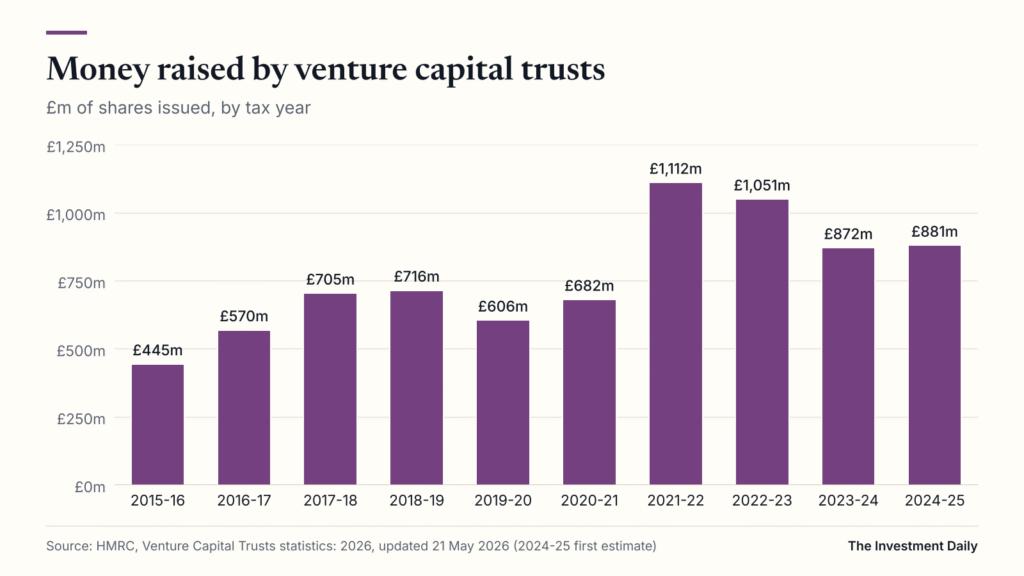
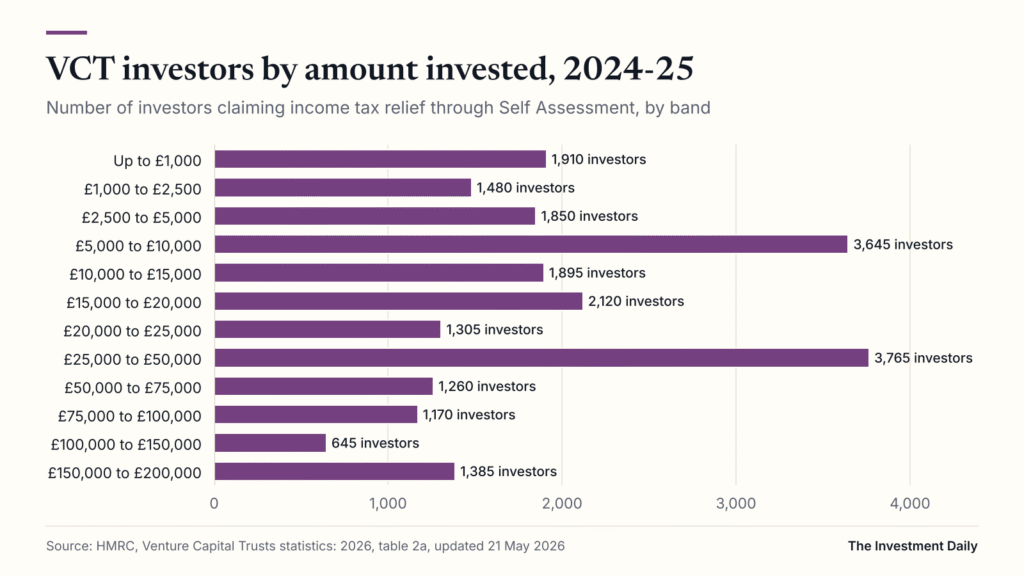
HMRC’s Venture Capital Trusts statistics, updated on 21 May 2026, cover the 2024-25 tax year. VCTs “issued shares to the value of £881 million in 2024 to 2025”, up from £872m in 2023-24. Investors claimed relief on £825m of investment, and the number of investors claiming fell 8% to 22,430.
| Tax year | Funds raised (£m) | VCTs raising funds | VCTs managing funds |
|---|---|---|---|
| 2019-20 | 606 | 43 | 60 |
| 2020-21 | 682 | 40 | 57 |
| 2021-22 | 1,112 | 45 | 52 |
| 2022-23 | 1,051 | 45 | 49 |
| 2023-24 | 872 | 45 | 49 |
| 2024-25 | 881 | 45 | 46 |
Every year in the table was raised at 30% VCT tax relief. The number of VCTs managing funds has fallen from 80 in 2015-16 to 46, as trusts merged or closed. HMRC also notes that “most investors tend to invest under £50,000”. The 2025-26 figures, the last year at 30% relief, are not due until spring 2027, so official data on how investors responded to the cut is not yet available.
Costs, risks and what to check before claiming VCT tax relief
VCT tax relief is an incentive to put money into risky companies. The companies are small and young, and many fail. Past performance of any VCT is not a guide to future returns, and a 20% upfront reduction leaves less room for disappointing results than 30% did.
- Capital risk. Losses on VCT shares cannot be used to reduce capital gains tax elsewhere.
- Liquidity. Selling usually depends on the trust’s buyback, at a discount to net asset value, and sales within five years claw back the income tax relief.
- Fees. VCT share offers can carry initial fees, and trusts can charge annual management fees and performance fees. Budget 2026 said the government would engage stakeholders on “enhancing transparency of fees” across the venture capital schemes.
- Concentration. A VCT spreads money across a number of companies, but all of its qualifying holdings must be in small, unquoted businesses, so the portfolio sits in one high-risk part of the market.
- Rule risk. The VCT and the companies it holds must keep meeting the conditions, and the rules can change, as 2026 showed.
- Protection. The FSCS can pay up to £85,000 per person per firm if an authorised investment provider or adviser has gone out of business, but says it cannot accept claims for poor investment performance. The Financial Ombudsman Service can consider complaints about an FCA-regulated firm, for example if you were advised to make an investment that was not right for you, but not a loss caused by performance alone.
Before relying on VCT tax relief, check:
- That you have enough income tax liability in the year of subscription to use the 20% reduction.
- That you can leave the money in place for at least five years from the issue date.
- The total cost of the offer, including initial, annual and performance fees, and any adviser charge.
- The trust’s buyback policy and its record of meeting it.
- Whether you have sold shares in the same VCT in the last six months, or plan to in the next six, which would make it a linked sale.
- How dividends have been funded, and the trend in net asset value after dividends.
- That your total VCT acquisitions in the tax year, new and second-hand, stay within £200,000.
VCT tax relief has become less generous, but the tax-free dividends and gains on venture capital trusts remain, and they now count for more against higher dividend tax rates. For the rules on the other schemes, see our guide to SEIS, EIS and VCTs compared, our explainer on what the reliefs do to startup returns and tax-efficient investing in the UK. Our piece on dividend investing after the 2026 tax rise covers how ordinary dividends are taxed.