EIS tax relief gives an individual who subscribes for new shares in a qualifying company an income tax reduction of 30% of the amount invested, on up to £1m a year, or £2m if at least £1m goes into knowledge-intensive companies, according to HMRC guidance updated on 6 April 2026. Gains on the shares are free of capital gains tax if they are held for at least three years and the relief is not withdrawn. Losses can be set against income, and gains on other assets can be deferred by reinvesting.
Budget 2025 doubled the amount companies can raise from 6 April 2026, but the investor rate and limits did not change. Budget 2026, on 28 October 2026, made only technical amendments to EIS tax relief, mostly from April 2027.
EIS tax relief at a glance
The Enterprise Investment Scheme offers five separate reliefs, which together make up what most people mean by EIS tax relief. Each has its own conditions, and you can qualify for one without qualifying for another. The table sets out the position on 1 November 2026, drawn from HMRC’s investor guidance, the HS341 helpsheet and the HS297 helpsheet.
| Relief | What it does | Main condition |
|---|---|---|
| Income tax reduction | Reduces your income tax bill by 30% of the amount subscribed | New shares, up to £1m a year (£2m with knowledge-intensive companies); held at least three years |
| Carry back | Treats some or all of the investment as made in the previous tax year | Subject to that earlier year’s limit |
| CGT disposal relief | No capital gains tax on a gain when the shares are sold | The 30% relief given in full and not withdrawn; shares held at least three years |
| CGT deferral relief | Postpones tax on a gain from another asset | EIS shares issued between one year before and three years after the gain; the 30% relief need not be claimed |
| Loss relief | Sets a loss, less the 30% relief already given, against income | Claim within one year of 31 January after the tax year of the loss |
A sixth benefit sits outside the Enterprise Investment Scheme itself. Shares in unlisted trading companies can qualify for business relief from inheritance tax after two years of ownership, though that relief has its own rules and, from 6 April 2026, the 100% rate applies only up to a £2.5m allowance. We cover it below.
How the 30% income tax relief works
The Venture Capital Schemes Manual says relief “is available to individuals who subscribe for shares in an EIS” company. The shares must be new ordinary shares, paid for in cash. Buying existing shares from another shareholder does not qualify. The relief is a reduction in your income tax bill, not a deduction from income, so a higher rate taxpayer and a basic rate taxpayer get the same 30%.
The relief cannot take your tax bill below zero. HS341 puts it plainly: if your tax liability “is not high enough to absorb all the relief, then you have to forgo the excess”. Someone who invests £100,000 needs an income tax liability of at least £30,000 in the year of claim to use all of the relief.
The annual limits
The most you can claim on in a tax year is £2m, and anything over £1m must be in shares issued by knowledge-intensive companies, according to HS341. There is no minimum investment set out in the HMRC guidance we checked, though companies and fund managers can set their own.
Carry back to the previous year
You can elect to treat some or all of an investment as made in the previous tax year and claim the relief against that year’s tax (HMRC). This helps if last year’s income was higher, or if this year’s allowance is already used. The carried-back amount counts towards the earlier year’s limit.
Knowledge-intensive companies
Knowledge-intensive companies are innovative businesses that spend heavily on research. HMRC’s guidance for these companies says they must spend at least 10% of operating costs a year on research, development or innovation for three years, or 15% in one of those years. HMRC also sets tests on creating intellectual property and on the share of skilled employees doing research.
The rules for knowledge-intensive companies are looser in some respects. They must have fewer than 500 full-time equivalent employees, against fewer than 250 for most EIS companies, and can raise money within 10 years of their first commercial sale or of turnover passing £200,000, rather than seven years (HMRC). Investors get the higher £2m limit only for money placed in knowledge-intensive companies.
What changed in April 2026 and at Budget 2026
Budget 2025 changed the company side of the Enterprise Investment Scheme. A policy paper published on 26 November 2025 raised the annual and lifetime amounts that companies can raise, and widened the gross assets test, with effect from 6 April 2026. It did not change the 30% rate of EIS tax relief for investors. The same paper cut VCT relief from 30% to 20%, which is a separate scheme.
| Company limit | Before 6 April 2026 | From 6 April 2026 |
|---|---|---|
| Annual investment limit | £5m | £10m |
| Annual limit, knowledge-intensive companies | £10m | £20m |
| Lifetime limit | £12m | £24m |
| Lifetime limit, knowledge-intensive companies | £20m | £40m |
| Gross assets before share issue | £15m | £30m |
| Gross assets after share issue | £16m | £35m |
Source: HMRC policy paper, 26 November 2025, and section 14 of the Finance Act 2026, which made the changes. The higher limits do not apply to a “specified Northern Ireland company”: one with its registered office in Northern Ireland whose trade involves goods, or the generation, transmission, distribution, supply, wholesale trade or cross-border exchange of electricity. Those companies stay on the old limits.
For investors, the change matters indirectly, because EIS tax relief follows the company. Larger and older companies can now use the scheme, so the range of businesses offering EIS shares is wider. A bigger company is not necessarily a safer one, and the risks below still apply.
Budget 2026, delivered on 28 October 2026, made no change to the headline reliefs. The Overview of Tax Legislation and Rates, item 1.36, says Finance Bill 2026-27 will “fix minor technical issues” in the SEIS, EIS and VCT rules. The VCT withdrawal amendment applies to shares issued on or after 6 April 2026, and the rest of the changes take effect from 6 April 2027. The government will also engage on improving advance assurance and fee transparency, with more HMRC compliance work on “fee arrangements that divert investment away from qualifying companies”.
HMRC’s tax information and impact note sets out the EIS changes, which apply to shares issued on or after 6 April 2027. If a company goes over its annual or lifetime limit, relief “will remain available for the proportion of the share issue that falls within the relevant limit”, rather than being lost on the whole issue. HMRC will get a discretionary power to treat shares as fully paid where money arrives late because of exceptional and unavoidable circumstances, and one investor’s late payment will no longer, of itself, deny relief to other investors in the same issue.
SEIS shares and EIS shares will also be able to be issued on the same day without affecting relief. HMRC expects the package to affect fewer than 100 investors a year. The changes are due in Finance Bill 2026-27, so they are not yet law.
Holding period and how EIS tax relief can be withdrawn
EIS tax relief is conditional, and the conditions run for years. The HMRC manual says the company must observe the rules “not just at the time of the investment but for at least three years afterwards”. The investor has obligations too. If either side breaks the rules, HMRC can withdraw or reduce the relief.
The three years
The three years run to what the legislation calls the termination date. VCM23070 defines it as the third anniversary of the share issue or, if the money was raised for a trade the company had not started when the shares were issued, the third anniversary of the date the trade began. So a pre-trading company can tie your money up for longer than three years from the date you paid.
HMRC’s manual also uses three named windows. VCM10540 says period A starts with the company’s incorporation, or two years before the share issue if later, and ends the day before the termination date. Period B runs from the share issue to the termination date.
Period C starts twelve months before the issue. Different conditions are tested over different periods, which is why the company’s history before your investment matters.
What can cost you the relief
- Selling early. A disposal before the end of the three years normally withdraws or reduces the relief.
- Being connected. You cannot claim if you or your associates are employees, or hold more than 30% of the shares, voting rights, asset rights or loan capital. HMRC tests this for two years before the investment as well as afterwards (HMRC).
- Receiving value. If you receive value from the company, such as a payment or a benefit outside normal commercial terms, HS341 says the amount on which you claim must be restricted.
- Linked loans. Relief is not available where you have a loan “which would not have been made” without the investment (HS341).
- The company failing the rules. If the company moves into excluded activities, breaks the trading rules or uses the money for the wrong purpose, relief can be withdrawn from investors in that share issue.
Most qualifying trades are open to the scheme, but HMRC lists exclusions. Its guidance for companies gives examples including property development, running a hotel or a nursing home, and banking, insurance, debt or financing services, and says a company may not qualify if more than 20% of its trade is in such activities.
Capital gains tax: exemption and deferral relief
EIS shares carry two separate capital gains tax reliefs. One makes the gain on the EIS shares themselves tax-free. The other postpones tax on a gain you made on something else.
The exemption on EIS shares
According to HS297, you generally pay no capital gains tax on a gain from EIS shares if you have “held the EIS shares for at least 3 years” and received the income tax reduction in full, with none of it withdrawn. If that relief was only partly given, only part of the gain is exempt, in proportion to the relief that stands. Shares that never received income tax relief get no exemption at all, though the £3,000 annual exempt amount may help.
For comparison, gains outside the scheme are taxed at 18% or 24% in 2026-27 and 2027-28, after a £3,000 annual exempt amount, according to Budget 2026 Annex A. Budget 2026 did not change those rates.
Deferral relief
Deferral relief lets you postpone capital gains tax on a gain from any asset by investing the gain in EIS shares. HS297 says the shares must be issued “in the period beginning one year before, and ending three years after” the disposal that produced the gain. There is “no upper limit” on the amount, and you “do not have to obtain Income Tax relief” to claim deferral relief.
The deferred gain is not cancelled. It comes back into charge when you dispose of the EIS shares or when they stop qualifying, and is then taxed at the rates in force at that time. Deferral relief therefore postpones a bill rather than removing it, and the rate when the gain revives may differ from today’s.
Worked example, for illustration only. Sam, a higher rate taxpayer, sells a share portfolio in 2026-27 and makes a gain of £50,000. Without relief, after the £3,000 annual exempt amount, tax at 24% would be £11,280.
If Sam subscribes £50,000 for EIS shares within the window and claims deferral relief, that £11,280 is not paid now. If Sam also claims income tax relief, the subscription reduces Sam’s income tax by £15,000. When the EIS shares are sold, the £50,000 deferred gain revives, alongside any separate gain on the EIS shares themselves.
HS297 says you “may claim less than the maximum Deferral Relief, for example, if you want to use your annual exempt amount”. On those numbers, Sam could defer £47,000 and let the £3,000 exemption cover the rest of the gain.
Loss relief if the company fails
Loss relief softens a failure. The HMRC manual says investors “can elect that the amount of the loss, less any Income Tax relief given, can be set against income”. You can use it against income of the tax year of the loss or the year before. The alternative is to set the loss against capital gains.
The loss is measured after deducting the 30% relief you kept. HS297 says the claim must be made “within 1 year from the 31 January following the tax year in which the loss was made”. Loss relief is worth more to a higher earner, because it saves tax at the investor’s top rate.
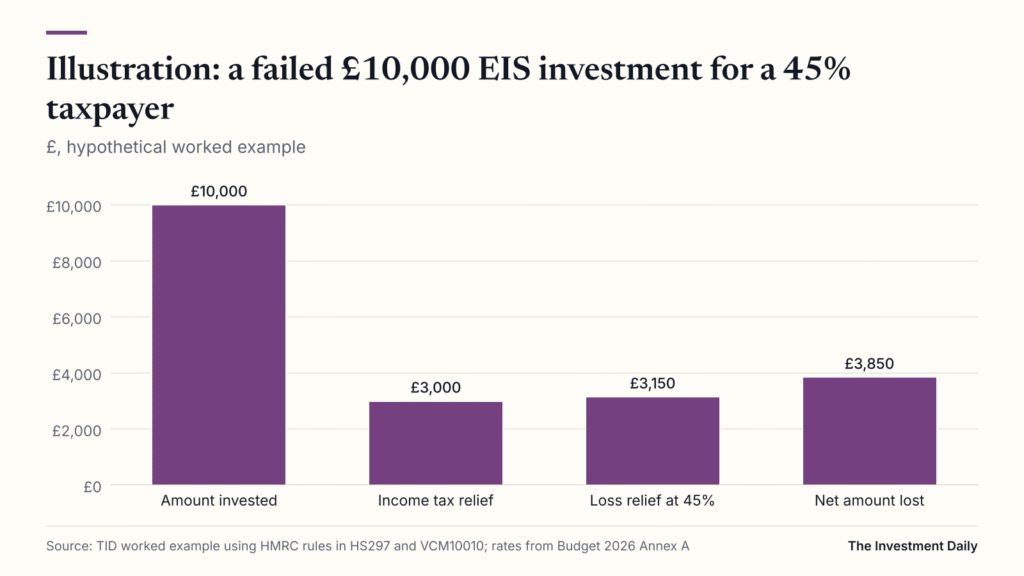
Worked example, for illustration only. An investor subscribes £10,000 for EIS shares, claims £3,000 of EIS tax relief, and the company later fails with the shares worth nothing. The allowable loss is £10,000 minus £3,000, or £7,000. The table uses the main income tax rates of 20%, 40% and 45% (Scottish rates differ) shown in Budget 2026 Annex A, and assumes the investor has enough income at that rate.
| Tax rate on the loss | Income tax relief | Loss relief on £7,000 | Net amount lost | Net loss as % of £10,000 |
|---|---|---|---|---|
| 20% | £3,000 | £1,400 | £5,600 | 56% |
| 40% | £3,000 | £2,800 | £4,200 | 42% |
| 45% | £3,000 | £3,150 | £3,850 | 38.5% |
Even in the best case, the investor still loses more than a third of the money. Loss relief also only helps if you have income or gains to set it against, and it does nothing for an investment that limps on, never fails outright and never returns cash. Our article on SEIS loss relief shows how the same arithmetic works under the seed scheme, where the relief rate on income is higher.
Inheritance tax and business relief
Business relief is an inheritance tax relief, not part of the Enterprise Investment Scheme, but EIS shares often qualify for it. GOV.UK’s business relief guidance lists “shares in an unlisted company” among assets that can get 100% relief, provided the deceased owned them “for at least 2 years”. It excludes companies that mainly deal in securities, land or buildings, or in making or holding investments.
The rules changed on 6 April 2026. A policy paper, updated on 3 March 2026, says 100% relief now applies only up to a £2.5m allowance, raised from the £1m first announced, with relief at 50% on qualifying property above that. Any unused allowance can pass to a surviving spouse or civil partner. Shares on markets designated as “not listed” now get 50% relief in all cases.
The policy paper says 96% of estates claiming business property relief in 2021-22 claimed on less than £2.5m of business property, and the median value qualifying was £200,000. Budget 2026 Annex A shows the £2.5m allowance for both 2026-27 and 2027-28. Estates that also hold farmland or a family business share the same allowance. GOV.UK says shares traded on markets that do not meet HMRC’s definition of listed, such as AIM, get 50% relief. EIS status and business relief are separate tests: a company can qualify for one and not the other, and both depend on facts at the time.

How to claim EIS tax relief
EIS tax relief is claimed by the investor, not given automatically by the Enterprise Investment Scheme rules. The company first has to satisfy HMRC that it meets the conditions, and then issues each investor a compliance certificate, form EIS3. HS341 says the form “is used by the company invested in to certify that certain conditions of the scheme are satisfied”. If you invest through an approved fund, you receive form EIS5 instead.
- Wait for the EIS3 or EIS5. HS341 says that without the form “you cannot claim relief for that investment”.
- Decide which tax year to claim in: the year of investment, or the previous year if you elect to carry back.
- In a Self Assessment return, enter the total amount in box 2 of the “Other tax reliefs” section on page Ai 2, and list each investment in box 19 on page TR 7, as HS341 describes.
- If the shares were issued in a different tax year from the one you are claiming for, HMRC’s guidance says you need to complete the claim part of the certificate.
- For deferral relief, complete the claim form on the EIS3 and attach it to the capital gains pages of your return, within five years of the 31 January after the tax year of issue (HS297).
- Keep every certificate. HMRC may ask to see it, and you will need it again when you sell or claim loss relief.
HMRC’s investor guidance allows claims for EIS tax relief on income up to five years after the 31 January following the tax year in which you invested. A company may also hold an advance assurance letter from HMRC, which HMRC says “should not be read as a general endorsement by HMRC or an indication of potential investment performance”. Our guide to advance assurance explains why that is not a guarantee that the reliefs will hold.
What HMRC’s statistics show
HMRC’s EIS and SEIS statistics, published on 21 May 2026, show 3,735 companies raised £1,575m under the Enterprise Investment Scheme in 2024-25. That was level with 2023-24, when 3,775 companies raised the same total. HMRC says the 2024-25 figures are provisional and will be revised.
- About 1,145 companies used the scheme for the first time in 2024-25, raising around £333m, or 21% of the total.
- Information and communication businesses raised £550m, 35% of all EIS investment.
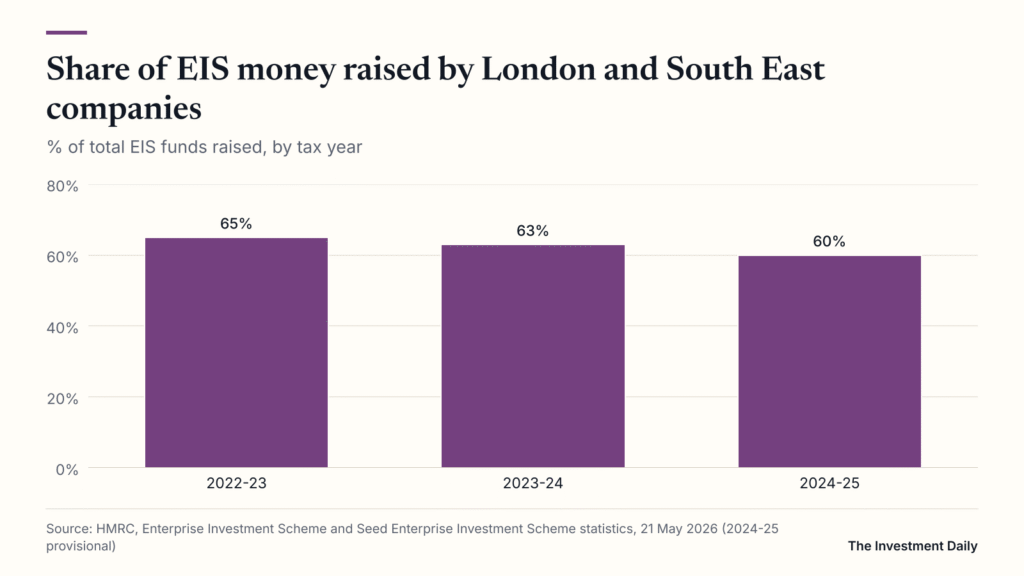
- Companies in London and the South East raised £948m, or 60%, down from 63% in 2023-24 and 65% in 2022-23.
- 33,220 investors claimed income tax relief through Self Assessment, down from 35,675, and the total investment on which relief was claimed fell 7%.
The same release shows 2,430 companies raised £276m under SEIS in 2024-25, up 14% on the year. SEIS is the smaller, earlier-stage scheme, with income tax relief at 50% on up to £200,000 a year (HMRC); see SEIS for investors for how it compares. The 2025-26 figures, the first that could reflect the higher company limits, are not due until spring 2027.
Risks and what to check before relying on EIS tax relief
EIS tax relief changes the arithmetic of a risky investment; it does not change the risk. The Enterprise Investment Scheme was designed for small, unproven businesses. Past performance of any EIS company or fund is not a guide to future returns, and the relief cannot rescue a business that runs out of cash.
- Capital loss. Many early-stage companies fail. Loss relief reduces, but does not remove, the damage, as the worked example shows.
- Liquidity. There is usually no market for unquoted shares. Exits often depend on a sale of the whole company, which may take many years or never happen.
- Relief risk. EIS tax relief can be lost after the event. The company’s conduct over at least three years decides whether you keep the relief. A breach can withdraw it from every investor.
- Dilution. Later funding rounds can shrink your percentage holding, and new investors may get preferential rights.
- Fees. Funds and some companies charge initial, annual and performance fees. Budget 2026 flagged fee arrangements that divert money away from qualifying companies as a compliance focus.
- Concentration. A single company is a single bet. Funds spread money across several companies but still hold a narrow, high-risk portfolio.
- Limited protection. The FSCS can pay up to £85,000 per person per firm if an authorised investment provider or adviser has gone out of business, but says it cannot accept claims for poor investment performance. The Financial Ombudsman Service can consider complaints about an FCA-regulated firm, such as unsuitable advice, but not losses from performance alone.
Before relying on EIS tax relief, check:
- That you have enough income tax liability, this year or last, to use the 30% relief.
- Whether the company has advance assurance, and what the EIS3 will cover.
- When the termination date falls if the company has not yet started trading.
- Whether you or your family are connected with the company through shares, loans or employment.
- All fees, who pays them and whether any are charged to the company.
- How and when the company or fund expects to return money, and what happens if it cannot.
- Whether the amount you invest is money you could afford to lose in full.
EIS tax relief is substantial on paper: 30% off your income tax, tax-free gains, deferral of other gains and a cushion on losses. Those reliefs depend on Enterprise Investment Scheme rules that run for at least three years, and the shares behind them carry some of the highest risks a private investor can take on. For a wider view of where EIS fits, see our comparison of SEIS, EIS and VCTs and our guide to investing in early-stage companies.