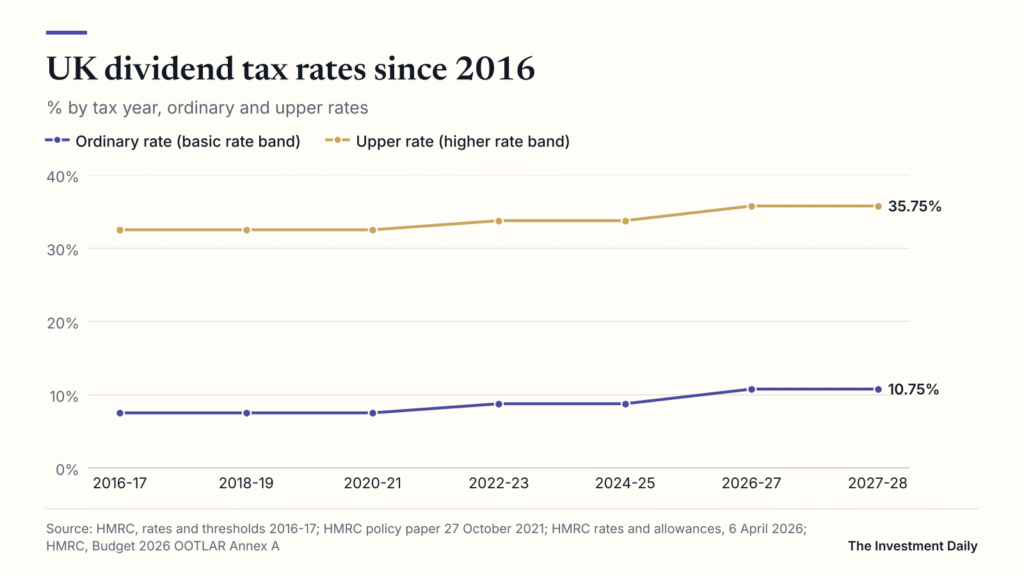
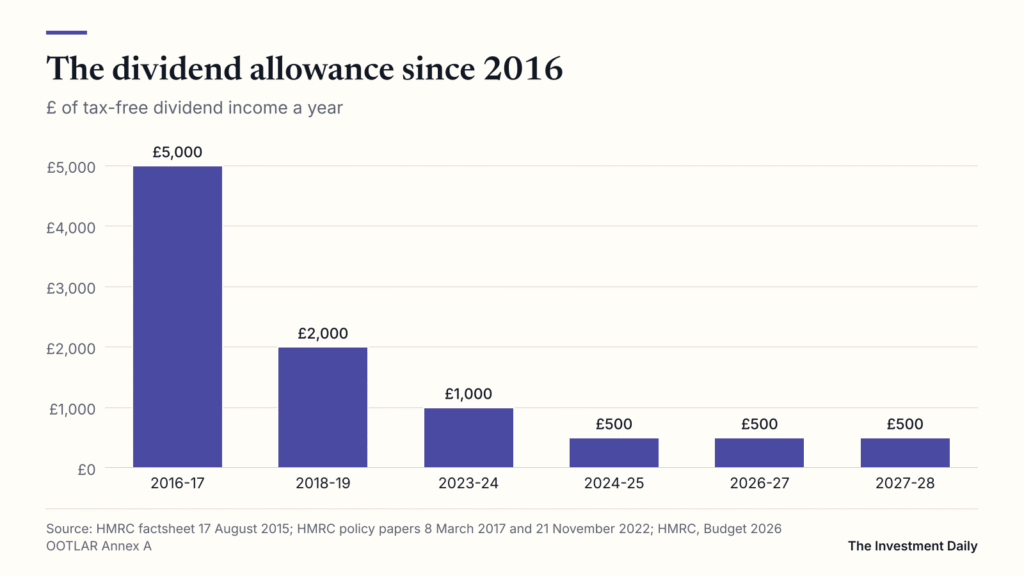
UK dividend tax rates for 2026 to 2027 are 10.75% for dividends in the basic rate band, 35.75% in the higher rate band and 39.35% in the additional rate band, according to GOV.UK. The first £500 of dividends each year is tax-free under the dividend allowance, and no tax is due on dividends covered by any unused personal allowance. Dividends held in an ISA or a pension are not taxed at all. Budget 2026, delivered on 28 October 2026, left these rates and the £500 allowance unchanged for 2027 to 2028.
Dividend tax rates for 2026 to 2027
The current rates took effect on 6 April 2026. Budget 2025 raised the ordinary rate from 8.75% to 10.75% and the upper rate from 33.75% to 35.75% for distributions made on or after that date, and kept the additional rate at 39.35% (HMRC, 27 November 2025). The change applies across the UK.
The Budget 2026 rates and allowances annex shows the same three dividend tax rates for 2027 to 2028, and the same £500 dividend allowance (HMRC, OOTLAR Annex A). That contrasts with savings interest, where Budget 2026 confirmed rises to 24%, 44% and 49% from 6 April 2027.
| Band | Taxable income band | Dividend rate 2026 to 2027 | Dividend rate 2027 to 2028 |
|---|---|---|---|
| Dividend allowance | First £500 of dividends | 0% | 0% |
| Basic rate (ordinary rate) | £1 to £37,700 | 10.75% | 10.75% |
| Higher rate (upper rate) | £37,701 to £125,140 | 35.75% | 35.75% |
| Additional rate | Over £125,140 | 39.35% | 39.35% |
Source: OOTLAR Annex A. Bands are measured on taxable income after the personal allowance of £12,570, so with a full allowance the higher rate starts at total income of £50,270. Trustees of discretionary and accumulation trusts pay a dividend trust rate of 39.35%.
The rates are lower than the main income tax rates of 20%, 40% and 45%. Dividends are paid out of company profits, which have usually been subject to corporation tax already. For the shareholder, the figure that matters is the rate on each slice of dividend income above the allowance.
How the dividend allowance works
The dividend allowance is a 0% band for the first £500 of dividend income in a tax year, whatever your tax band. GOV.UK says you pay tax only on dividend income above the allowance, and no tax on dividends that fall within your personal allowance (GOV.UK). Unlike the personal savings allowance for interest, it does not shrink for higher or additional rate taxpayers.
The allowance is not an exemption that takes income out of the calculation. When the allowance was introduced, HMRC said that “dividends within your allowance will still count towards your basic or higher rate bands” (HMRC factsheet, 17 August 2015). So £500 of tax-free dividend income still uses up £500 of your basic rate band, which can push later dividends into the higher rate.
Nor is it something you claim. It applies automatically to dividends from UK and overseas companies and to dividend distributions from funds, as long as the shares or fund units are held outside an ISA or a pension.
The order of taxation: why dividends are taxed last
Income tax is worked out in a set order. Earnings, pensions and rental profits come first, then savings income such as interest, then dividends. HMRC’s manual says that where someone has both savings and dividend income, “the amounts taken together are treated as the highest part of their total income”, and “the dividend income is taken as the highest part of the combined amount” (HMRC, SAIM1090). Life insurance gains and employment termination payments are the exceptions, ranking above dividends.
Because dividends sit on top, they are the slice most likely to fall into a higher band, and the tax on dividends can jump once the basic rate band is used up. Which of the dividend tax rates you pay therefore depends on how much other income you have, not just on the dividends themselves.
- Add up non-savings income: salary, self-employed profits, pensions, rental profits.
- Deduct the personal allowance. If non-savings income is below £12,570, the unused allowance passes to savings and then to dividends.
- Tax non-savings income at 20%, 40% or 45% (Scotland sets its own rates for this slice, and from April 2027 rental profits have separate property rates; dividend rates are UK-wide).
- Tax savings income next, using the starting rate for savings and the personal savings allowance first.
- Tax dividends last: the first £500 at 0%, then the rest at the rate for whichever band each pound falls in.
The personal allowance itself falls by £1 for every £2 of adjusted net income above £100,000, and is zero at £125,140 or above (GOV.UK). Dividends count as income for that test, so a large dividend can remove part of the allowance as well as being taxed at the upper rate.
Worked examples using the dividend tax rates
The examples below are hypothetical and for illustration only. They assume a full personal allowance unless stated, rest-of-UK rates on earnings, no savings income and no pension contributions.
GOV.UK’s own example
Someone receives £3,000 in dividends and £29,570 in wages in 2026 to 2027 (GOV.UK). Total income is £32,570; after the £12,570 personal allowance, taxable income is £20,000. They pay 20% on £17,000 of wages, nothing on £500 of dividends, and 10.75% on the other £2,500 of dividends, which is £268.75.
Higher rate shareholder
Farah earns £60,000 and receives £4,000 of dividends. Her salary alone takes her into the higher rate band, so after the £500 allowance the remaining £3,500 is taxed at 35.75%: £1,251.25. At the 2025 to 2026 rate of 33.75% the same dividends would have cost £1,181.25, so the 2026 rise adds £70.
Dividends that straddle two bands
George earns £44,870 and receives £10,000 of dividends. After his personal allowance, his salary uses £32,300 of the £37,700 basic rate band, leaving £5,400. The £500 dividend allowance uses part of that space, leaving £4,900 of dividends taxed at 10.75%, or £526.75.
The remaining £4,600 of dividends falls in the higher rate band and is taxed at 35.75%, or £1,644.50. His total tax on dividends is £2,171.25.
Interest and dividends together
Jo earns £40,000 and receives £2,000 of interest and £3,000 of dividends. Her total income of £45,000 keeps her a basic rate taxpayer. After the personal allowance, her salary uses £27,430 of the basic rate band, leaving £10,270 for her savings and dividend income.
Interest is taxed before dividends. Her £1,000 personal savings allowance covers half the interest and the other £1,000 is taxed at 20%, or £200. The first £500 of dividends is covered by the allowance and the remaining £2,500 is taxed at 10.75%, or £268.75. All of it stays inside the basic rate band.
Her total tax on investment income is £468.75 in 2026 to 2027. With the same income in 2027 to 2028, the interest is taxed at 24% instead of 20%, so the bill rises to £508.75, while the tax on dividends stays the same.
Retired shareholder with a low pension
Hannah has pension income of £10,000 and £6,000 of dividends. Her pension uses £10,000 of her personal allowance, leaving £2,570 to cover dividends. Of the remaining £3,430, the first £500 is covered by the dividend allowance and £2,930 is taxed at 10.75%: £314.98.
Additional rate shareholder
Ian earns £200,000 and receives £20,000 of dividends. He has no personal allowance at that income. After the £500 allowance, £19,500 is taxed at 39.35%: £7,673.25.
| Example (illustration only) | Other income | Dividends | Tax on dividends 2026 to 2027 | Effective rate on dividends |
|---|---|---|---|---|
| GOV.UK example | £29,570 wages | £3,000 | £268.75 | 9.0% |
| Farah, higher rate | £60,000 salary | £4,000 | £1,251.25 | 31.3% |
| George, straddles bands | £44,870 salary | £10,000 | £2,171.25 | 21.7% |
| Jo, interest and dividends | £40,000 salary, £2,000 interest | £3,000 | £268.75 | 9.0% |
| Hannah, low pension | £10,000 pension | £6,000 | £314.98 | 5.2% |
| Ian, additional rate | £200,000 salary | £20,000 | £7,673.25 | 38.4% |
The effective rate is the tax divided by total dividends, a simple way to compare dividend tax rates across cases. It is always below the headline rate because of the £500 allowance, and well below it where some dividends fall in a lower band or within the personal allowance.
A short history of dividend tax rates
The present system dates from 6 April 2016, when the dividend tax credit was abolished and replaced by a tax-free dividend allowance. HMRC’s factsheet at the time set the allowance at £5,000 and the rates at 7.5%, 32.5% and 38.1% (HMRC; HMRC rates for 2016-17). Since then the allowance has been cut three times and the rates raised twice.
| From | Change | Ordinary, upper and additional rates | Dividend allowance |
|---|---|---|---|
| 6 April 2016 | New system replaces the dividend tax credit | 7.5%, 32.5%, 38.1% | £5,000 |
| 6 April 2018 | Allowance cut (Spring Budget 2017) | 7.5%, 32.5%, 38.1% | £2,000 |
| 6 April 2022 | Rates up 1.25 percentage points | 8.75%, 33.75%, 39.35% | £2,000 |
| 6 April 2023 | Allowance cut (Autumn Statement 2022) | 8.75%, 33.75%, 39.35% | £1,000 |
| 6 April 2024 | Allowance cut again | 8.75%, 33.75%, 39.35% | £500 |
| 6 April 2026 | Ordinary and upper rates up 2 points (Budget 2025) | 10.75%, 35.75%, 39.35% | £500 |
| 6 April 2027 | No change at Budget 2026 | 10.75%, 35.75%, 39.35% | £500 |
Sources: HMRC policy papers of 8 March 2017, 27 October 2021, 21 November 2022 and 27 November 2025; HMRC rates and allowances; OOTLAR Annex A.
The 2022 cut to £1,000 and then £500 was expected to affect 3,235,000 people in 2023 to 2024 and 4,405,000 in 2024 to 2025, HMRC estimated (HMRC). For the 2026 rate rise, HMRC estimated that 3.9 million people, 9% of taxpayers, would be affected by 2029 to 2030 (HMRC). Dividend income of £10,000 that was tax-free up to £5,000 in 2016 to 2017 now leaves £9,500 exposed to tax.
ISAs and pensions: where dividend tax rates do not apply
Two wrappers take dividends out of the calculation entirely, so the dividend tax rates never apply to them. GOV.UK says you do not pay tax on dividends from shares in an ISA (GOV.UK), and that you do not pay tax on income or capital gains from investments in an ISA (GOV.UK). The adult ISA subscription limit is £20,000 in 2026 to 2027 and 2027 to 2028 (OOTLAR Annex A). Dividends from an ISA also do not use the allowance or the basic rate band.
Inside a registered pension scheme, HMRC’s Pensions Tax Manual says income from investments held for the scheme is exempt from income tax and gains are exempt from capital gains tax (HMRC, PTM024400). The trade-off is that money taken out of a pension is generally taxed as income, and the pension annual allowance is £60,000 in both 2026 to 2027 and 2027 to 2028 (OOTLAR Annex A).
Budget 2026 also said the government will explore a new incentive for people investing in a stocks and shares ISA for the first time, with the design to be developed with the investment industry (HM Treasury, Budget 2026). No details or start date had been published at 1 November 2026. Our guide to tax-efficient investing: ISA, SIPP and GIA in order sets out how the wrappers compare.

Funds, accumulation units and foreign shares
The dividend tax rates are not only for people who own shares directly; they also reach most fund investors. HMRC’s manual says investors in OEICs and authorised unit trusts are taxed on the basis that amounts available for distribution are dividends (HMRC, SAIM5070). An equity fund’s distributions therefore count towards the dividend allowance in the same way as dividends from shares.
Bond funds are the main exception. A fund can pay its income as an interest distribution only if the market value of its qualifying, interest-type investments exceeds 60% of all its investments throughout the distribution period, and investors are then taxed as if they had received interest (HMRC, IFM02224; IFM02222). Those distributions fall under the savings rules, not the dividend rules.
Accumulation units are still taxed
Choosing accumulation units, where income is reinvested rather than paid out, does not avoid tax on dividends. HMRC says amounts reinvested “are taxed as income accruing to investors in the same way as if they had been distributed” (HMRC, IFM03120). Investors holding accumulation units outside a wrapper need to include the reinvested amount as dividend income.
Overseas dividends
Dividends from overseas companies count towards the same £500 allowance as UK dividends. GOV.UK says UK residents with foreign income usually need to file a Self Assessment return.
The exception is where your only foreign income is dividends, your total dividends including UK ones are below the £500 allowance and you have no other income to report (GOV.UK). Income already taxed abroad is included on the return to claim Foreign Tax Credit Relief, if you are eligible. For background on owning shares directly, see how to invest in shares.
How to report dividends and pay the tax
Any tax due on dividends is settled directly with HMRC. GOV.UK sets out the steps (GOV.UK):
- Within the allowance: you do not need to tell HMRC if your dividends are within the dividend allowance for the tax year.
- Up to £10,000 of dividends: if you already file Self Assessment, report them on your return. If not, tell HMRC after the tax year ends on 5 April and before 5 October, either by asking HMRC to change your tax code so the tax is taken from your wages or pension, or through the income tax helpline.
- Over £10,000 of dividends: you need to complete a Self Assessment tax return. If you do not usually file, you must tell HMRC that you need one by 5 October after the tax year ends, by registering for Self Assessment.
The Self Assessment deadlines for paying the tax are on GOV.UK. Keep the dividend confirmations or tax vouchers from each company or fund, and any platform consolidated tax certificate. Those records show the amount and payment date of each dividend, which decides the tax year it falls in.
Dividend tax rates against tax on interest and gains
A portfolio held outside a wrapper can produce three types of return, each taxed under different rules. The table sets out the 2026 to 2027 and 2027 to 2028 position from the Budget 2026 annex.
| Type of return | Tax-free amount | Rates 2026 to 2027 | Rates 2027 to 2028 |
|---|---|---|---|
| Dividends | £500 dividend allowance | 10.75%, 35.75%, 39.35% | 10.75%, 35.75%, 39.35% |
| Interest | £1,000 or £500 personal savings allowance; up to £5,000 starting rate for savings | 20%, 40%, 45% | 24%, 44%, 49% |
| Capital gains on shares | £3,000 annual exempt amount | 18%, 24% | 18%, 24% |
Source: OOTLAR Annex A. Interest above the allowances is already taxed at higher headline rates than dividends in every band, and from April 2027 the gap widens: 24% against 10.75% for a basic rate taxpayer, 44% against 35.75% for a higher rate taxpayer. Dividends come from profits that have usually borne corporation tax first, so the headline rates are not a full comparison.
Tax is one input only. Dividends can be cut or suspended, share prices can fall, and past performance is not a guide to future returns. Our dividends and income desk covers how dividend income is generated and the risks to it.
Dividend tax rates: what to check this tax year
The dividend tax rates for 2026 to 2027 also apply in 2027 to 2028, which makes planning simpler than for interest. Tax on dividends depends on the size of the dividends and on where the rest of your income leaves you in the basic rate band. A few checks cover most situations.
- Total your expected dividends from all accounts outside ISAs and pensions, including fund distributions and accumulation units.
- Work out where your other income leaves you in the basic rate band, remembering that dividends are taxed last and the allowance still uses band space.
- Check whether your adjusted net income is near £100,000, where the personal allowance starts to be withdrawn.
- Note whether you need to tell HMRC by 5 October or file a Self Assessment return, and keep tax vouchers.
- Check how much ISA allowance you have used this tax year before it resets on 6 April.
Common mistakes
- Treating the allowance as an exemption. Dividends within the £500 allowance still use the basic rate band, so they can push later dividends into the higher rate.
- Forgetting reinvested income. Accumulation units are taxed on the reinvested amount, even though no cash is paid out.
- Missing the 5 October deadline. People who do not file Self Assessment and owe tax on dividends must tell HMRC by 5 October after the tax year.
- Using out-of-date rates. Calculations made before 6 April 2026 used 8.75% and 33.75%; the ordinary and upper rates are now 10.75% and 35.75%.
- Ignoring the £100,000 threshold. Dividends count towards adjusted net income, which decides whether the personal allowance is withdrawn.
In short, the dividend tax rates are 10.75%, 35.75% and 39.35% on dividends above a £500 allowance, in both 2026 to 2027 and 2027 to 2028. Budget 2026 did not change them, but the bigger rise in tax on savings interest from 6 April 2027 changes how the two compare. Shares and funds held in an ISA or pension stay outside the system altogether.