The personal savings allowance lets most UK savers receive some interest each tax year without paying income tax on it: up to £1,000 for a basic rate taxpayer, £500 for a higher rate taxpayer and nothing for an additional rate taxpayer, according to GOV.UK. People on low earnings can also use the starting rate for savings, which taxes up to £5,000 more interest at 0%. Interest above those amounts is taxed at 20%, 40% or 45% in 2026 to 2027. Budget 2026 raised those savings income rates to 24%, 44% and 49% from 6 April 2027, while leaving the allowances unchanged.
How the personal savings allowance works
The allowance is not a separate account or a product. It is a slice of interest that is taxed at a 0% rate, called the savings nil rate in the legislation (Income Tax Act 2007, section 12A). It applies automatically. You do not apply for it, and your bank does not need to know about it.
The allowance started on 6 April 2016. When it was announced, HMRC expected that “around 95% of taxpayers will not have any tax to pay on their savings income” (HMRC policy paper, 9 December 2015). At the same time, banks and building societies stopped deducting tax from interest before paying it.
The amounts have not changed since. The Budget 2026 rates and allowances annex confirms £1,000 for basic rate taxpayers and £500 for higher rate taxpayers in both 2026 to 2027 and 2027 to 2028 (HMRC, OOTLAR Annex A).
| Your income tax band | Taxable income band, 2026 to 2027 | Personal savings allowance |
|---|---|---|
| Basic rate | £1 to £37,700 above the personal allowance | £1,000 |
| Higher rate | £37,701 to £125,140 | £500 |
| Additional rate | Over £125,140 | £0 |
Source: OOTLAR Annex A. The personal allowance is £12,570 in both years, so with a full allowance the higher rate starts at total income of £50,270.
How your band is decided
Your band depends on your total income, including the interest. GOV.UK puts it plainly: your tax band is based on adding all your interest to your other income (GOV.UK). Interest covered by the allowance still counts as income when HMRC works out which band you are in.
This creates a cliff edge. A basic rate taxpayer whose interest pushes total income a few pounds over the higher rate threshold becomes a higher rate taxpayer, and the allowance halves from £1,000 to £500. We show the effect in a worked example below.
The starting rate for savings: up to £5,000 more at 0%
The starting rate for savings is a second, older relief that sits underneath the main allowance. It taxes up to £5,000 of savings income at 0%, and the Budget 2026 annex keeps both the rate and the £5,000 limit for 2026 to 2027 and 2027 to 2028 (OOTLAR Annex A). HMRC’s manual says that from 6 April 2015 the limit is the personal allowance plus the £5,000 starting rate band (HMRC, SAIM1112).
It is only available to people with low other income. According to GOV.UK, you can get it if your other taxable income, not counting interest or dividends, is less than £17,570. Every £1 of other income above your personal allowance reduces the starting rate for savings by £1 (GOV.UK).
GOV.UK’s own example: someone earns £16,000 in wages and £200 in interest. The personal allowance covers the first £12,570 of wages. The remaining £3,430 reduces the starting rate for savings from £5,000 to £1,570, so the £200 of interest is not taxed.
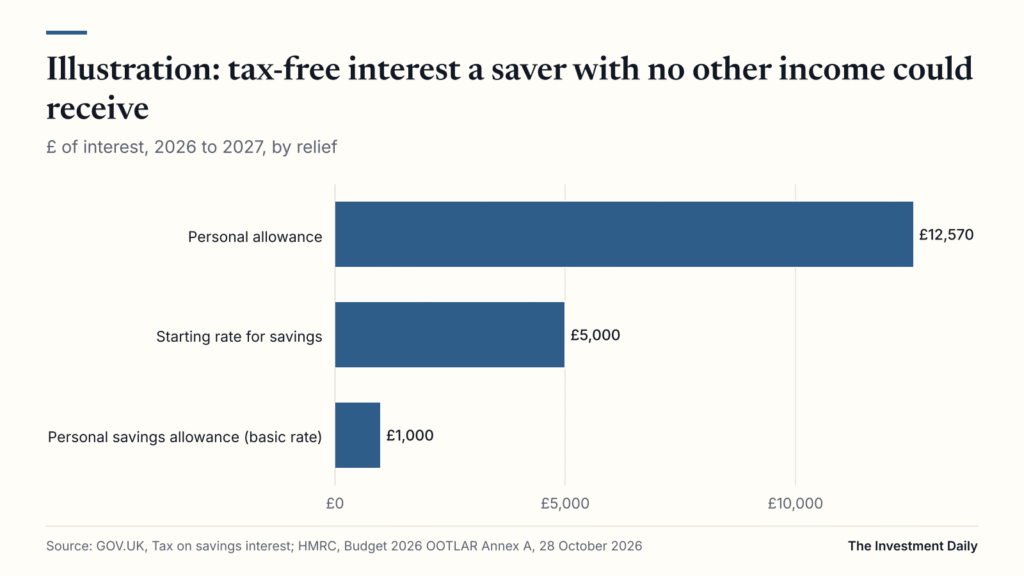
The two reliefs stack. When the personal savings allowance was introduced, HMRC said income taxed at the 0% starting rate “will not use up any part of an individual’s savings allowance” (HMRC policy paper). A person with no other income at all could therefore receive up to £18,570 of interest tax-free in 2026 to 2027: £12,570 covered by the personal allowance, £5,000 by the starting rate for savings and £1,000 by the personal savings allowance.
What counts as savings income
The allowance covers savings income, which is wider than bank interest. HMRC’s factsheet on the allowance, issued when it started, listed the main types (HMRC factsheet):
- interest on bank and building society accounts, and on accounts with credit unions and NS&I;
- interest distributions, not dividends, from authorised unit trusts, open-ended investment companies and investment trusts;
- income from government or company bonds, such as gilt coupons;
- most types of purchased life annuity payments.
That factsheet was withdrawn in 2018 and replaced by the current GOV.UK guidance, but the categories are a useful map. The current guidance says you may have to pay tax on interest from bank and building society accounts and from savings and credit union accounts (GOV.UK).
What does not use the allowance
Some income is already tax-free and does not touch the personal savings allowance at all. GOV.UK says you do not pay tax on interest on cash in an ISA, or on income or gains from investments in an ISA (GOV.UK). HMRC’s factsheet also listed Premium Bonds prizes and NS&I Fixed Interest and Index-linked Savings Certificates as already tax-free. Dividends are taxed separately under the £500 dividend allowance, not the rules on tax on savings.
For more on how the wrappers fit together, see our guide to tax-efficient investing in the UK.
Budget 2026: tax on savings rises from 6 April 2027
Budget 2026, delivered on 28 October 2026, raised the rates of tax on savings income above the allowances. From 6 April 2027 the savings basic rate rises to 24%, the savings higher rate to 44% and the savings additional rate to 49%, according to HMRC’s tax information and impact note published on 29 October 2026 (HMRC). The rates apply across the UK, including Scotland and Wales.
This is the second increase announced in a year. Budget 2025 had already legislated rates of 22%, 42% and 47% for 2027 to 2028, after savings rates of 20%, 40% and 45% since April 2017 (HMRC, 27 November 2025). Budget 2026 adds a further 2 percentage points on top, through Finance Bill 2026-27. Older articles that quote 22% for 2027 are now out of date.
| Savings income rate | 2026 to 2027 | 2027 to 2028 as set by Budget 2025 | 2027 to 2028 after Budget 2026 |
|---|---|---|---|
| Starting rate for savings (up to £5,000) | 0% | 0% | 0% |
| Within the personal savings allowance | 0% | 0% | 0% |
| Savings basic rate | 20% | 22% | 24% |
| Savings higher rate | 40% | 42% | 44% |
| Savings additional rate | 45% | 47% | 49% |
Sources: OOTLAR Annex A; HMRC tax information and impact notes of 27 November 2025 and 29 October 2026.
What did not change matters as much. The personal savings allowance stays at £1,000 and £500, the starting rate for savings stays at £5,000, and the income tax thresholds are the same in 2027 to 2028 as in 2026 to 2027 (OOTLAR Annex A). So the higher tax on savings only bites on interest above the allowances, but every pound of it costs more.
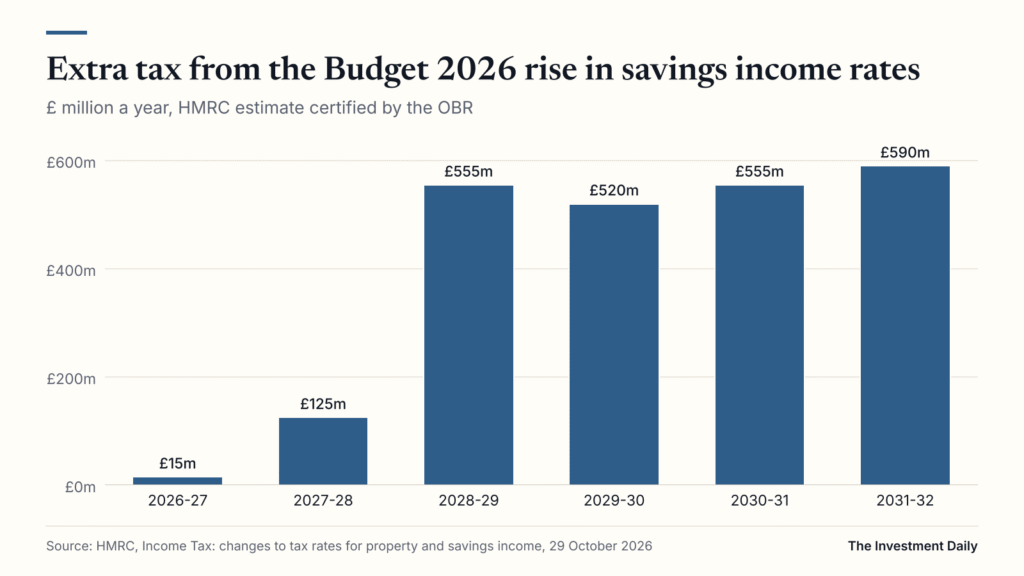
HMRC estimates that about 12% of taxpayers will pay an average of £113 a year more in 2027 to 2028 because of the Budget 2026 savings change, and that by 2031 to 2032 about 6 million people, 13% of taxpayers, will have savings income above the allowances and face higher tax. HMRC also says a basic rate taxpayer using both 0% reliefs in full would need over £150,000 in savings held outside an ISA, earning 4%, before paying any tax on interest (HMRC). The arithmetic behind it is that £150,000 at 4% earns £6,000, the £5,000 starting rate plus the £1,000 allowance, which only works for someone whose other income is no more than the personal allowance. That is rare for people in work.
Worked examples: the personal savings allowance by tax band
The examples below are hypothetical and for illustration only. They assume a full personal allowance, rest-of-UK rates on earnings, no dividends and no pension contributions, and that the same interest arises in both tax years.
Basic rate taxpayer
Asha earns a salary of £30,000 and receives £1,800 of interest from savings accounts. Her total income of £31,800 keeps her a basic rate taxpayer, so her personal savings allowance is £1,000. Her salary is well above £17,570, so the starting rate for savings is not available. She pays tax on £800 of interest: £160 at 20% in 2026 to 2027, or £192 at 24% in 2027 to 2028.
Higher rate taxpayer
Ben earns £60,000 and receives £1,500 of interest. As a higher rate taxpayer his allowance is £500. The other £1,000 of interest is taxed at the savings higher rate: £400 in 2026 to 2027 and £440 in 2027 to 2028.
Additional rate taxpayer
Chloe earns £150,000 and receives £3,000 of interest. Additional rate taxpayers get no personal savings allowance, so all £3,000 is taxed: £1,350 at 45% in 2026 to 2027 and £1,470 at 49% in 2027 to 2028.
Retired saver using the starting rate for savings
Dev has pension income of £14,000 and £4,000 of interest. His personal allowance covers £12,570 of the pension. The other £1,430 reduces his starting rate for savings from £5,000 to £3,570.
The first £3,570 of interest is taxed at 0% under the starting rate, and his £1,000 personal savings allowance covers the remaining £430. He pays no tax on his savings interest in either year.
The cliff edge at the higher rate threshold
Ella earns £49,500 and receives £1,200 of interest, so her total income is £50,700. That is above the £50,270 point at which the higher rate starts, so she is a higher rate taxpayer and her personal savings allowance is £500, not £1,000.
After the personal allowance, her salary uses £36,930 of the £37,700 basic rate band, leaving £770. The £500 of interest covered by the allowance uses part of that, leaving £270 taxed at the savings basic rate and £430 at the savings higher rate.
Her tax on savings interest is £226 in 2026 to 2027 (£54 plus £172) and £254 in 2027 to 2028 (£64.80 plus £189.20). Had her interest been £700, total income of £50,200 would have kept her in the basic rate band, and the full £1,000 allowance would have covered it.
| Example (illustration only) | Interest | Allowance used | Tax on interest 2026 to 2027 | Tax on interest 2027 to 2028 |
|---|---|---|---|---|
| Asha, basic rate, £30,000 salary | £1,800 | £1,000 | £160 | £192 |
| Ben, higher rate, £60,000 salary | £1,500 | £500 | £400 | £440 |
| Chloe, additional rate, £150,000 salary | £3,000 | £0 | £1,350 | £1,470 |
| Dev, £14,000 pension | £4,000 | £3,570 starting rate plus £430 | £0 | £0 |
| Ella, £49,500 salary | £1,200 | £500 | £226 | £254 |
How HMRC collects tax on savings interest
Because banks pay savings interest gross, any tax on savings is collected afterwards. GOV.UK sets out the process (GOV.UK):
- After the tax year ends, your bank or building society tells HMRC how much interest you earned.
- If you are employed or receive a pension, HMRC usually collects the tax through your tax code. The code may be changed to collect tax owed for the previous year, or to include an estimate of interest for the current year.
- If you owe tax, HMRC sends a tax calculation, usually between June and the following March.
- If you have no tax code, or it cannot be changed, HMRC may send a Simple Assessment letter with a bill.
- If you already file Self Assessment, you report interest on your return instead.
If your savings interest is more than £10,000, GOV.UK says you need to report it on a Self Assessment tax return, and to register for Self Assessment if you do not already file one. HMRC sends a notice to file a return when a bank reports interest above that level. If you think you owe tax but receive no letter by 31 March after the tax year, GOV.UK says you must contact HMRC. You can check the estimate in your tax code through your personal tax account and ask HMRC to correct it if it is wrong.
Claiming back tax you should not have paid
Tax can still be deducted from some savings and investment income, and there is a route to reclaim it. GOV.UK says you can claim back tax paid on savings interest if your total income was below your personal allowance, within 4 years of the end of the tax year concerned (GOV.UK). Self Assessment filers claim through the return. Others can use form R40, which HMRC says is for people whose gross savings and investment income is £10,000 or less, with a separate claim for each year (HMRC, R40).
Timing, joint accounts and children’s savings
When interest counts matters, because the allowance resets each tax year and cannot be carried forward.
When interest is taxed
HMRC’s manual says interest “arises” when it is received or made available to you, which includes being credited to an account you are free to draw on (HMRC, SAIM2440).
That has a practical effect on fixed-term accounts. On a five-year bond that credits interest each year and allows early access with a penalty, the interest is taxable each year as it is credited. If the terms allow no access until maturity, the interest arises, and is taxed, at that point. A multi-year bond that pays everything at the end can therefore put several years of interest into one tax year and exhaust the allowance in one go.
Joint accounts
For married couples and civil partners, interest on a joint account is normally split 50:50, and each is taxable on half (HMRC, SAIM2420). If the money is not in fact owned equally, they can elect to be taxed on their actual shares. For other joint holders, each is taxed on the interest they are actually entitled to. HMRC says that in most cases this means an equal split, with shares based on what each contributed where there is not enough evidence that the money was meant to be owned jointly. A couple can therefore use two personal savings allowances against one account.
Children’s savings
Children have their own personal allowance and personal savings allowance, but there is an anti-avoidance rule. HMRC’s manual says interest on an account held by an unmarried child under 18 is treated as the parent’s income if the money was a gift from that parent and the interest exceeds £100 (HMRC, SAIM2430). The rule is limited to gifts from a parent. Junior ISAs, with a £9,000 annual limit in 2026 to 2027, are a separate tax-free wrapper (OOTLAR Annex A).
How much cash the personal savings allowance covers
How much savings the allowance shelters depends on the interest rate. Bank Rate, which influences what banks pay, was held at 3.75% by the Bank of England on 17 September 2026, with three of the nine committee members voting for a rise to 4%. The next decision is due on 5 November 2026 (Bank of England). Savings rates offered by banks vary and can sit above or below Bank Rate.
The table shows, for illustration only, the balance at which a year’s interest uses up the whole allowance at three hypothetical rates.
| Hypothetical interest rate | Balance that earns £1,000 a year (basic rate allowance) | Balance that earns £500 a year (higher rate allowance) |
|---|---|---|
| 3% | £33,333 | £16,667 |
| 4% | £25,000 | £12,500 |
| 5% | £20,000 | £10,000 |
The allowance is fixed in cash terms, so higher interest rates mean a smaller balance is sheltered. For a higher rate taxpayer at 4%, interest on anything above £12,500 outside an ISA or pension is taxable. Our comparison of Premium Bonds, gilts and fixed-rate savings and our guide to gilts or a savings account by tax band show how the after-tax return changes by band. More on rates and deposits is on our cash savings desk.
Personal savings allowance: common mistakes and what to check before April 2027
The rules are simple in outline, but several points catch savers out. Each point below is drawn from HMRC’s own guidance.
- Assuming the allowance is per account. It is per person, per tax year, across all your savings interest.
- Ignoring the band test. Interest counts towards your total income, so it can move you into the higher rate band and halve your allowance.
- Forgetting interest that is not from a bank. Gilt coupons, corporate bond interest and interest distributions from bond funds are savings income too.
- Missing the timing on fixed-term bonds. A bond with no access until maturity can put several years of interest into one tax year.
- Not checking the tax code. HMRC estimates current-year interest in some tax codes. If the estimate is too high, you can ask for it to be corrected.
- Relying on old rates. From 6 April 2027 interest above the allowances is taxed at 24%, 44% or 49%, not the 22%, 42% or 47% announced in 2025.
Before the new rates arrive, some savers check how much interest they expect in 2026 to 2027 and 2027 to 2028, whether a spouse or civil partner has unused allowance, and whether their ISA allowance, which stays at £20,000 and covers cash ISAs for all adults from April 2027 under Budget 2026, is in use (OOTLAR). Keeping cash in accounts with different maturity dates can also spread interest across tax years. None of these is right for everyone, and the after-tax return is only one factor alongside access, protection and inflation.
In short, the personal savings allowance still covers interest of £1,000 or £500 a year, and the starting rate for savings still covers up to £5,000 for people on low incomes. What has changed is the tax on savings above them. From 6 April 2027, each £100 of taxable interest costs a basic rate taxpayer £24 rather than £20. If your interest sits close to your allowance, the figures to watch are your total income, the timing of interest on fixed-term accounts and the tax code HMRC sends you.