A stocks and shares ISA is a tax wrapper: the shares, funds and bonds inside it pay no UK tax on dividends, interest or gains. In the 2026 to 2027 tax year you can pay in up to £20,000 across all your ISAs, and Budget 2026 on 28 October 2026 confirmed the same £20,000 limit for 2027 to 2028 (HMRC, Budget 2026 Annex A). The Budget also reversed the planned cut to the cash ISA limit and said the government will explore a new incentive for first-time investors. The wrapper removes tax, not risk: the investments inside can fall in value.
What a stocks and shares ISA is
An Individual Savings Account is not an investment in itself. It is an account with tax rules attached, run by an ISA manager approved by HMRC. Inside the account you choose the investments, or pay a manager to choose them. The wrapper means no dividend tax, no income tax on interest and no capital gains tax on what it holds.
GOV.UK lists four adult ISA types that can take new money: cash ISAs, stocks and shares ISAs, innovative finance ISAs and Lifetime ISAs (GOV.UK, How ISAs work). You must be 18 or over and resident in the UK to pay in, with an exception for Crown employees serving overseas and their spouses or civil partners (HMRC, Who can invest in an ISA).
HMRC’s guidance says you do not pay tax on dividends from shares held in an ISA (GOV.UK, Tax on dividends), and the GOV.UK guide adds that if you complete a tax return you do not need to declare any ISA interest, income or capital gains on it (GOV.UK, ISAs). That administrative point matters as much as the tax saving for many investors: no records of acquisition costs for gains inside the account, and no dividend figures to report.
The ISA allowance for 2026/27 and what Budget 2026 changed
The ISA allowance is £20,000 a tax year, running from 6 April to 5 April. GOV.UK says you can save it “in one account or split the allowance across multiple accounts” (GOV.UK). Its own example: £10,000 in one cash ISA, £3,000 in another cash ISA and £7,000 in a stocks and shares ISA in one tax year.
Since 6 April 2024 you can pay into more than one ISA of the same type in a tax year, within the overall limit. The exceptions are the Lifetime ISA and the Junior ISA, where you can still pay into only one each year (HMRC). Unused ISA allowance cannot be carried forward. HMRC’s guidance for ISA managers says an investor who has not subscribed up to the limit in any year “cannot carry forward the difference and add it to the subscription limit for the next year” (HMRC, Manage ISA subscriptions).
What Budget 2026 confirmed
The Budget 2026 overview of tax legislation and rates (OOTLAR), published on 28 October 2026, sets out the ISA decisions (HMRC, OOTLAR):
- Item 2.5: the government “will retain the cash ISA limit at £20,000 for all savers over 18 years old from April 2027”. The change will be made by secondary legislation to be laid in November 2026.
- Item 2.5 also says the government will work with industry to explore a new ISA incentive “for people investing in a Stocks and Shares ISA for the first time”. No design, amount or start date has been published.
- Item 2.3: a First Time Buyer ISA will replace the Lifetime ISA for new savers from April 2029, with a 25% bonus on the final balance up to £20,000 for a first home worth up to £450,000. Existing Lifetime ISA holders keep the current rules.
- Item 2.4: from 29 October 2026, the Lifetime ISA withdrawal charge falls from 25% to 20% for purchases above the property price cap. Other unauthorised withdrawals stay at 25%.
The Budget document itself says “the government has decided not to reduce the cash ISA limit, so that it remains at £20,000” (HM Treasury, Budget 2026). The overall ISA allowance was never due to change, and Annex A shows £20,000 for both 2026 to 2027 and 2027 to 2028.
| Limit | 2026 to 2027 | 2027 to 2028 |
|---|---|---|
| Overall adult ISA subscription limit | £20,000 | £20,000 |
| Cash ISA limit within that | £20,000 | £20,000 (planned £12,000 cut for under-65s to be reversed by regulations due in November 2026) |
| Junior ISA subscription limit | £9,000 | £9,000 |
| Child Trust Fund subscription limit | £9,000 | £9,000 |
Source: Budget 2026 Annex A and OOTLAR item 2.5, 28 October 2026.
How much savers pay in
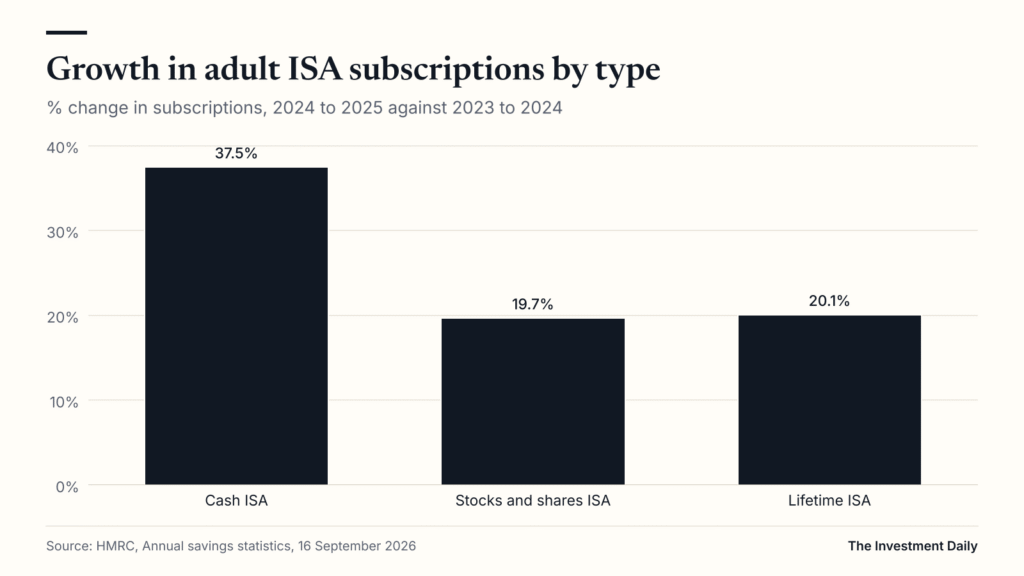
HMRC’s annual savings statistics, published on 16 September 2026, show around £135.7bn was subscribed to adult ISAs in 2024 to 2025, up £32.7bn on the year before (HMRC, Annual savings statistics). Cash ISA subscriptions grew by 37.5% and stocks and shares ISA subscriptions by 19.7%. At the end of 2024 to 2025 adult ISA holdings were worth £952bn, with stocks and shares ISAs accounting for 55.8% of that value and cash ISAs 44.1%.
Many investors use an ISA alongside a pension and a general account. The usual sequence and the trade-offs between those wrappers are covered in our guide to tax-efficient investing in the UK.
What you can hold in a stocks and shares ISA
GOV.UK lists the investments a stocks and shares ISA can include: shares in companies, unit trusts and investment funds, corporate bonds, government bonds and long-term asset funds (GOV.UK, How ISAs work). In practice that covers listed shares, investment trusts, open-ended funds, exchange traded funds and gilts. Our guides to what an ETF is and how to buy gilts explain those building blocks.
Two boundary changes took effect on 6 April 2026. Long-term asset funds (LTAFs) need to be held in a stocks and shares ISA: they cannot be held in an innovative finance ISA unless they were held there before that date. Cryptoasset exchange traded notes went the other way: they “cannot be held in a stocks and shares ISA, unless they were held there before 6 April 2026” and need to be held in an innovative finance ISA instead (GOV.UK).
You cannot usually move shares you already own straight into the account. GOV.UK says shares held outside an ISA cannot be transferred in unless they come from an employee share scheme (GOV.UK). Investors who want existing holdings inside the wrapper normally sell them and buy them back inside the ISA, which can create a capital gains tax bill on the sale outside it.
| Eligible investments | Belong in an innovative finance ISA instead |
|---|---|
| Shares in companies | Peer-to-peer loans |
| Unit trusts and investment funds | Crowdfunding debentures |
| Corporate bonds | Funds whose notice or redemption period rules them out of this ISA type |
| Government bonds | Cryptoasset exchange traded notes (from 6 April 2026, unless held before) |
| Long-term asset funds (from 6 April 2026) |
Source: GOV.UK, How ISAs work, accessed 1 November 2026.
How a stocks and shares ISA is taxed, compared with a general account
The value of the wrapper depends on what the same investments would cost you in tax outside it, in a general investment account. Three taxes matter: dividend tax, tax on interest, and capital gains tax.
Dividend tax
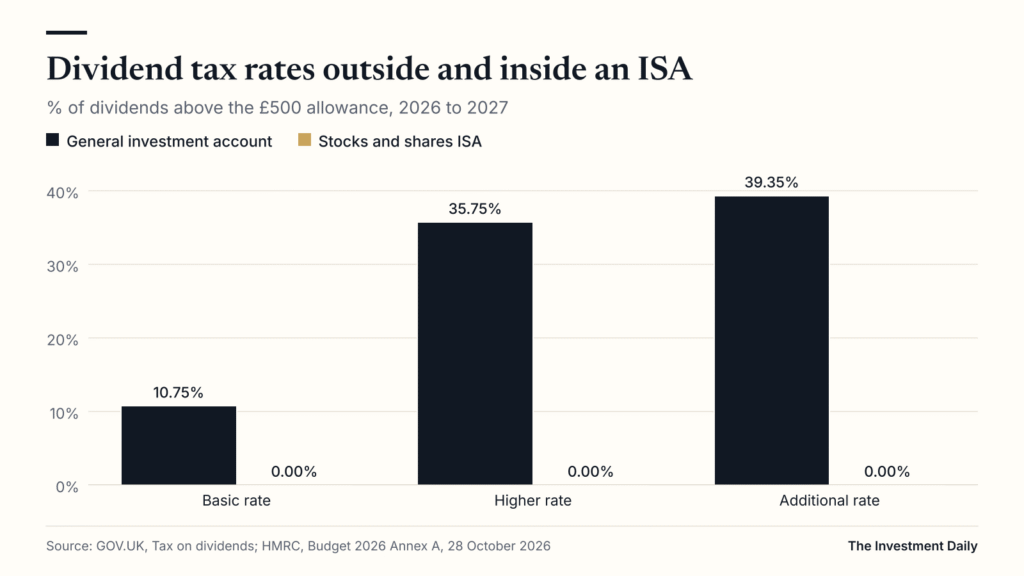
Outside an ISA, dividends above the £500 dividend allowance are taxed at 10.75% for basic rate taxpayers, 35.75% at the higher rate and 39.35% at the additional rate in 2026 to 2027 (GOV.UK, Tax on dividends). Annex A to the Budget shows the same dividend tax rates and the same £500 allowance for 2027 to 2028 (Annex A). Inside a stocks and shares ISA there is no dividend tax at all.
Interest from bonds and cash
Interest from gilts, corporate bonds and bond funds held outside a wrapper is savings income. The savings rates are 20%, 40% and 45% in 2026 to 2027. Budget 2026 announced that from 6 April 2027 they will rise to 24%, 44% and 49% across the UK (OOTLAR item 1.1). The Personal Savings Allowance stays at £1,000 for basic rate taxpayers and £500 for higher rate taxpayers (Annex A). Inside the ISA, that interest is tax-free.
Capital gains
Outside an ISA, gains above the £3,000 annual allowance are taxed at 18% where they fall in the basic rate band and 24% above it (GOV.UK, Capital Gains Tax rates). The £3,000 figure and both rates are unchanged for 2027 to 2028 (Annex A). Gains inside a stocks and shares ISA are free of capital gains tax, but losses inside it cannot be set against gains elsewhere.
| Income or gain | General investment account, 2026 to 2027 | From 6 April 2027 | Inside the ISA |
|---|---|---|---|
| Dividends above £500 | 10.75% / 35.75% / 39.35% | 10.75% / 35.75% / 39.35% | No tax |
| Interest above the Personal Savings Allowance | 20% / 40% / 45% | 24% / 44% / 49% | No tax |
| Capital gains above £3,000 | 18% / 24% | 18% / 24% | No tax |
| Reporting on a tax return | Required where tax is due | Required where tax is due | Not required |
Sources: GOV.UK, GOV.UK, OOTLAR and Annex A. Rates shown as basic / higher / additional.
A worked example
For illustration only: a higher rate taxpayer holds a £60,000 share portfolio yielding 3.5%, or £2,100 of dividends a year. In a general account, £1,600 is taxable after the £500 allowance, and the dividend tax at 35.75% is £572 a year. Inside the ISA the bill is nil. If the same investor later sells with a £20,000 gain, the capital gains tax bill in the general account would be £17,000 above the £3,000 allowance at 24%, or £4,080. Inside the ISA there is nothing to pay or report.
Two limits on this arithmetic. A basic rate taxpayer with small holdings may pay little or no tax outside an ISA anyway, because of the allowances. And the tax saving only matters if there are returns to shelter; the wrapper does not change the risk of loss.
Withdrawals, the flexible ISA and the 22% charge question
You can withdraw from an ISA at any time without losing the tax benefits on what remains, although providers may set their own terms or charges (GOV.UK, Withdrawing your money). Normally a withdrawal does not give back allowance: unless the account is a flexible ISA, money taken out and paid back in counts as a new subscription.
A flexible ISA is the exception. If the provider’s terms allow it, you can “take out cash then put it back in during the same tax year” without reducing the current year’s ISA allowance (GOV.UK). GOV.UK’s example: with a £20,000 allowance, £10,000 paid in and £3,000 withdrawn, you could pay in £13,000 more if the ISA is flexible, or £10,000 if it is not. Not every investment account is a flexible ISA, and GOV.UK says your provider can confirm whether yours is. With a flexible ISA, the replacement must happen in the same tax year.
Cash held inside a stocks and shares ISA
Money waiting to be invested sits as cash inside the account and usually earns some interest. The Individual Savings Account (Amendment) (No. 2) Regulations 2026, made on 10 September 2026 and due to come into force on 6 April 2027, were written to support the planned cut to the cash ISA limit. They insert a new regulation 22A: interest on cash held in a stocks and shares ISA or innovative finance ISA gets no tax relief, and the ISA manager must instead pay HMRC a flat rate charge on it (SI 2026/1018, legislation.gov.uk). The same regulations restrict transfers from these ISAs into cash ISAs for savers under 65.
HMRC’s policy paper on the measure, published on 17 September 2026, described this as “a flat rate charge of 22% on any interest paid on cash held in non-cash ISAs” (HMRC, Cash ISA limit reduction). The regulations themselves do not fix a percentage: they set the charge at “the savings basic rate in force for the year”. Budget 2026 Annex A puts the savings basic rate at 24% for 2027 to 2028 (Annex A).
Budget 2026 then reversed the cut those rules were written to support. OOTLAR item 2.5 and the Budget 2026 document confirm the £20,000 cash ISA limit and the first-time investor incentive, but neither mentions the charge on cash interest, the transfer restrictions or regulation 22A (OOTLAR item 2.5). As at 1 November 2026, the September regulations had not been revoked or amended on legislation.gov.uk, and the 17 September paper was still on GOV.UK with no withdrawal notice or update note.
The regulations that keep the £20,000 cash ISA limit are due to be laid before Parliament in November 2026. Whether the charge on cash interest inside a stocks and shares ISA still applies from 6 April 2027, and at what rate, depends on those regulations, which had not been published at the time of writing.
Transferring a stocks and shares ISA
An ISA transfer moves your account from one provider to another without using any of your ISA allowance. GOV.UK says to contact the provider you want to move to and complete its transfer form, and warns that if you withdraw the money yourself instead “you will not be able to reinvest that part of your tax-free allowance again” (GOV.UK, Transferring your ISA).
- Timescales: GOV.UK says an ISA transfer between cash ISAs should take no more than 15 working days and other types no more than 30 calendar days.
- What moves: an ISA transfer can cover money paid in this tax year or in earlier years.
- How it moves: some holdings can move in specie, as the same shares or funds. Others are sold and moved as cash, which means time out of the market while the ISA transfer completes.
- Costs: providers may have their own restrictions and may charge an exit fee (GOV.UK).
Transfers between a cash ISA and an investment ISA are possible in either direction under the rules in force in 2026 to 2027. The September 2026 regulations described above would, from 6 April 2027, stop savers under 65 transferring from a stocks and shares ISA into a cash ISA, unless the November 2026 regulations change that. Lifetime ISA and Junior ISA transfers have restrictions of their own. Both providers can confirm which holdings can move in specie and what each will charge before an ISA transfer starts.
Charges on a stocks and shares ISA
The tax saving can be eroded by fees. An investment ISA usually carries several layers of cost, set by each provider and fund rather than by HMRC:
- A platform or account fee, either a percentage of the value or a flat amount.
- Dealing commission on each purchase or sale of shares, investment trusts or ETFs.
- The ongoing charge of any fund, taken inside the fund’s price.
- The spread between buying and selling prices, and 0.5% stamp duty on purchases of UK shares (Annex A).
- Exit fees, where a provider charges them on an ISA transfer.
Budget 2026 also confirmed that a Securities Transfer Tax will replace Stamp Duty and Stamp Duty Reserve Tax on shares from late 2027, by commencement order (OOTLAR item 1.64).
For illustration only, the table shows how percentage and flat fees compare on two account sizes. The fee levels are hypothetical, not any provider’s prices.
| Illustration | £10,000 account | £100,000 account |
|---|---|---|
| Percentage platform fee of 0.25% a year | £25 | £250 |
| Flat platform fee of £120 a year | £120 | £120 |
| Fund ongoing charge of 0.20% a year | £20 | £200 |
| Four trades a year at £5 each | £20 | £20 |
As the example suggests, percentage fees tend to cost less on small accounts and flat fees less on large ones. The figure that matters is the total yearly cost in pounds, on the account size and pattern of trading expected.
The risks of a stocks and shares ISA
The wrapper protects returns from tax. It does nothing to protect the investments themselves. Shares and funds can fall sharply and stay down for years, and you may get back less than you put in. Past performance is not a guide to future returns.
- Market risk: prices of shares, bonds and funds move with markets, interest rates and company results.
- Concentration: a portfolio of a few shares or one sector can fall much further than a broad fund. Our guide to building a diversified portfolio covers spreading risk.
- Currency risk: overseas investments rise and fall with exchange rates as well as prices.
- Provider failure: the Financial Services Compensation Scheme can pay up to £85,000 per eligible person, per firm, where an investment firm has gone out of business and there is a shortfall in the money or assets it held for you (FSCS).
- No performance protection: the FSCS says “We can’t accept any claims that are for poor investment performance” (FSCS).
Time horizon matters. Money needed within a few years is exposed to a fall at the wrong moment, which is one reason many savers keep an emergency fund in cash and invest only money they can leave for longer. Our guide to starting investing covers that order of priorities.
Death, moving abroad and other edge cases
When an ISA holder dies
Investments in an ISA keep their tax-free status for a period after death: GOV.UK says the provider will close the ISA 3 years and 1 day after the holder dies if the executor has not closed it or the estate administration has not been completed earlier (GOV.UK). ISA investments still count towards the estate for inheritance tax.
A surviving spouse or civil partner can claim an additional permitted subscription, on top of their own ISA allowance, up to the higher of the value of the deceased’s ISA at the date of death and its value when it stopped being a continuing account of a deceased investor. For cash subscriptions the window ends 3 years after the death or, if later, 180 days after the administration of the estate is complete (HMRC, Additional permitted subscriptions).
Moving abroad
You can keep the account open if you leave the UK and it stays free of UK tax, but you cannot pay into it while you are not UK resident, unless you are a Crown employee working overseas or their spouse or civil partner, and you must tell the provider when you stop being resident (GOV.UK). The country you move to may tax the income and gains under its own rules.
Children
Under-18s cannot have an adult ISA. A Junior ISA, with a £9,000 limit in 2026 to 2027, can hold cash or investments for a child (Annex A). See investing for children.
Before you open a stocks and shares ISA: a checklist
- Check you are 18 or over and UK resident, and how much ISA allowance you have left this tax year.
- Decide what the account is for and how long the money can stay invested.
- Check the provider is an HMRC-approved ISA manager and authorised by the FCA.
- Compare total charges in pounds on your expected account size and trading.
- If you hold investments outside an ISA, check the capital gains tax position before selling them to rebuy inside the wrapper.
- Ask whether the account is a flexible ISA and what happens to uninvested cash.
- If you are moving an existing ISA, check the move is made as an ISA transfer: GOV.UK warns that withdrawing the money loses that part of the allowance.
- Watch for the November 2026 ISA regulations and any detail on the first-time investor incentive.
The stocks and shares ISA rules for 2026/27 are settled: a £20,000 allowance shared with cash ISAs, no dividend tax, tax on interest or capital gains tax inside the account, and nothing to report to HMRC. Budget 2026 kept that limit for 2027 to 2028 and left the cash ISA limit at £20,000. What remains open is the detail of the new first-time investor incentive and how the regulations due in November 2026 treat cash held inside a stocks and shares ISA.